Hangul Romanization Revision Proposed
Already? Even now this country is awash with two quite different Romanization schemes. I hate typing Korean words in English because, quite unlike Japanese or even Chinese, there is NO universally agreed on system of Romanizing Korean words. Without getting into actual names of different Romanization schemes, there is an old system (Pusan, Taegu, Chongno, Kyongju with a doohickey above the "o") and a new system (Busan, Daegu, Jongno, Gyeongju, with no special characters).
Even this blog is not internally consistent. I spell the neighborhood where I spent most of my waking hours J-O-N-G-N-O (new system) but just a few entries below this one I mention Kangnam (old system) not Gangnam (new system). Why? Because I felt like it.
I'll agree that the "new system", which most guidebooks follow, can be confusing to pronounce for people who don't know Korean phonetics. The big Buddhist temple in Busan is called Beomeosa. That's pronounced "buhm-uh-sa." Not exactly intuitive. But look at Chinese Pinyin, which is pretty universal as a way of writing Chinese words. What Westerner would instinctively know how to say "c" or "x" in Pinyin words? Pinyin works because the Chinese government has been promoting it for decades, even getting the whole world to write "Beijing" and "Mao Zedong" rather than "Peking" and "Mao Tse-tung".
My only piece of advice for Korea: Pick a Romanization scheme, and stick with it. Don't change it after five years. You don't want half the English signs saying "Kyongju" and the other half "Gyeongju".
Tuesday, October 03, 2006

Monday, September 25, 2006
E-Mart
I went to E-Mart (in Yongsan) this morning. Thoughts:
Is the "Happy Happy Song" specifically an E-Mart thing? I've never heard it anywhere else but it plays at E-Mart every single time I'm there. (I don't know the song's actual name, but if you've ever heard it you know exactly what I mean by the "Happy Happy Song".) I know it ought to be annoying, but I've gotten weirdly fond of it, and I'll be disappointed if I ever go to E-Mart and I don't hear it.
There are always a lot of non-Asians shopping at E-Mart. I figure it's partly because Yongsan's probably got the largest foreign population, per capita, on the entire Korean Peninsula. But also E-Mart's got a huge range of products, organized along broadly the same lines as a Western supermarket. Open-air neighborhood markets are scenic and all, but I get the feeling a majority of Western expats prefer something a little more familiar. In any case, I've never felt like the only foreigner around while shopping at E-Mart.
That said, E-Mart's got a business model I've never seen duplicated in the States. At Yongsan, the main sales area is two floors; the top floor sells a range of clothing and other products - rather like K-Mart in the U.S. but with far fewer electronics. The bottom floor is a supermarket. There are escalator-ramps you can take a shopping cart on, and each level has a about a dozen checkout lines where you can pay for goods picked up on either floor. Does this supermarket-retail goods combo exist in the United States?
Subliminal Marketing! In one part of the produce area, they have speakers set up quietly playing the sound of birds singing. Obviously to remind people of the farms this produce supposedly came from - remember this is a metropolitan area of 22 million people and you could probably travel for miles in any direction from E-Mart without ever encountering countryside.
One more thing, a minor anecdote I just want to put out there. I bought some lightweight but bulky storage units at E-Mart, and as they were quite awkward to carry I took a taxi home. The cabdriver initially misunderstood where I wanted to go (probably my fault - I have no illusions about speaking Korean with an accent) but when he realized he'd made a mistake he reset the meter when he changed course. It's nothing, but so many foreigners in this country have stories of bad-tempered, rude cabdrivers that you'd think most cabdrivers here spend their days in a perpetual rage that they sometimes have to give rides to foreigners. Resetting the meter was enough of a gesture to remind me that not everyone fits the negative stereotype.
Is the "Happy Happy Song" specifically an E-Mart thing? I've never heard it anywhere else but it plays at E-Mart every single time I'm there. (I don't know the song's actual name, but if you've ever heard it you know exactly what I mean by the "Happy Happy Song".) I know it ought to be annoying, but I've gotten weirdly fond of it, and I'll be disappointed if I ever go to E-Mart and I don't hear it.
There are always a lot of non-Asians shopping at E-Mart. I figure it's partly because Yongsan's probably got the largest foreign population, per capita, on the entire Korean Peninsula. But also E-Mart's got a huge range of products, organized along broadly the same lines as a Western supermarket. Open-air neighborhood markets are scenic and all, but I get the feeling a majority of Western expats prefer something a little more familiar. In any case, I've never felt like the only foreigner around while shopping at E-Mart.
That said, E-Mart's got a business model I've never seen duplicated in the States. At Yongsan, the main sales area is two floors; the top floor sells a range of clothing and other products - rather like K-Mart in the U.S. but with far fewer electronics. The bottom floor is a supermarket. There are escalator-ramps you can take a shopping cart on, and each level has a about a dozen checkout lines where you can pay for goods picked up on either floor. Does this supermarket-retail goods combo exist in the United States?
Subliminal Marketing! In one part of the produce area, they have speakers set up quietly playing the sound of birds singing. Obviously to remind people of the farms this produce supposedly came from - remember this is a metropolitan area of 22 million people and you could probably travel for miles in any direction from E-Mart without ever encountering countryside.
One more thing, a minor anecdote I just want to put out there. I bought some lightweight but bulky storage units at E-Mart, and as they were quite awkward to carry I took a taxi home. The cabdriver initially misunderstood where I wanted to go (probably my fault - I have no illusions about speaking Korean with an accent) but when he realized he'd made a mistake he reset the meter when he changed course. It's nothing, but so many foreigners in this country have stories of bad-tempered, rude cabdrivers that you'd think most cabdrivers here spend their days in a perpetual rage that they sometimes have to give rides to foreigners. Resetting the meter was enough of a gesture to remind me that not everyone fits the negative stereotype.
Friday, September 22, 2006
More Jongno Protests!
An advantage of spending my weekday afternoons on the 6th floor of the YBM building is that I get a great vantage point to see all the demonstrations marching down Jongno.
This week there was nobody protesting the modern re-interpretation of the history of any ancient kingdoms, but I did see several hundred working-class-looking men and women carrying banners, preceded by a half dozen drummers dressed in colorful old-fashioned costumes, drumming out a beat I could hear even in the 6th floor. Can anyone guess what their grievance was?
They were noraebang (karaoke establishments) workers and brewery employees who demanded the right of noraebang to sell beer on the premises. Traditionally noraebang have a reputation as a place for people to sober up after an evening of drinking, and beer is not permitted.
This week there was nobody protesting the modern re-interpretation of the history of any ancient kingdoms, but I did see several hundred working-class-looking men and women carrying banners, preceded by a half dozen drummers dressed in colorful old-fashioned costumes, drumming out a beat I could hear even in the 6th floor. Can anyone guess what their grievance was?
They were noraebang (karaoke establishments) workers and brewery employees who demanded the right of noraebang to sell beer on the premises. Traditionally noraebang have a reputation as a place for people to sober up after an evening of drinking, and beer is not permitted.
The Very Long Weekend
The first week of October is a freakish one-day workweek this year, due to the once-in-a-decade proximity of 2 major holidays. I do have to work on Monday the 2nd - somewhat frustrating since for arcane scheduling reasons I have the preceding Friday off - but then I will launch into a 6-day weekend.
My plan is to loaf around Tuesday and then on Wednesday fly to Taiwan to visit an English-teaching friend. I'll try to take plenty of pics of Taipei and whatever other Taiwanese sites we visit. I'll also post a full report on Taiwanese food, which I am looking forward to.
My plan is to loaf around Tuesday and then on Wednesday fly to Taiwan to visit an English-teaching friend. I'll try to take plenty of pics of Taipei and whatever other Taiwanese sites we visit. I'll also post a full report on Taiwanese food, which I am looking forward to.
Thursday, September 21, 2006
Cold Stone
A few days ago I visited the new Cold Stone Creamery in Jongno. Cold Stone is an ice cream chain that I previously knew in Northern Virginia. They specialize in mixing bits of candy in with your ice cream - M&Ms, Oreos, and the like.
This Cold Stone location just opened a few weeks ago, and you could feel the enthusiasm among the employees. They didn't just have fake "service worker" smiles - two employees were stationed outside the front door pulling people in (common enough at nightclubs around here, but at an ice cream shop?) and the employees regularly burst into Cold Stone songs, in both Korean and English. Granted, chain stores in Korea are often overmanned by American standards, but I've never seen, say, Starbucks employees start singing Starbucks-themed songs.
I suspect the Cold Stone in Jongno is the first Cold Stone in the country. Jongno's not the ritziest part of Seoul but it's got good nightlife and it's full of chain stores. Makes sense they'd put the first one here.
This Cold Stone location just opened a few weeks ago, and you could feel the enthusiasm among the employees. They didn't just have fake "service worker" smiles - two employees were stationed outside the front door pulling people in (common enough at nightclubs around here, but at an ice cream shop?) and the employees regularly burst into Cold Stone songs, in both Korean and English. Granted, chain stores in Korea are often overmanned by American standards, but I've never seen, say, Starbucks employees start singing Starbucks-themed songs.
I suspect the Cold Stone in Jongno is the first Cold Stone in the country. Jongno's not the ritziest part of Seoul but it's got good nightlife and it's full of chain stores. Makes sense they'd put the first one here.
Sunday, September 17, 2006
Cafe de Maxwell House
 That's a Cafe de Maxwell House. I didn't realize Maxwell House was also in the business of running coffee shops. Does Cafe de Maxwell House exist in the States? If it's not in the U.S., what other countries have they opened up shop in?
I haven't been there yet; I'm just curious.
Seoul
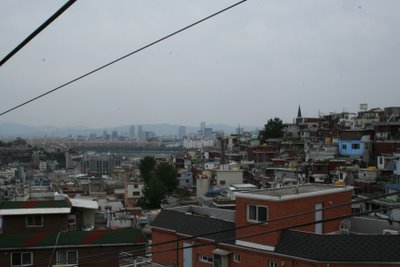
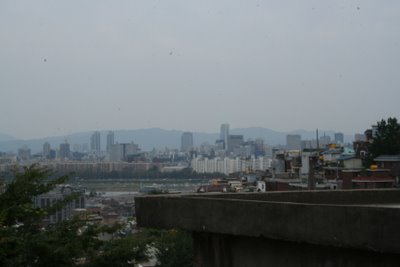 These pics were taken from near the mosque in Itaewon, right where the ground begins to slope away. That's the Kangnam skyline in the background - tallest visible building is the Trade Tower (4th tallest building in the city). Pity there was no blue sky - the view can be breathtaking on a clear day, particularly if it takes you by suprise.
Saturday, September 16, 2006
I have a cold
I've had a cold for the last few days. Nothing serious, but having a runny nose and a hoarse-sounding voice can be annoying. When I lived in Korea from 2002 to 2004, I had serious colds twice - once in November and once in February - and fortunately what I have hasn't approached what I had back then.
Back when I was sick before, it was a lingering cough that was bothering me the most (a lingering cough that had seldom been a problem in the States... can I blame Seoul air pollution here?) I would go to one of the ubiquitous pharmacies in this city, ask for 기침 약 (cough medicine), and I would get some tablets that promised to help for a cough but didn't do anything. Placebos. But my Korean tutor grated some radish and boiled it, creating a revolting drink that looked like saliva but did a better job than commercial medicine.
My chief cold prevention technique is to eat a lot of those wonderful little oranges that are ubiquitous in fall and winter. They're the kind of oranges you can eat with your hands without creating a mess - the peel comes off easily, and the sections are easily separable, like finger food. There are also canned Vitamin C drinks you can get from vending machines.
Thursday, September 14, 2006
Goguryeo Protest
Yesterday afternoon I watched a demonstration march down Jongno from my vantage point on the 6th floor of the YBM building. Banners, patriotic songs, the works. Can anyone guess what it was about?
Obviously it was about Goguryeo (or Koguryo, depending on your Romanization preference), an ancient kingdom in northeastern Asia that China claims as part of its cultural heritage and Korea claims as a predecessor of the modern Korean nation. Goguryeo was geographically centered on modern North Korea, but also covered much of modern China. Koreans see Goguryeo as an ancient Korean kingdom (it's one of the famous "3 Kingdoms" of old Korea) while China sees it as a vassal state that got included in the eventual growth of imperial China.
As I understand it, there's more going on here than just national pride and arguing over who gets to write history. There's a real fear that if the North Korean government collapses, China will use its claim on old Goguryeo to favorably redraw the Korean-Chinese border. So it's not just ancient history they're squabbling about.
Still, I can't quite picture hundreds of demonstrators getting together in the US to opine about which country gets to claim an ancient kingdom as their own.
Obviously it was about Goguryeo (or Koguryo, depending on your Romanization preference), an ancient kingdom in northeastern Asia that China claims as part of its cultural heritage and Korea claims as a predecessor of the modern Korean nation. Goguryeo was geographically centered on modern North Korea, but also covered much of modern China. Koreans see Goguryeo as an ancient Korean kingdom (it's one of the famous "3 Kingdoms" of old Korea) while China sees it as a vassal state that got included in the eventual growth of imperial China.
As I understand it, there's more going on here than just national pride and arguing over who gets to write history. There's a real fear that if the North Korean government collapses, China will use its claim on old Goguryeo to favorably redraw the Korean-Chinese border. So it's not just ancient history they're squabbling about.
Still, I can't quite picture hundreds of demonstrators getting together in the US to opine about which country gets to claim an ancient kingdom as their own.
Tuesday, September 12, 2006
An announcement
Holly's Coffee in Seoul is playing the exact same mix of songs as the Georgetown University Bookstore when I worked there in the fall of 2004.
Saturday, September 09, 2006
Cheonggyecheon pics
Sometime soon I want to walk the entire length of Cheonggyecheon from its downtown beginnings to where it flows into the Han River near Ttukseom. So far I've only made the first half of the journey.
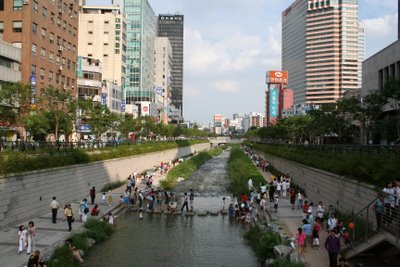 Downtown Cheonggyecheon. On nice days, weekends especially, it's crowded with people enjoying the weather and families on picnics.
Downtown Cheonggyecheon. On nice days, weekends especially, it's crowded with people enjoying the weather and families on picnics. 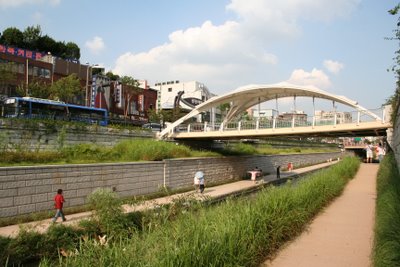
A bit further away the people thin out a bit.
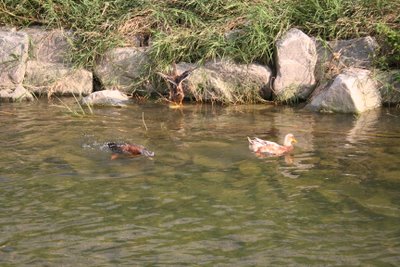
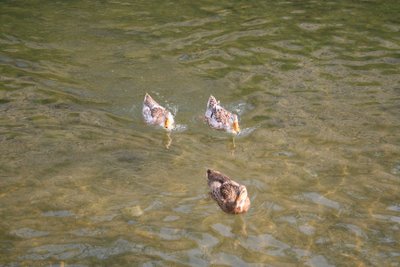
Some of the Cheonggyecheon wildlife. I don't know if they were introduced here or if they found the place without human intervention. There are also fish in the stream (not in the downtown section, though) which I suspect were introduced by humans.
Dongdaemun Playground?
Okay, this strikes me as not only a bad translation, but also lazy.
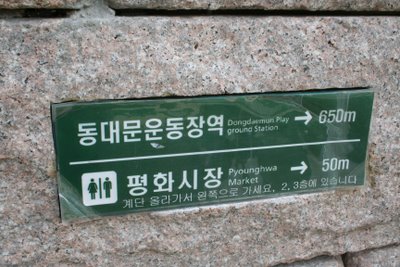 This is one of at least two similar signs near Cheonggyecheon. First, "Playground" might be listed in dictionaries as a possible translation of 운동장, but here it's just not right. It's a stadium. It's called Dongdaemun Stadium.
But it gets worse. This sign directs people not to the playground/stadium, but to the subway station. Dongdaemun Stadium subway station is a major subway station, adjacent to both the stadium and a major shopping area, and as the intersection of 3 subway lines, it's also a major transfer point. I think the fact that every subway map calls it "Dongdaemun Stadium", making it clearly the official name, makes this not the worst mistranslation I've seen, but probably the most inexcusable.
This is one of at least two similar signs near Cheonggyecheon. First, "Playground" might be listed in dictionaries as a possible translation of 운동장, but here it's just not right. It's a stadium. It's called Dongdaemun Stadium.But it gets worse. This sign directs people not to the playground/stadium, but to the subway station. Dongdaemun Stadium subway station is a major subway station, adjacent to both the stadium and a major shopping area, and as the intersection of 3 subway lines, it's also a major transfer point. I think the fact that every subway map calls it "Dongdaemun Stadium", making it clearly the official name, makes this not the worst mistranslation I've seen, but probably the most inexcusable.
Friday, September 08, 2006
YBM Korean
After 4 years, I'm a student again! I'm taking Korean classes 2 hours a day, 5 days a week, at YBM-Sisa in Jongno. I was all worried when I got placed into Level 4 (after a short interview where the guy asked me easy questions like "Where do you live?" and "How did you get here this morning?") but the class level seems to be about right for me.
The class is heavily Japanese and female, along with one Chinese and one Canadian. I was a bit nervous when I thought I might be the only non-Japanese in class, not because I was afraid of being the odd person out, but because Japanese tend to find Korean a much easier language than most other nationalities do. (Though it works both ways, and I've been told many times that if I get really good at Korean, I'll find Japanese a much easier language to learn.)
The class is a bit on the teacher-centered side (I don't think I'll be learning conversation as efficiently as if I'd enrolled at Seogang or Ewha) but it's conducted entirely in Korean, which is good for me. There is homework, but I am going to try to also do all the grammar exercises in the textbook that the teacher never checks.
The class runs for two months, by the end of which we will have finished the rather dull, picture-free YBM textbook. I'll probably go on to level 5 - if my schedule allows it.
The class is heavily Japanese and female, along with one Chinese and one Canadian. I was a bit nervous when I thought I might be the only non-Japanese in class, not because I was afraid of being the odd person out, but because Japanese tend to find Korean a much easier language than most other nationalities do. (Though it works both ways, and I've been told many times that if I get really good at Korean, I'll find Japanese a much easier language to learn.)
The class is a bit on the teacher-centered side (I don't think I'll be learning conversation as efficiently as if I'd enrolled at Seogang or Ewha) but it's conducted entirely in Korean, which is good for me. There is homework, but I am going to try to also do all the grammar exercises in the textbook that the teacher never checks.
The class runs for two months, by the end of which we will have finished the rather dull, picture-free YBM textbook. I'll probably go on to level 5 - if my schedule allows it.
Monday, September 04, 2006
They do things differently here
I just bought a 4-language electronic dictionary. As a free bonus, I also got a set of DVDs chronicling the World Cup.
I bet most teenaged or twentysomething Korean men would be thrilled, but I'm underwhelmed. Anyone want some World Cup DVDs?
I bet most teenaged or twentysomething Korean men would be thrilled, but I'm underwhelmed. Anyone want some World Cup DVDs?
Sunday, September 03, 2006
Yoko Tagami
Following the recommendation of the Let's Learn Korean blog, I've started Yoko Tagami's Bride Yoko's Korean Life (새댁 요코짱의 한국살이). Yoko Tagami's a Japanese woman who married a Korean man she met in China, and then spent a couple of years living in Korea. She's apparently moderately well-known as a cartoonist, and the general format of her book is her cartoon portrayal of a situation on the left-hand page, and a few written paragraphs on the right.
I agree that the Korean is not that difficult (far easier than the Level 5 Korean readers Yonsei University puts out). All of the Japanese from the cartoons is preserved intact, with Korean translations on the sides. Now that I've started studying hanja, I'm finding that I can understand bits of the written Japanese, though I still have no idea how to pronounce it. "Japan" (日本) and "Japanese language" (日本語) are written identically in hanja-Korean and Japanese, while the word for Korea (韓國) is only subtly different (Japanese people write 國 slightly differently but it retains its general shape).
Here's a cartoon early in the book:
(Japanese woman gets into a cab)
Woman: (in broken Korean) Take me to Gangnam, please.
Driver: (stern look) Miss - you're not Korean. Are you Japanese?
(Woman looks isolated and frightened, and thinks, 'Yes, I'm Japanese... Textbook controversy... Dokdo...')
Woman: Yes...
Driver: (expression brightening) So what brings you to Korea? How about Korean men? The World Cup...
(Woman thinks, Ah, he just LOOKS scary...)
Another one:
(Yoko is reading a book)
"This book says that Japanese people cannot speak plainly, but Koreans speak very frankly."
Yoko: Ah, really...
(Yoko and a Korean friend are walking down the street)
Friend: Am I gaining weight?
Yoko: Uh...
Friend: Tell me the truth.
(Yoko thinks, "Until now I would have always said, 'No not at all'... but plainly, frankly...)
Yoko: Yes, a little.
(Friend starts crying.)
Friend: REALLY?
(Yoko thinks, "I'm still a long way from understanding foreign culture.")
That said, I have a question about how we in the west treat Japanese names. We always flip Japanese names around so the personal name is first, family name last: Yoko (personal) Tagami(family). Junichiro (personal) Koizumi (family). Even though Japanese names put the personal name last, family name first.
But we maintain the original name order for Chinese and Koreans. Nobody ever talks about Zedong Mao or Jintao Hu. You never hear anything about Jong-il Kim or Moo-hyun Roh. How did it get started?
Maybe we can find the reason through a guy who attended my university a hundred years ago, and is about the sole well-known Korean known in the West with his family name last: Syngman Rhee. His name is also Romanized a bit oddly by Korean standards (if he were living today we'd probably call him Rhee Seung-man) and I always figured it's because he became famous in the West before Korean Romanization got standardized. Maybe Japanese proper names are flipped around because it's a habit Westerners got into a hundred and fifty years ago that never got changed. But Westerners didn't begin to pay much attention to individual Chinese and Koreans until a bit later, and they got into the habit of leaving the order of their names alone.
I agree that the Korean is not that difficult (far easier than the Level 5 Korean readers Yonsei University puts out). All of the Japanese from the cartoons is preserved intact, with Korean translations on the sides. Now that I've started studying hanja, I'm finding that I can understand bits of the written Japanese, though I still have no idea how to pronounce it. "Japan" (日本) and "Japanese language" (日本語) are written identically in hanja-Korean and Japanese, while the word for Korea (韓國) is only subtly different (Japanese people write 國 slightly differently but it retains its general shape).
Here's a cartoon early in the book:
(Japanese woman gets into a cab)
Woman: (in broken Korean) Take me to Gangnam, please.
Driver: (stern look) Miss - you're not Korean. Are you Japanese?
(Woman looks isolated and frightened, and thinks, 'Yes, I'm Japanese... Textbook controversy... Dokdo...')
Woman: Yes...
Driver: (expression brightening) So what brings you to Korea? How about Korean men? The World Cup...
(Woman thinks, Ah, he just LOOKS scary...)
Another one:
(Yoko is reading a book)
"This book says that Japanese people cannot speak plainly, but Koreans speak very frankly."
Yoko: Ah, really...
(Yoko and a Korean friend are walking down the street)
Friend: Am I gaining weight?
Yoko: Uh...
Friend: Tell me the truth.
(Yoko thinks, "Until now I would have always said, 'No not at all'... but plainly, frankly...)
Yoko: Yes, a little.
(Friend starts crying.)
Friend: REALLY?
(Yoko thinks, "I'm still a long way from understanding foreign culture.")
That said, I have a question about how we in the west treat Japanese names. We always flip Japanese names around so the personal name is first, family name last: Yoko (personal) Tagami(family). Junichiro (personal) Koizumi (family). Even though Japanese names put the personal name last, family name first.
But we maintain the original name order for Chinese and Koreans. Nobody ever talks about Zedong Mao or Jintao Hu. You never hear anything about Jong-il Kim or Moo-hyun Roh. How did it get started?
Maybe we can find the reason through a guy who attended my university a hundred years ago, and is about the sole well-known Korean known in the West with his family name last: Syngman Rhee. His name is also Romanized a bit oddly by Korean standards (if he were living today we'd probably call him Rhee Seung-man) and I always figured it's because he became famous in the West before Korean Romanization got standardized. Maybe Japanese proper names are flipped around because it's a habit Westerners got into a hundred and fifty years ago that never got changed. But Westerners didn't begin to pay much attention to individual Chinese and Koreans until a bit later, and they got into the habit of leaving the order of their names alone.
Ahyeon-dong
I live in Ahyeon, north of the Han River and about a 45 minute walk to most downtown Seoul landmarks as City Hall and Gwanghwamun.
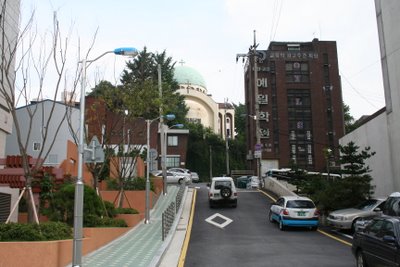 That domed building is a Russian Orthodox Church, the only one I know of in the country. My apartment building is on the extreme right, just barely visible.
Artwork photographed from across the street.
That domed building is a Russian Orthodox Church, the only one I know of in the country. My apartment building is on the extreme right, just barely visible. 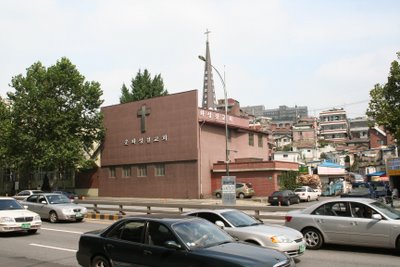
Just to compare, most churches in this city have architecture something like this.

Maporo, the multi-lane road that I live on.
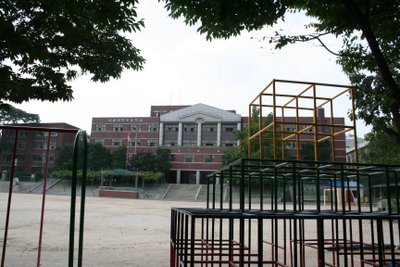 Ahyeon Elementary School, as seen from the road (I poked my camera through a fence).
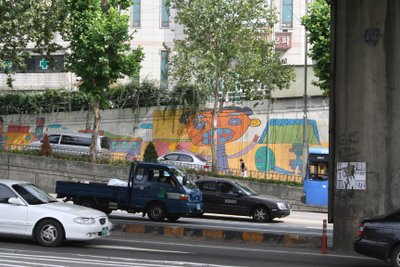
Artwork photographed from across the street.
Saturday, September 02, 2006
What I'm reading
Lately I've been reading NTC's Dictionary of Korea's Business and Cultural Code Words by Boyé Lafayette De Mente. The book is organized by important Korean words (in Romanized alphabetical order) with accompanying cultural notes and explanations. It goes into Korean history, current culture, and business practices.
It's not really a resource for people learning Korean, as it's mostly in English and the Romanization is quite idiosyncratic, but it's got a lot of interesting information, especially when it comes to the root causes of why Koreans act and think the way they do, or why the culture is shaped the way it is. There are times when the author (whose nationality I'm not sure of) sounds almost like a Korean cultural chauvinist. But when he discusses Neo-Confucianism philosophy and the Chosun Dynasty, he comes close to describing Neo-Confucianism's effects on the Korean people as downright evil. It's Neo-Confucianism that he blames for Korea's relative lack of development prior to the beginning of the Japanese colonial era.
One flaw is that the book is written like it's a reference book, but I cannot imagine anyone actually using it as one. So I've been reading it sequentially, but it's slow going and I can only read a few pages a day.
It's not really a resource for people learning Korean, as it's mostly in English and the Romanization is quite idiosyncratic, but it's got a lot of interesting information, especially when it comes to the root causes of why Koreans act and think the way they do, or why the culture is shaped the way it is. There are times when the author (whose nationality I'm not sure of) sounds almost like a Korean cultural chauvinist. But when he discusses Neo-Confucianism philosophy and the Chosun Dynasty, he comes close to describing Neo-Confucianism's effects on the Korean people as downright evil. It's Neo-Confucianism that he blames for Korea's relative lack of development prior to the beginning of the Japanese colonial era.
One flaw is that the book is written like it's a reference book, but I cannot imagine anyone actually using it as one. So I've been reading it sequentially, but it's slow going and I can only read a few pages a day.
Friday, September 01, 2006
Durga
Durga, the new Indian restaurant on Jongno, is actually pretty good. If you don't mind high Indian-food-in-Korea prices. I went there with a friend yesterday and we each ordered the lunch special (she got the chicken curry, I went for the lamb curry, and we had dal and naan). Nothing spectacular if you're used to Indian food, but it was pretty decent. The clientel looked like it was mostly Korean, but there were a couple of Indian waiters who spoke Korean that's far superior to my own. Also on the menu was "steak". I always wanted to go to an Indian restaurant and order a nice, big juicy steak.
Still, Chakraa remains my favorite among Indian restaurants in Seoul, particularly the place near Noksapyeong station up in the direction of Namsan (I forget the neighborhood name). It always seems to be next to empty, and I hardly ever see Korean customers, but it's the cheapest Indian place I know of in the city and they do the southern stuff like dosa and idli.
In Korean food news, I really like hui dopbap. Raw fish, raw vegetables, and rice all mixed together with spicy sauce. It seems so wholesome - like there's nothing in it that could possibly be bad for you. Though I hear that some say you shouldn't eat raw fish in summer.
Still, Chakraa remains my favorite among Indian restaurants in Seoul, particularly the place near Noksapyeong station up in the direction of Namsan (I forget the neighborhood name). It always seems to be next to empty, and I hardly ever see Korean customers, but it's the cheapest Indian place I know of in the city and they do the southern stuff like dosa and idli.
In Korean food news, I really like hui dopbap. Raw fish, raw vegetables, and rice all mixed together with spicy sauce. It seems so wholesome - like there's nothing in it that could possibly be bad for you. Though I hear that some say you shouldn't eat raw fish in summer.
Monday, August 28, 2006
International Love and Understanding.
 This poster is for a movie called (something like) "The Sinking of Japan". It's a Japanese disaster movie that's been described as kind of a "Japanese The Day After Tomorrow." Basically Japan sinks into the ocean due to some natural disaster.
The line above the title says "The day has finally come." People I know expect Korean audiences to be cheering.
Saturday, August 26, 2006
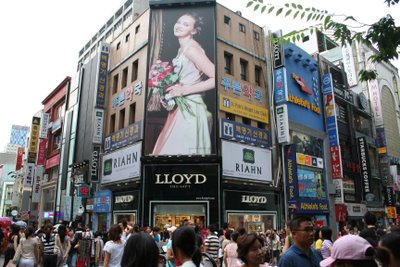
Myeongdong II
More pictures:
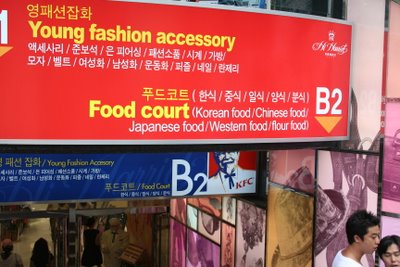 Not only do I not have the faintest idea what "flour food" is, but being able to read the Korean doesn't help me at all.
Now I am standing in front of the screen. Most of the pictures I took are within about 100 meters of this intersection.
Not only do I not have the faintest idea what "flour food" is, but being able to read the Korean doesn't help me at all.Most buildings in Myeongdong look something like this. I can't post a pic with high enough definition for you to see, but this building has fashion stores, restaurants, hair stylists, sneaker stores, a pharmacy, a real estate office, and "Dr. Paik's Weight Loss Clinic."
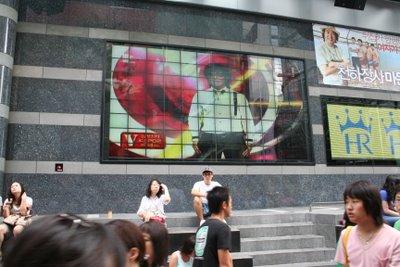
That big screen shows movie promos and music videos.
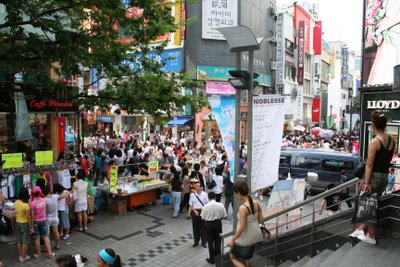
Now I am standing in front of the screen. Most of the pictures I took are within about 100 meters of this intersection.
Myeongdong I
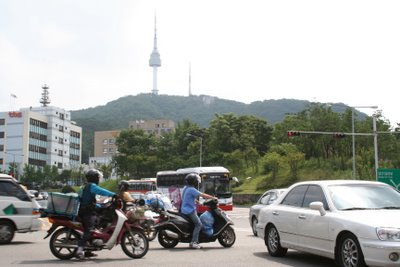 Today the informal photo class I'm in roamed the streets of Myeongdong to take pictures. Our leader Michael practices street photography - particularly candid shots.
For me, today was all about overcoming my shyness taking candid photos of strangers in public. I don't know how many of my shots have artistic merit, but then I'm new at this game.
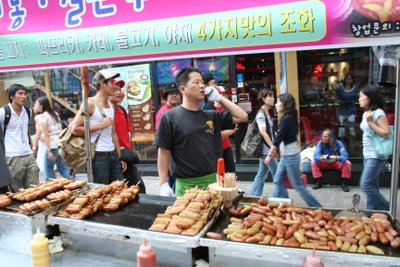
Sausages-on-skewer vendor. Of the five little sausages on each skewer, two are actually some sort of fishy substance.
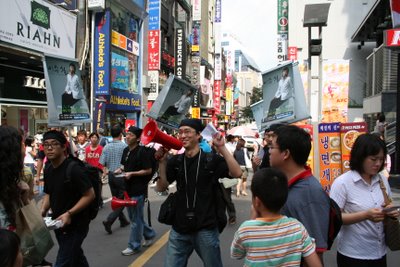
At first it looks like a protest, but then you see it's an organized ad activity making its way through the streets.
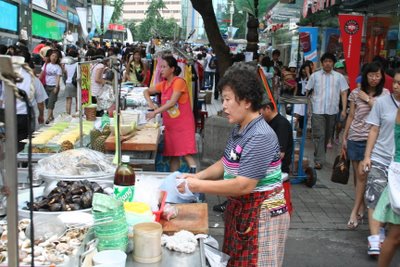
Woman selling all sorts of street stall food.
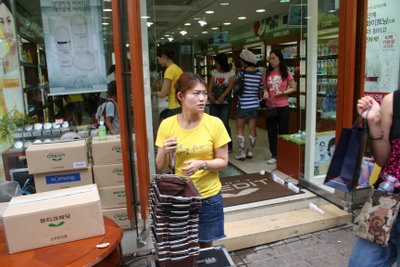
This employee looks either angry or cautiously watching something.
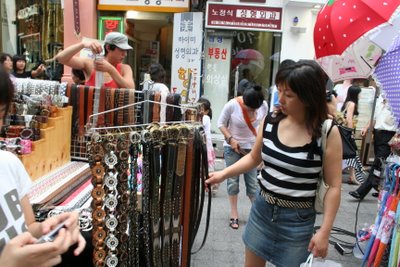
Stylish belts for sale.
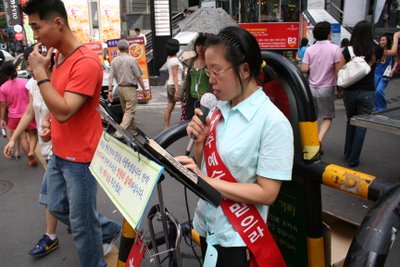
Reading a sermon. It's not unusual to see people standing at intersections handing out Christian pamphlets, or ever marching through crowded streets carrying a big cross-shaped sign with Christian music playing.
Photos, at last
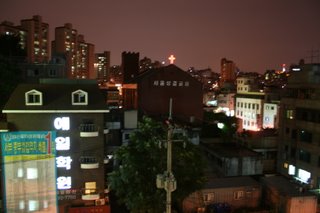
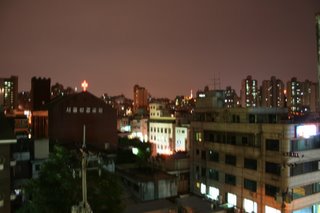
Nighttime views from my window, taken with my new camera. Once I get the software figured out I may be able to combine those two photos into one picture.
The building on the far left is a hagwon, or an academy for students to take extra classes after school to meet the demands of the educational system over here. Notice the church in the middle of the scene, with the neon cross.
There's only a small section of the window I can actually open to let in fresh air. I had to poke my camera through it and point it in different directions. The exposure time was quite long (this was night, remember); I think I did a good job minimizing blurring considering the weird angle I had to hold the camera at.
Thursday, August 24, 2006
Hanja
I've decided to start making an effort to learn hanja, or Chinese characters as they're used in Korean.
For a long time I stubbornly refused to study them. After all, my greatest weaknesses in Korean are speaking and understanding what people say to me, and it's not obvious how studying Chinese characters will help me with that. Also - quite unlike Japan - in Korea there's not really a need to learn Chinese characters to be able to function well in the language. Most books and magazines omit them completely. Sometimes it seems they're reserved for special occasions. For example, the name of the author on a book cover might be written in hanja, or a business card might be all hanja.
But recently I discovered Lee Young-hee's Learn Hanja the Fun Way in a bookstore, and I decided to go for it. First of all, learning to write the characters will give me a head start when I learn Japanese and Chinese, though I know that the Japanese and Chinese use and pronounce characters differently (not to mention the several hundred characters that the PRC decided to alter a few decades ago). Also, as I learn the characters I'll review and learn high-level Korean vocabulary. Finally, I genuinely feel like I'm learning a new skill - but I need to find someone who will check and correct me on my handwriting. (I'm assuming that if I learn to write Korean hanja well, that at least will carry over to Chinese and Japanese.)
Classical Chinese has about the same relationship to Korean that Latin and Greek do to English. Take the syllable dent. Through words like dentist, dental, dental floss, dentures, and dentistry, we can see that dent means "tooth". But we wouldn't use it alone to mean "tooth"; for that we'd use the native English word. (The Korean word for "tooth" is 이 or ee; the Chinese-derived equivalent of dent is 치 or chee.)
Now imagine that, although we usually wrote Latin and Greek-derived words in our own alphabet, it was also possible to write them in a special writing system quite distinct from our alphabet. And most educated people knew the symbol for dent, even though they usually just spelled it out in English letters.
To write dentist, you would usually just use English letters, but another option would be to pair the dent symbol with the ist symbol, also used in words like pianist, taxidermist, scientist, and so on. So you would have 2 options to write dentist: you could spell it out d-e-n-t-i-s-t, or you could write it in 2 characters: the dent character and the ist character. But for a word like tooth, you would have no choice but to spell it t-o-o-t-h.
That is how Chinese characters work in Korean.
I've noticed a few hanja-based cross-linguistic puns. These days lots of Korean companies advertise "well-being," or healthy, foods. No effort is made to translate "well-being" into Korean; instead they've just adapted the English words and write it 웰빙 ("wel-beeng"). The other day I saw a street stall where they were selling healthy iced snack foods. The slogan "well-being" was prominent, but the "being" part of it was replaced by the Chinese character for ice. The Korean pronounciation for this character is "beeng".
For a long time I stubbornly refused to study them. After all, my greatest weaknesses in Korean are speaking and understanding what people say to me, and it's not obvious how studying Chinese characters will help me with that. Also - quite unlike Japan - in Korea there's not really a need to learn Chinese characters to be able to function well in the language. Most books and magazines omit them completely. Sometimes it seems they're reserved for special occasions. For example, the name of the author on a book cover might be written in hanja, or a business card might be all hanja.
But recently I discovered Lee Young-hee's Learn Hanja the Fun Way in a bookstore, and I decided to go for it. First of all, learning to write the characters will give me a head start when I learn Japanese and Chinese, though I know that the Japanese and Chinese use and pronounce characters differently (not to mention the several hundred characters that the PRC decided to alter a few decades ago). Also, as I learn the characters I'll review and learn high-level Korean vocabulary. Finally, I genuinely feel like I'm learning a new skill - but I need to find someone who will check and correct me on my handwriting. (I'm assuming that if I learn to write Korean hanja well, that at least will carry over to Chinese and Japanese.)
Classical Chinese has about the same relationship to Korean that Latin and Greek do to English. Take the syllable dent. Through words like dentist, dental, dental floss, dentures, and dentistry, we can see that dent means "tooth". But we wouldn't use it alone to mean "tooth"; for that we'd use the native English word. (The Korean word for "tooth" is 이 or ee; the Chinese-derived equivalent of dent is 치 or chee.)
Now imagine that, although we usually wrote Latin and Greek-derived words in our own alphabet, it was also possible to write them in a special writing system quite distinct from our alphabet. And most educated people knew the symbol for dent, even though they usually just spelled it out in English letters.
To write dentist, you would usually just use English letters, but another option would be to pair the dent symbol with the ist symbol, also used in words like pianist, taxidermist, scientist, and so on. So you would have 2 options to write dentist: you could spell it out d-e-n-t-i-s-t, or you could write it in 2 characters: the dent character and the ist character. But for a word like tooth, you would have no choice but to spell it t-o-o-t-h.
That is how Chinese characters work in Korean.
I've noticed a few hanja-based cross-linguistic puns. These days lots of Korean companies advertise "well-being," or healthy, foods. No effort is made to translate "well-being" into Korean; instead they've just adapted the English words and write it 웰빙 ("wel-beeng"). The other day I saw a street stall where they were selling healthy iced snack foods. The slogan "well-being" was prominent, but the "being" part of it was replaced by the Chinese character for ice. The Korean pronounciation for this character is "beeng".
Public Service Annoucement
You should now be able to post comments, even if you're not a Blogger user.
Monday, August 21, 2006
Korean class!
I've done it - I've registered for a month of Korean classes at YBM-Sisa. It's not my first choice, but it's apparently popular, and cheaper than a university (but still a significant investment), and a 5 minute walk from my workplace. 2 hours a day, 5 days a week, starting September 4.
The guy who briefly interviewed me put me into Level 4. The web site says of level 4, "Students learn not only the language but also things to help students better understand Korean culture. Students will learn to speak in longer and more complex forms accurately." I'm somewhat worried that I've been put into too difficult a class - I don't understand spoken Korean well at all, but I can speak reasonably well enough to make people assume that I do - but I'll only know for sure in 2 weeks. I bought the textbook, which looks quite boring, but I teach English with equally boring books so I guess this is cosmic justice.
Between this class and other looming purchases (plane tickets to Taiwan, digital camera), I'm going to spend quite a bit of money this week. At least it will be mostly one-time expenses.
The guy who briefly interviewed me put me into Level 4. The web site says of level 4, "Students learn not only the language but also things to help students better understand Korean culture. Students will learn to speak in longer and more complex forms accurately." I'm somewhat worried that I've been put into too difficult a class - I don't understand spoken Korean well at all, but I can speak reasonably well enough to make people assume that I do - but I'll only know for sure in 2 weeks. I bought the textbook, which looks quite boring, but I teach English with equally boring books so I guess this is cosmic justice.
Between this class and other looming purchases (plane tickets to Taiwan, digital camera), I'm going to spend quite a bit of money this week. At least it will be mostly one-time expenses.
Saturday, August 19, 2006
Yonsei's Korean reader
I've been studying Yonsei University 5-6급 한국어 독본 (Korean Reader). Each reading (they vary from 2-3 pages long to several pages long) is followed by a whole bunch of vocabulary words with English translations.
I wonder how the editors decided which words to give English translations for. In Chapter 6: 까치 ("Magpies") most of the translated words are on the advanced side, but there are some relatively basic words, like 호기심 ("curiosity"). But look at this sentence:
음력 칠월 칠석에 견우와 직녀가 은하수에 걸린 오작교를 건너 일 년에 딱 한 번 만난다는 이야기는 너무나 유명한 전살이다.
My translation, with the help of a dictionary:
There is a very well-known legend that on the seventh day of the seventh month of the lunar calendar, the crow and the magpie are in the Milky Way for Altair and Vega to meet annually.
(...And so on to other astrological matters. I have little confidence that I translated that accurately.)
Does the book offer the English speaker any help translating "Vega" or "Altair" or "Milky Way"? No. Of course, living near the center of a brightly lit city of 11 million people I rather have to take it on faith that Altair and Vega and the Milky Way even exist.
This is a very philosophical set of Korean readings. The first 6 chapters:
1. "Language and Living" by Shim Jae-gi. The author gripes that young Koreans can't speak their own language correctly, says that speaking well is a requisite for thinking well, and quotes Buddha to support his position.
2. "Life's Happiness" by Lee Chang-bae. How to be happy, in the author's opinion.
3. "Meetings"by An Byeong-wook. The author believes in reincarnation, and reflects that the stranger we sit next to on a train may well have repeatedly been our soulmate or good friend in dozens of past lives.
4. "Trees" by Lee Yang-ha. The author imagines trees are sentient and speculates on their personalities, and would like to come back as a tree in a future life.
5. "Life as a Person" by Lee Eo-ryeong. The author compares Korean and Western thought by examining how they cry for help (Koreans say "Save this person!" rather than the egocentric "Help me!").
6. "Magpies" by Oh Chang-yeong. All about magpies in Korean culture and legend.
That last one is the least philosophical one in the bunch (so far). We'll see if the theme continues.
I wonder how the editors decided which words to give English translations for. In Chapter 6: 까치 ("Magpies") most of the translated words are on the advanced side, but there are some relatively basic words, like 호기심 ("curiosity"). But look at this sentence:
음력 칠월 칠석에 견우와 직녀가 은하수에 걸린 오작교를 건너 일 년에 딱 한 번 만난다는 이야기는 너무나 유명한 전살이다.
My translation, with the help of a dictionary:
There is a very well-known legend that on the seventh day of the seventh month of the lunar calendar, the crow and the magpie are in the Milky Way for Altair and Vega to meet annually.
(...And so on to other astrological matters. I have little confidence that I translated that accurately.)
Does the book offer the English speaker any help translating "Vega" or "Altair" or "Milky Way"? No. Of course, living near the center of a brightly lit city of 11 million people I rather have to take it on faith that Altair and Vega and the Milky Way even exist.
This is a very philosophical set of Korean readings. The first 6 chapters:
1. "Language and Living" by Shim Jae-gi. The author gripes that young Koreans can't speak their own language correctly, says that speaking well is a requisite for thinking well, and quotes Buddha to support his position.
2. "Life's Happiness" by Lee Chang-bae. How to be happy, in the author's opinion.
3. "Meetings"by An Byeong-wook. The author believes in reincarnation, and reflects that the stranger we sit next to on a train may well have repeatedly been our soulmate or good friend in dozens of past lives.
4. "Trees" by Lee Yang-ha. The author imagines trees are sentient and speculates on their personalities, and would like to come back as a tree in a future life.
5. "Life as a Person" by Lee Eo-ryeong. The author compares Korean and Western thought by examining how they cry for help (Koreans say "Save this person!" rather than the egocentric "Help me!").
6. "Magpies" by Oh Chang-yeong. All about magpies in Korean culture and legend.
That last one is the least philosophical one in the bunch (so far). We'll see if the theme continues.
Thursday, August 17, 2006
Transportation
South Korea is, for all practical purposes at the moment, an island. And not a terribly huge one at that. So it's amazing to compare the quality of the passenger railroad service here and in the United States.
First, there are the high-speed trains, that run several times an hour between Seoul and Busan. Another high-speed line runs from Seoul to Gwangju and Mokpo. The Seoul-Busan line is often packed.
One step below the high-speed trains are the Saemaul trains, which run only a few times a day but link up every city in South Korea of any size. I traveled by Saemaul between Seoul and Gwangju, economy class (first-class seats are also available), and other than the lack of a tray table the ride was considerably more comfortable than riding Amtrak's Northeast Corridor. Not only the seats - the ride itself seemed to be smoother.
Then there are the cheap trains, the Mugunghwa trains, which presumably stop at all the little towns that the Saemaul train I was on sped by. There is also an excellent intercity bus system.
Compare to the United States. Passenger trains don't even run any more to central-eastern Maine - I can take Amtrak from DC as far as Boston before I have to switch to a bus. Koreans value cars - as a status symbol especially - but they don't have the US's car-centric culture that relegates all other forms of transportation to secondary status. I've been spoiled living here.
First, there are the high-speed trains, that run several times an hour between Seoul and Busan. Another high-speed line runs from Seoul to Gwangju and Mokpo. The Seoul-Busan line is often packed.
One step below the high-speed trains are the Saemaul trains, which run only a few times a day but link up every city in South Korea of any size. I traveled by Saemaul between Seoul and Gwangju, economy class (first-class seats are also available), and other than the lack of a tray table the ride was considerably more comfortable than riding Amtrak's Northeast Corridor. Not only the seats - the ride itself seemed to be smoother.
Then there are the cheap trains, the Mugunghwa trains, which presumably stop at all the little towns that the Saemaul train I was on sped by. There is also an excellent intercity bus system.
Compare to the United States. Passenger trains don't even run any more to central-eastern Maine - I can take Amtrak from DC as far as Boston before I have to switch to a bus. Koreans value cars - as a status symbol especially - but they don't have the US's car-centric culture that relegates all other forms of transportation to secondary status. I've been spoiled living here.
Monday, August 14, 2006
Gyeongju
Gyeongju is hot. Very hot.
I came down here yesterday morning by Saemaul train. My economy-class seat on Korea's non-highspeed train was if anything more comfortable than my trip to Busan by highspeed train two months ago - there was no tray table, but plenty of legroom. I wonder what a first-class seat would have been like.
The Gyeongju train station - my first small-town Korean train station - lies on the east side of town, and I soon found cheap accomodations and some mandu for lunch. Gyeongju is compact enough that the central areas are all easily walkable from each other, and so I more or less immediately left the central area and walked south.
I skipped some of Gyeongju's more famous attractions, south of the city center - I was here a few years ago with a friend and took in most of the tombs and ruins of the south-central area - and instead hiked directly to the National Museum, which Lonely Planet rates as the best history museum in Korea, surpassing any in Seoul (though to be fair, the new National Museum in Yongsan is too new to qualify for inclusion.)
The museum turned out to consist of four seperate buildings, all of which had (this seemed like the most important thing at the time) air conditioning. The central building is devoted to archeological finds; not just pottery but also armor, crowns, spearpoints and little statuettes. The art gallery was generally ancient Buddhist sculpture. The remaining two buildings are more tangential.
At the museum I kept encountering the same group of French-speaking foreigners who I had noticed boarding the train back in Seoul and getting off in Gyeongju. I hope they didn't think I was stalking them.
Today, ever mindful of the heat and sunshine (I've been buying bottled water like I rarely have before), I took the bus to Bulguksa, and from there to Seokguram. At Seokguram, Buddha, carved in stone, has been looking out from his cliffside grotto across eastern Korea for over a thousand years. The grotto itself seemed almost an excuse to make the trek up a shaded mountain path from the parking area; even given that it wasn't a totally clear day, the views were gorgeous. (On a clear day apparently you can see the sea.)
I returned to the collection of tourist shops near Bulguksa, ate dotori muk for lunch (I've never eaten dotori muk in Seoul, for some reason, but often have it when outside of the city limits), and... decided against going to Bulguksa this time. Maybe it was the heat, maybe it was the fact that I'd been to Bulguksa last time I was in Gyeongju and it and similar places I've been to are all running together in my mind. Bulguksa's the most famous Buddhist temple in the country, but it will be there next time I am in Gyeongju.
Now to leave and face the heat once again...
I came down here yesterday morning by Saemaul train. My economy-class seat on Korea's non-highspeed train was if anything more comfortable than my trip to Busan by highspeed train two months ago - there was no tray table, but plenty of legroom. I wonder what a first-class seat would have been like.
The Gyeongju train station - my first small-town Korean train station - lies on the east side of town, and I soon found cheap accomodations and some mandu for lunch. Gyeongju is compact enough that the central areas are all easily walkable from each other, and so I more or less immediately left the central area and walked south.
I skipped some of Gyeongju's more famous attractions, south of the city center - I was here a few years ago with a friend and took in most of the tombs and ruins of the south-central area - and instead hiked directly to the National Museum, which Lonely Planet rates as the best history museum in Korea, surpassing any in Seoul (though to be fair, the new National Museum in Yongsan is too new to qualify for inclusion.)
The museum turned out to consist of four seperate buildings, all of which had (this seemed like the most important thing at the time) air conditioning. The central building is devoted to archeological finds; not just pottery but also armor, crowns, spearpoints and little statuettes. The art gallery was generally ancient Buddhist sculpture. The remaining two buildings are more tangential.
At the museum I kept encountering the same group of French-speaking foreigners who I had noticed boarding the train back in Seoul and getting off in Gyeongju. I hope they didn't think I was stalking them.
Today, ever mindful of the heat and sunshine (I've been buying bottled water like I rarely have before), I took the bus to Bulguksa, and from there to Seokguram. At Seokguram, Buddha, carved in stone, has been looking out from his cliffside grotto across eastern Korea for over a thousand years. The grotto itself seemed almost an excuse to make the trek up a shaded mountain path from the parking area; even given that it wasn't a totally clear day, the views were gorgeous. (On a clear day apparently you can see the sea.)
I returned to the collection of tourist shops near Bulguksa, ate dotori muk for lunch (I've never eaten dotori muk in Seoul, for some reason, but often have it when outside of the city limits), and... decided against going to Bulguksa this time. Maybe it was the heat, maybe it was the fact that I'd been to Bulguksa last time I was in Gyeongju and it and similar places I've been to are all running together in my mind. Bulguksa's the most famous Buddhist temple in the country, but it will be there next time I am in Gyeongju.
Now to leave and face the heat once again...
Saturday, August 12, 2006
Gyeongju-bound?
I have this Monday and Tuesday (Aug. 14-15) off, as a direct result of Japan losing World War II. (Actually Japan losing World War II is probably responsible in one way or another for a lot of stuff that affects me, but this is the most immediate.) I've decided to go to Gyeongju tomorrow and stay for 2 nights.
I went to Gyeongju a while ago with a friend, but we only were able to stay for a night and I didn't get around to seeing the National Museum or the Seokguram grotto.
Right now my plan is to go to Gyeongju not by bus like last time, but by train. This makes it a more complicated excursion than my trip to Busan, because the high-speed train doesn't service Gyeongju. So I have to take an ordinary 새마을 - saemaul - train, which I haven't experienced before. Also, it appears the last morning train for Gyeongju leaves Seoul Station at 7:40AM, and if I miss it I either find other transportation (possibly a high-speed train to Daegu, and try my luck from there) or wait until evening
That's assuming Seoul Station is even where I want to be. Seoul's got 3 big passenger train terminals, and the official site of the national train service sure makes it look like Gyeongju-bound trains all depart from Cheongnyangni Station, which is where I went yesterday hoping to buy a ticket in advance. The girl at the ticket window was quite amused that I had come there and directed me to go to Seoul Station, which I did, only to find it so hopelessly crowded that I resolved to return only on Sunday morning. But I confirmed that the train numbers that the web site said were Gyeongju-bound were indeed on the big timetable, so I left feeling relieved and optimistic.
I went to Gyeongju a while ago with a friend, but we only were able to stay for a night and I didn't get around to seeing the National Museum or the Seokguram grotto.
Right now my plan is to go to Gyeongju not by bus like last time, but by train. This makes it a more complicated excursion than my trip to Busan, because the high-speed train doesn't service Gyeongju. So I have to take an ordinary 새마을 - saemaul - train, which I haven't experienced before. Also, it appears the last morning train for Gyeongju leaves Seoul Station at 7:40AM, and if I miss it I either find other transportation (possibly a high-speed train to Daegu, and try my luck from there) or wait until evening
That's assuming Seoul Station is even where I want to be. Seoul's got 3 big passenger train terminals, and the official site of the national train service sure makes it look like Gyeongju-bound trains all depart from Cheongnyangni Station, which is where I went yesterday hoping to buy a ticket in advance. The girl at the ticket window was quite amused that I had come there and directed me to go to Seoul Station, which I did, only to find it so hopelessly crowded that I resolved to return only on Sunday morning. But I confirmed that the train numbers that the web site said were Gyeongju-bound were indeed on the big timetable, so I left feeling relieved and optimistic.
Sunday, August 06, 2006
Cicadas
Cicadas are loud little creatures. I'd assumed that the noise I heard walking under some trees was being caused by dozens - hundreds? - of the insects sitting up in the branches. But today I came across a single, solitary cicada sitting on the trunk of a tree. Chirping. More loudly than I would have thought possible from such a little animal. Impressive.
China and Korea
English tutors complain of Chinese abuse
Scary stuff. Every expat teaching English in Korea has heard horror stories about schools that mistreat their foreign teachers. But I haven't heard many stories that come close to the schools described in the article.
It's almost funny. It seems so many people in East Asian countries are sensitive about how their nation is seen by Westerners, and they really want foreign visitors to come away with a good impression. But some businessmen in China and Korea treat foreign teachers in a way that almost assures some of them will go home and complain about how greedy and uncaring the Chinese and Koreans are. Greed is stronger than national pride for many people - in any country.
Not to be overly negative, but in Korea - and in China too, I'd expect - there are a large number of migrant workers from South and Southeast Asia who make less than English teachers, work longer hours under substandard work conditions - and yet you don't hear much about them.
Sunday, July 30, 2006
한국어 어렵다
Foreigners who live in Korea like to talk about how difficult the Korean language supposedly is. They cite the completely unfamilliar vocabulary, the difficult sound system that foreigners have trouble getting their tongues around, and the complex grammar which is so very different from English.
I think they're barking up the wrong tree. The only languages I've seriously studied before have been Spanish and German, but still, from a purely linguistic standpoint, I don't see how Korean is the hardest thing ever. Sure, acquiring a good vocabulary in Korean is a lot tougher than doing the same in French or Italian, but that's because of the massive Latin influence on English that won't help you a bit when learning Korean. I think Korean vocabulary's not that much harder than most other non-European languages. I think Korean phonetics is harder for English speakers than, say, Spanish, but it's probably not much more difficult than French. (Although French people are probably more used to hearing foreigners butchering their language than Koreans, which means the learner of Korean has to put in more effort to be understood.) And grammar? It's certainly different from English, but I once heard a language buff say that if Korean grammar ever seems difficult, you should try learning about Navajo grammar. Then Korean will seem so easy you can learn it by smacking a grammar book against your forehead.
So is Korean easier than people say? Well, don't fool yourself by thinking in purely linguistic terms. I recently read Michael Agar's wonderful Language Shock: Understanding The Culture Of Conversation in which he argues that people tend to overvalue the importance of the nuts and bolts of learning a language - correct grammar, vocabulary, and the like. And people ignore cultural differences in conversation and thinking.
I certainly hope that I am learning about Korean interpersonal relationships. Take the idea of nunchi. Nunchi is, basically, the ability to sense another person's intents by way of facial expression, eyes - and shared cultural expectations. Every culture in the world probably has some version of nunchi - but Koreans have an explicit word for it and they highly value it. I plan to be as adept at it as a native Korean approximately... never. I probably will not live in this country long enough.
And yet people who say "Korean is hard" still get caught up on things like grammar and phonetics...
I think they're barking up the wrong tree. The only languages I've seriously studied before have been Spanish and German, but still, from a purely linguistic standpoint, I don't see how Korean is the hardest thing ever. Sure, acquiring a good vocabulary in Korean is a lot tougher than doing the same in French or Italian, but that's because of the massive Latin influence on English that won't help you a bit when learning Korean. I think Korean vocabulary's not that much harder than most other non-European languages. I think Korean phonetics is harder for English speakers than, say, Spanish, but it's probably not much more difficult than French. (Although French people are probably more used to hearing foreigners butchering their language than Koreans, which means the learner of Korean has to put in more effort to be understood.) And grammar? It's certainly different from English, but I once heard a language buff say that if Korean grammar ever seems difficult, you should try learning about Navajo grammar. Then Korean will seem so easy you can learn it by smacking a grammar book against your forehead.
So is Korean easier than people say? Well, don't fool yourself by thinking in purely linguistic terms. I recently read Michael Agar's wonderful Language Shock: Understanding The Culture Of Conversation in which he argues that people tend to overvalue the importance of the nuts and bolts of learning a language - correct grammar, vocabulary, and the like. And people ignore cultural differences in conversation and thinking.
I certainly hope that I am learning about Korean interpersonal relationships. Take the idea of nunchi. Nunchi is, basically, the ability to sense another person's intents by way of facial expression, eyes - and shared cultural expectations. Every culture in the world probably has some version of nunchi - but Koreans have an explicit word for it and they highly value it. I plan to be as adept at it as a native Korean approximately... never. I probably will not live in this country long enough.
And yet people who say "Korean is hard" still get caught up on things like grammar and phonetics...
Friday, July 28, 2006
Classes
I want to take a serious Korean class. Right now I am leaning towards the big YBM academy in Jongno - possibly starting in September.
Sogang University's Korean program attracted me for a while. At 3 hours a day, 5 days a week, plus homework, it likely would have reduced my weekday existence to school and work - but is that such a bad thing? I think I have a general mental trend towards laziness and sometimes it feels like the less free time I have, the more I accomplish. And Sogang has a generally good reputation among foreigners here.
But I've been unable to get a guarantee from the head teacher that I'll continue to be free between 10am and 1pm in future months. So it looks like, if Sogang is in my future at all, it will have to wait. (Yonsei and Ewha universities have comparable programs for foreigners, but the timing of the class appear to be just as inconvenient for me.)
YBM offers a less intensive experience than Sogang - 2 hours a day, 5 days a week. And the 3pm-5pm timeslot is perfect - my head teacher confirms that I won't have a class scheduled then anytime soon. There's also the matter of cost - a 3 month course at Sogang would have cost nearly 3/4 of one month's salary, though it could be argued that that would give me an incentive to study hard and make the most of it. YBM is not particularly cheap, but it's less of a financial hit than Sogang. Also, YBM is about a 5 minute walk from where I work, while Sogang U. is a bus ride away.
But how would the classes compare? The impression I'm getting is that YBM classes are focused on learning grammar and vocab, at the expense of actually SPEAKING. I can study grammar and vocab all by myself sitting in Starbucks. But do I have the mental discipline to actually do it? I think paying the money and taking a class is probably the best idea for me.
Anyway, I'm going to look into taking a YBM class, to begin in September. I'm almost certainly going to have to get a student visa - the red tape involved in obtaining a visa when I already have an E-2 work visa is something I will have learn about.
Sogang University's Korean program attracted me for a while. At 3 hours a day, 5 days a week, plus homework, it likely would have reduced my weekday existence to school and work - but is that such a bad thing? I think I have a general mental trend towards laziness and sometimes it feels like the less free time I have, the more I accomplish. And Sogang has a generally good reputation among foreigners here.
But I've been unable to get a guarantee from the head teacher that I'll continue to be free between 10am and 1pm in future months. So it looks like, if Sogang is in my future at all, it will have to wait. (Yonsei and Ewha universities have comparable programs for foreigners, but the timing of the class appear to be just as inconvenient for me.)
YBM offers a less intensive experience than Sogang - 2 hours a day, 5 days a week. And the 3pm-5pm timeslot is perfect - my head teacher confirms that I won't have a class scheduled then anytime soon. There's also the matter of cost - a 3 month course at Sogang would have cost nearly 3/4 of one month's salary, though it could be argued that that would give me an incentive to study hard and make the most of it. YBM is not particularly cheap, but it's less of a financial hit than Sogang. Also, YBM is about a 5 minute walk from where I work, while Sogang U. is a bus ride away.
But how would the classes compare? The impression I'm getting is that YBM classes are focused on learning grammar and vocab, at the expense of actually SPEAKING. I can study grammar and vocab all by myself sitting in Starbucks. But do I have the mental discipline to actually do it? I think paying the money and taking a class is probably the best idea for me.
Anyway, I'm going to look into taking a YBM class, to begin in September. I'm almost certainly going to have to get a student visa - the red tape involved in obtaining a visa when I already have an E-2 work visa is something I will have learn about.
Wednesday, July 26, 2006
스타벅스
They just opened up a new Starbucks near where I work. I was really taken aback to walk by it last night and see it nearly open for business (today's opening day), because I'd walked past that same spot a dozen times this past week and I hadn't noticed it. Maybe they put the big green logo up just yesterday, and until then the identity of the new store was A Big Secret.
Jongno 2-ga must be about the most Starbucks-dense places I have ever been. A few weeks ago I was astonished to see a Starbucks close up shop here. I'd never seen that happen before. Barely a week passed before a business moving in down the street put up the big green Starbucks logo.
An inventory of Jongno 2-ga Starbucks:
- The Starbucks that faces Cheonggyecheon
- The Starbucks that is on a side street between Jongno and Cheonggyecheon
- The newly opened Starbucks on Jongno
- The Starbucks across from Jongno Tower
- The Starbucks on the southern end of Insadong
- The Starbucks in Youngpoong Bookstore
That last Starbucks is not visible from the street, which raises the possibility that there might be other Starbucks I don't know about. All these Starbucks are within a very small geographical area, and I'm not counting the area south of Cheonggyecheon (which has several Starbucks) or north of Insadong (likewise).
Jongno has officially surpassed Dupont Circle in Washington, DC on my count of Starbucks density.
Jongno 2-ga must be about the most Starbucks-dense places I have ever been. A few weeks ago I was astonished to see a Starbucks close up shop here. I'd never seen that happen before. Barely a week passed before a business moving in down the street put up the big green Starbucks logo.
An inventory of Jongno 2-ga Starbucks:
- The Starbucks that faces Cheonggyecheon
- The Starbucks that is on a side street between Jongno and Cheonggyecheon
- The newly opened Starbucks on Jongno
- The Starbucks across from Jongno Tower
- The Starbucks on the southern end of Insadong
- The Starbucks in Youngpoong Bookstore
That last Starbucks is not visible from the street, which raises the possibility that there might be other Starbucks I don't know about. All these Starbucks are within a very small geographical area, and I'm not counting the area south of Cheonggyecheon (which has several Starbucks) or north of Insadong (likewise).
Jongno has officially surpassed Dupont Circle in Washington, DC on my count of Starbucks density.
Monday, July 17, 2006
바람난 한국어
A week ago I picked up 바람난 한국어 by 곽상흔 (Gwak Sang-heun) at the "Korean language for foreigners" section at Kyobo bookstore. Ms. Gwak's apparently an experienced teacher of the Korean language to f0reigners, and in this book she's assembled her favorite tidbits from her classes, along with her commentary on Korean culture.
To be honest I'm not sure if this book was written more for foreigners or native Korean speakers. Still, right now it's my main object of study - it's written all in Korean, but not Korean that's so difficult I need to use a dictionary more than 3-4 times per page, on average. (It's way easier than Yonsei University's level 5 Korean reader.) So by rereading it a few times I feel I can retain vocabulary. And Gwak ties everything to her own observations of Korean culture.
In just the first half of the book, Gwak:
- properly explains 근사하다, an excellent example of a word that Koreans do not use the way dictionaries say they should.
- clarifies differences, like between 미련이 있다 (be emotionally attached to) and 미련하다 (be stupid), so that the reader remembers that they look/sound similar but mean different things.
- ties vocabulary to culture, like when she deals with 어리광 부리다, 애교 부리다 and 교태 부리다, all 3 of which have something to do with a woman acting cute or deliberately immature to appeal to men.
- talks about social problems, like when a student complains that a doctor was rude to her. Gwak admits that a lot of Korean doctors are lacking when it comes to relating to patients, and just to remind them of their duty she prints a Korean translation of the Hippocratic Oath (though I had to refer to my dictionary ten times to get through it!)
To be honest I'm not sure if this book was written more for foreigners or native Korean speakers. Still, right now it's my main object of study - it's written all in Korean, but not Korean that's so difficult I need to use a dictionary more than 3-4 times per page, on average. (It's way easier than Yonsei University's level 5 Korean reader.) So by rereading it a few times I feel I can retain vocabulary. And Gwak ties everything to her own observations of Korean culture.
In just the first half of the book, Gwak:
- properly explains 근사하다, an excellent example of a word that Koreans do not use the way dictionaries say they should.
- clarifies differences, like between 미련이 있다 (be emotionally attached to) and 미련하다 (be stupid), so that the reader remembers that they look/sound similar but mean different things.
- ties vocabulary to culture, like when she deals with 어리광 부리다, 애교 부리다 and 교태 부리다, all 3 of which have something to do with a woman acting cute or deliberately immature to appeal to men.
- talks about social problems, like when a student complains that a doctor was rude to her. Gwak admits that a lot of Korean doctors are lacking when it comes to relating to patients, and just to remind them of their duty she prints a Korean translation of the Hippocratic Oath (though I had to refer to my dictionary ten times to get through it!)
Saturday, July 15, 2006
Ginseng
A while ago I began drinking a little bottle of red ginseng extract every day, inspired in part by Simon Winchester's book on Korea where he claimed the stuff genuinely did good.
My report on the effects of Red Ginseng extract on me:
A bottle of Red Ginseng extract makes me feel as though I got a full night's sleep the previous night. It doesn't make me feel caffeinated, but I do feel less fatigued and sleepy-stupid.
For a while I felt that I feel most intelligent on Sunday, which is also the only day of the week I can sleep in to my heart's content. When I take ginseng, I feel like every day is Sunday.
Disclaimer: Yes, I know that "correlation does not equal causation", and there might be placebo effects at work. Who knows?
My report on the effects of Red Ginseng extract on me:
A bottle of Red Ginseng extract makes me feel as though I got a full night's sleep the previous night. It doesn't make me feel caffeinated, but I do feel less fatigued and sleepy-stupid.
For a while I felt that I feel most intelligent on Sunday, which is also the only day of the week I can sleep in to my heart's content. When I take ginseng, I feel like every day is Sunday.
Disclaimer: Yes, I know that "correlation does not equal causation", and there might be placebo effects at work. Who knows?
When Worlds Collide
Video: Shinhwa in North Korea
The South Korean group Shinhwa performs at some kind of benefit in Pyeongyang. What I find most fascinating about this video is the reactions on the faces of the North Koreans watching - something between polite plastered-on smiles, complete disdain, and the reaction of an anthropologist studying another culture's rituals.
Saturday, July 08, 2006
괭이부리말 아이들
I've finished the novel my Korean tutor gave me, 괭이부리말 아이들 (Gwaengiburimal Children). Gwaengiburimal - I'm not sure if it's fictional or not - is a poor, dirty, industrial neighborhood in or near Incheon. The book is about kids dealing with parental abandonment, drunkeness, and drug abuse, and some adults who try to help them.
I got the feeling it's not world-class fiction - one character's death was very obviously telegraphed to the point I was thinking, "well, I hope he at least dies quick" - but it was excellent reading experience for me, I thought.
Some thoughts about the Korean language that I had. In the book, Sook-ja and Sook-hee are twin girls. Sook-ja was born first. For this reason, the girls' parents are known as "Sook-ja's mother" and "Sook-ja's father". As far as I can figure, they have no other names in the book. This wasn't a new phenomenon to me - I used to know a Mr. Park, and his wife, who was always "Mr. Park's wife" and I never knew her family name. But it's interesting that Sook-ja won out over Sook-hee to be the person whose name her parents were known by, just because she was a few minutes older.
Another linguistic bit - Koreans sometimes use the word for "rice" to mean "food" in a generic way. Kind of like how "bread" is sometimes generic "food" in Western culture - think of "daily bread", "bread and circuses", and so on. So if a hungry kid is described as eating "two bowls of rice", is he really just downing two ordinary bowls of white rice and calling it a meal? Or is he eating something more interesting? Most of the characters in this book are pretty poor, so maybe he really is just eating two bowls of rice.
I got the feeling it's not world-class fiction - one character's death was very obviously telegraphed to the point I was thinking, "well, I hope he at least dies quick" - but it was excellent reading experience for me, I thought.
Some thoughts about the Korean language that I had. In the book, Sook-ja and Sook-hee are twin girls. Sook-ja was born first. For this reason, the girls' parents are known as "Sook-ja's mother" and "Sook-ja's father". As far as I can figure, they have no other names in the book. This wasn't a new phenomenon to me - I used to know a Mr. Park, and his wife, who was always "Mr. Park's wife" and I never knew her family name. But it's interesting that Sook-ja won out over Sook-hee to be the person whose name her parents were known by, just because she was a few minutes older.
Another linguistic bit - Koreans sometimes use the word for "rice" to mean "food" in a generic way. Kind of like how "bread" is sometimes generic "food" in Western culture - think of "daily bread", "bread and circuses", and so on. So if a hungry kid is described as eating "two bowls of rice", is he really just downing two ordinary bowls of white rice and calling it a meal? Or is he eating something more interesting? Most of the characters in this book are pretty poor, so maybe he really is just eating two bowls of rice.
Friday, July 07, 2006
Korean reading
I just finished Simon Winchester's Korea: A Walk through the Land of Miracles. I read Winchester's The Professor and the Madman a while ago, but I wasn't sure what to expect from his take on Korea.
It turns out that back in the 1980s (during the bad old days of Chun Doo-hwan's military dictatorship, which Winchester alludes to several times in his book) WInchester got the idea to walk from the southern coast of Jeju-do up Korea's west coast, ultimately stopping at the DMZ. The reason, was to follow the path taken by the survivors of a Dutch shipwreck who had gotten stuck in Jeju-do in the 1650s and were forcibly brought to Seoul - this was back in the days of the Hermit Kingdom, and the Korean government decided if they let the foreigners go it could ultimately involve Korea in all sorts of nasty entanglements, like the one with Japan in the 1590s that resulted in practically the whole country being burned down to the ground.
So Winchester walked across Jeju-do, then took a ferry to the mainland and walked from Mokpo to Seoul, stopping along the way at Buddhist temples, small inns, and American military bases. The picture he paints is of a heavily militarized country (one I never got to experience - a lot has changed since the 1980s) with a love-hate relationship with the American military presence. He also has a very active libido - you can't deny he has a thing for Korean women, including Korean prostitutes.
At one point Winchester visited a ginseng plant, and after half-skeptically relating many Korean claims about ginseng being a miracle root, he admits that in his experience it really does seem to work - it gives him more energy, makes him more alert, and seems to have no negative side effects. I bought a 12-pack of ginseng extract at E-mart this week. I'll see if it helps me.
It turns out that back in the 1980s (during the bad old days of Chun Doo-hwan's military dictatorship, which Winchester alludes to several times in his book) WInchester got the idea to walk from the southern coast of Jeju-do up Korea's west coast, ultimately stopping at the DMZ. The reason, was to follow the path taken by the survivors of a Dutch shipwreck who had gotten stuck in Jeju-do in the 1650s and were forcibly brought to Seoul - this was back in the days of the Hermit Kingdom, and the Korean government decided if they let the foreigners go it could ultimately involve Korea in all sorts of nasty entanglements, like the one with Japan in the 1590s that resulted in practically the whole country being burned down to the ground.
So Winchester walked across Jeju-do, then took a ferry to the mainland and walked from Mokpo to Seoul, stopping along the way at Buddhist temples, small inns, and American military bases. The picture he paints is of a heavily militarized country (one I never got to experience - a lot has changed since the 1980s) with a love-hate relationship with the American military presence. He also has a very active libido - you can't deny he has a thing for Korean women, including Korean prostitutes.
At one point Winchester visited a ginseng plant, and after half-skeptically relating many Korean claims about ginseng being a miracle root, he admits that in his experience it really does seem to work - it gives him more energy, makes him more alert, and seems to have no negative side effects. I bought a 12-pack of ginseng extract at E-mart this week. I'll see if it helps me.
Friday, June 30, 2006
A link for hungry people
I want to add a link to ZenKimchi Korea Food Journal, an excellent, heavily illustrated blog devoted to Korean food. Makes me want to cook more seriously.
Saturday, June 24, 2006
Post World Cup
Korea has been knocked out of the World Cup. A nationwide wave of depression has not come to pass.
I get the feeling a sizable percentage of the Korean fans staying up until 4am to cheer for their country's team are not huge soccer fans - and they're not even hyper-nationalistic Korea zealots that some of the more cynical expats here imagine Koreans to be. They're just interested in having a good time - and the World Cup is an excuse to let loose and party. Walking through Jongno last night at 10 o'clock, among the crowds of boisterous, happy people clad in red, it looked like maybe not one person in ten was over 30.
I get the feeling a sizable percentage of the Korean fans staying up until 4am to cheer for their country's team are not huge soccer fans - and they're not even hyper-nationalistic Korea zealots that some of the more cynical expats here imagine Koreans to be. They're just interested in having a good time - and the World Cup is an excuse to let loose and party. Walking through Jongno last night at 10 o'clock, among the crowds of boisterous, happy people clad in red, it looked like maybe not one person in ten was over 30.
Tuesday, June 20, 2006
The Standings Thus Far
On Sunday (Monday morning here) Korea played France to a 1-1 tie, a tie that Korea was much happier about than France was. I have not actually seen any World Cup games yet, but I am following things online so I can discuss Korea's situation intelligently.
Last night Togo played Switzerland, and all of Korea was (selfishly) hoping that Togo would emerge victorious. That's all because Korea, France, Togo, and Switzerland make up Group G, and out of those 4 countries 2 will go on to the next round. Togo was the weaker of the two teams, so if they had earned points by beating Switzerland they would not have threatened Korea's chances to advance as much. But Switzerland defeated Togo. Now Korea and Switzerland are at the top of Group G, with France lagging behind, and Togo already eliminated - though they still have to play France on Friday.
Everything will be decided on Friday (early Saturday morning here), when France plays Togo and Korea plays Switzerland. If Togo beats France despite their futile situation, then Korea advances to the next round, win or lose. If Togo ties France, then again Korea advances, win or lose.
But if France defeats Togo, then Korea will have to defeat Switzerland in order to advance. I think. If France beats Togo and Korea ties Switzerland, then Korea, France and Switzerland will be in a 3-way tie atop Group G, and (I think, I'm not sure) it will be cumulative margins of victory for each team that will decide who gets to go on to the next round.
It took Sudoku-like thinking on my part, looking at the standings, to figure that out. I think I'm right.
The two games will happen simultaneously - and at 4am Korea time. I plan to be asleep.
Last night Togo played Switzerland, and all of Korea was (selfishly) hoping that Togo would emerge victorious. That's all because Korea, France, Togo, and Switzerland make up Group G, and out of those 4 countries 2 will go on to the next round. Togo was the weaker of the two teams, so if they had earned points by beating Switzerland they would not have threatened Korea's chances to advance as much. But Switzerland defeated Togo. Now Korea and Switzerland are at the top of Group G, with France lagging behind, and Togo already eliminated - though they still have to play France on Friday.
Everything will be decided on Friday (early Saturday morning here), when France plays Togo and Korea plays Switzerland. If Togo beats France despite their futile situation, then Korea advances to the next round, win or lose. If Togo ties France, then again Korea advances, win or lose.
But if France defeats Togo, then Korea will have to defeat Switzerland in order to advance. I think. If France beats Togo and Korea ties Switzerland, then Korea, France and Switzerland will be in a 3-way tie atop Group G, and (I think, I'm not sure) it will be cumulative margins of victory for each team that will decide who gets to go on to the next round.
It took Sudoku-like thinking on my part, looking at the standings, to figure that out. I think I'm right.
The two games will happen simultaneously - and at 4am Korea time. I plan to be asleep.
Friday, June 16, 2006
The World Cup Begins
It's World Cup time! I missed all the excitement when the World Cup was held here 4 years ago, but even though it's being held on the opposite side of the world this time the whole country is once again paying full attention to it. Living in America you tend to forget just how seriously half of the world takes soccer. Since two weeks ago Gwanghwamun intersection has been graced with a giant soccer ball ringed with TV screens and statues of a half dozen soccer stars. I'd almost been expecting Korea to be swept by deep depression if the national team failed to win any games. But most people I talk to have modest expectations for the Korean team, despite all the hype.
Korea played Togo on Tuesday, at 10:00pm local time. I'll be one person to admit that, despite being pretty good at that sort of thing, I don't think I could find Togo on a map of Africa. By evening on Tuesday, the whole Jongno and Gwanghwamun area downtown had filled with people, mostly young people, in red T-shirts and often wearing red devil's horns. The Red Devils. I'd thought about heading down to Gwanghwamun to check out the crowds after work (I got off at about 9:40), but I'd hurt my ankle earlier that day (it's better now) and decided instead to just head home. I took the bus rather than the subway because it would head right through the heart of Gwanghwamun; traffic slowed to a crawl there as the area had been comandeered by thousands and thousands of soccer fans in red, with a heavy police contingent keeping order, and the game televised the huge TV screens overlooking the intersection. Several energetic people were leading fans in chants of Dae Han Min Guk!, which is, basically, the Korean equivalent of U-S-A! U-S-A!
The scene at City Hall was apparently even more impressive.
I wasn't enough of a soccer fan to actively seek out a venue to watch the game, but I live in a small apartment and I could tell things were going well in the 2nd half when I heard my neighbors' cheering. The Korean fans did not go home unhappy; in fact, many of them apparently did not go home at all for some time. When I left my building just after 6:00 the next morning, two guys in red T-shirts and horns were stumbling in; when I reached a garbage-strewn Jongno there was still a sizable contingent of Red Devils.
The time difference will make Korea's next game interesting. Korea plays France on Monday morning at 4:00. Most Koreans who plan to watch the game (a sizable majority of the ones I've asked) are not getting up early on Monday - they're just not going to bed on Sunday night. If Korea wins, I wouldn't be too suprised if some people celebrated by getting smashing drunk at 7:00am on a Monday. Making the commute to work, whether by bus or by subway, will be very interesting. I am not optimistic about having full attendance in my 7:00 or 8:00 classes.
Korea played Togo on Tuesday, at 10:00pm local time. I'll be one person to admit that, despite being pretty good at that sort of thing, I don't think I could find Togo on a map of Africa. By evening on Tuesday, the whole Jongno and Gwanghwamun area downtown had filled with people, mostly young people, in red T-shirts and often wearing red devil's horns. The Red Devils. I'd thought about heading down to Gwanghwamun to check out the crowds after work (I got off at about 9:40), but I'd hurt my ankle earlier that day (it's better now) and decided instead to just head home. I took the bus rather than the subway because it would head right through the heart of Gwanghwamun; traffic slowed to a crawl there as the area had been comandeered by thousands and thousands of soccer fans in red, with a heavy police contingent keeping order, and the game televised the huge TV screens overlooking the intersection. Several energetic people were leading fans in chants of Dae Han Min Guk!, which is, basically, the Korean equivalent of U-S-A! U-S-A!
The scene at City Hall was apparently even more impressive.
I wasn't enough of a soccer fan to actively seek out a venue to watch the game, but I live in a small apartment and I could tell things were going well in the 2nd half when I heard my neighbors' cheering. The Korean fans did not go home unhappy; in fact, many of them apparently did not go home at all for some time. When I left my building just after 6:00 the next morning, two guys in red T-shirts and horns were stumbling in; when I reached a garbage-strewn Jongno there was still a sizable contingent of Red Devils.
The time difference will make Korea's next game interesting. Korea plays France on Monday morning at 4:00. Most Koreans who plan to watch the game (a sizable majority of the ones I've asked) are not getting up early on Monday - they're just not going to bed on Sunday night. If Korea wins, I wouldn't be too suprised if some people celebrated by getting smashing drunk at 7:00am on a Monday. Making the commute to work, whether by bus or by subway, will be very interesting. I am not optimistic about having full attendance in my 7:00 or 8:00 classes.
Thursday, June 08, 2006
Cheonan Crossroads
Many of my Korean language readers have interesting sections that I want to try translating. Here's one I did a while ago. This story comes from Yonsei University's grade 4 Korean reader. Be kind, I'm new at this translation business. I'm struck by the traditional society evident here. The young women have no say, and while the young men do show some initiative, it's really the old men who decide everything.
From what I can tell, these days Andong and Cheonan are both somewhat dull mid-sized cities.
Cheonan Samgeori Iyagi (Tale of Cheonan Crossroads)
Mr. Kim lived in Andong, North Gyeongsang province, with his son Eul-dong and his older brother's son Kap-dong. He wanted both young men to marry. Eul-dong was a very handsome boy, and everywhere there was talk of finding a wife for him. But Kap-dong, without parents and not particularly handsome, found it difficult.
At last Eul-dong was betrothed to the daughter of Mr. Yi, a very rich official in the town of Cheonan, in Chungcheung province. Kap-dong came with him, en route to Seoul where he was to take the government examination, and Eul-dong's father accompanied the two young men. The three men traveled for three days before arriving in Cheonan, and as the sun went down they checked into an inn for the night.
When Kap-dong woke up the next day, Eul-dong was gone, with no trace remaining except for a letter on his bed. The letter read, "You are older, and I cannot marry before you. Please take my place. I will take your place at the examination." Shocked, Kap-dong showed the letter to his uncle in the next room. His plans in tatters, Kap-dong's uncle angrily returned to Andong.
At first Kap-dong did not know what to do. But at the same time, the son of a governor from Jeolla province was staying at the same inn. Kap-dong conferred with the man from Jeolla and made a request that they go on to the wedding. With the man from Jeolla preceding him, Kap-dong arrived at Mr. Yi's house pretending to be Eul-dong. He and Mr. Yi's daughter married. But the wedding night, Kap-dong could not bring himself to enter the bride's bedchamber, and instead got drunk with the man from Jeolla. The Jeolla governor's son finally passed out from drinking too much. Kap-dong fretted for a moment, then deposited the Jeolla man in the bride's bedchamber and returned to the inn.
The next morning, Mr. Yi's household was rocked by the scandal. The groom had vanished, and the man who had accompanied the groom had spent the night with the bride! When he became aware of the true situation, Mr. Yi had his daughter formally married to the son of the Jeolla governor. When the Jeolla governor came to hear of the distinguished family his son had married into, he was so pleased that he offered his own daughter to Kap-dong as a wife.
Eul-dong easily passed the state examination in Seoul. The test administrator was so impressed with Eul-dong's talent and handsome looks that he decided he wanted that man as his son-in-law. So Eul-dong married and lived in Seoul. In this way each of the three men married and lived happily thereafter.
One day ten years later, Kap-dong, Eul-dong, and the man from Jeolla gathered again in Cheonan. To remember the way in which the town of Cheonan had changed their lives, they each planted a willow tree in the direction of their cities of residence. Thus Kap-dong planted a willow on the road to Gyeongsang province, Eul-dong planted a willow on the road to Seoul, and the son of the Jeolla governor planted a willow on the road to Jeolla province. From then on Cheonan has been known as the crossroads to Seoul, Gyeongsang, and Jeolla, and has been called Cheonan Samgeori - Cheonan Crossroads.
From what I can tell, these days Andong and Cheonan are both somewhat dull mid-sized cities.
Cheonan Samgeori Iyagi (Tale of Cheonan Crossroads)
Mr. Kim lived in Andong, North Gyeongsang province, with his son Eul-dong and his older brother's son Kap-dong. He wanted both young men to marry. Eul-dong was a very handsome boy, and everywhere there was talk of finding a wife for him. But Kap-dong, without parents and not particularly handsome, found it difficult.
At last Eul-dong was betrothed to the daughter of Mr. Yi, a very rich official in the town of Cheonan, in Chungcheung province. Kap-dong came with him, en route to Seoul where he was to take the government examination, and Eul-dong's father accompanied the two young men. The three men traveled for three days before arriving in Cheonan, and as the sun went down they checked into an inn for the night.
When Kap-dong woke up the next day, Eul-dong was gone, with no trace remaining except for a letter on his bed. The letter read, "You are older, and I cannot marry before you. Please take my place. I will take your place at the examination." Shocked, Kap-dong showed the letter to his uncle in the next room. His plans in tatters, Kap-dong's uncle angrily returned to Andong.
At first Kap-dong did not know what to do. But at the same time, the son of a governor from Jeolla province was staying at the same inn. Kap-dong conferred with the man from Jeolla and made a request that they go on to the wedding. With the man from Jeolla preceding him, Kap-dong arrived at Mr. Yi's house pretending to be Eul-dong. He and Mr. Yi's daughter married. But the wedding night, Kap-dong could not bring himself to enter the bride's bedchamber, and instead got drunk with the man from Jeolla. The Jeolla governor's son finally passed out from drinking too much. Kap-dong fretted for a moment, then deposited the Jeolla man in the bride's bedchamber and returned to the inn.
The next morning, Mr. Yi's household was rocked by the scandal. The groom had vanished, and the man who had accompanied the groom had spent the night with the bride! When he became aware of the true situation, Mr. Yi had his daughter formally married to the son of the Jeolla governor. When the Jeolla governor came to hear of the distinguished family his son had married into, he was so pleased that he offered his own daughter to Kap-dong as a wife.
Eul-dong easily passed the state examination in Seoul. The test administrator was so impressed with Eul-dong's talent and handsome looks that he decided he wanted that man as his son-in-law. So Eul-dong married and lived in Seoul. In this way each of the three men married and lived happily thereafter.
One day ten years later, Kap-dong, Eul-dong, and the man from Jeolla gathered again in Cheonan. To remember the way in which the town of Cheonan had changed their lives, they each planted a willow tree in the direction of their cities of residence. Thus Kap-dong planted a willow on the road to Gyeongsang province, Eul-dong planted a willow on the road to Seoul, and the son of the Jeolla governor planted a willow on the road to Jeolla province. From then on Cheonan has been known as the crossroads to Seoul, Gyeongsang, and Jeolla, and has been called Cheonan Samgeori - Cheonan Crossroads.
Haeundae
Check out this picture of Haeundae on Tuesday. That's the beach I went to Monday afternoon. It wasn't half that crowded then - Monday was not a holiday for most people. I can only imagine what it will look like by August.
Wednesday, June 07, 2006
Returned
I am back from Busan. I kinda wish I'd taken a digital camera with me; it would have made these blog posts a lot more interesting. But then, there's something to be said for just living in the moment, without feeling the need to take pictures and decide what sights to commit to posterity. Kind of a free feeling.
I mentioned my hotel was somewhat overpriced (as was the coffee shop downstairs, even by Korean standards, as I found out Monday night), but I didn't mention the great view from my window. If I looked straight out from my window I could see the docked cargo ships and the cranes for loading and unloading cargo. I can't think of a more ideal view for Busan.
I mentioned my hotel was somewhat overpriced (as was the coffee shop downstairs, even by Korean standards, as I found out Monday night), but I didn't mention the great view from my window. If I looked straight out from my window I could see the docked cargo ships and the cranes for loading and unloading cargo. I can't think of a more ideal view for Busan.
Monday, June 05, 2006
Busan: A Full Day
The morning began with a relaxed coffee & sugar pastry at a pastry shop across from Busan train station. Then I headed downtown.
Jagalchi Fish Market is supposed to be the largest seafood market in Korea - Lonely Planet claims you can even buy whale meat there. I did not see any whale meat (as far as I could tell) but I did see some real impressively large octopi, far bigger than the puny little specimens that inhabit the tanks in front of Seoul seafood restaurants.
Full disclosure time: I am not a big seafood fan. I'll eat practically anything that's dead if I have a reasonable expectation of not getting food poisoning. But it all tastes kind of the same to me, and I very rarely seek out seafood if I have other options (exception: I like hui dopbap, which is raw fish mixed with rice and vegetables in a bowl). So perhaps another person would get far more out of a visit to Jagalchi. For lunch I went to a little restaurant a few blocks inland from Jagalchi where I had sundubu with assorted banchan, and it was excellent.
This morning the seaside area was covered with impenetrable fog, which did not seem all that different from the polluted haze you see in Seoul. That ruled out any afternoon activites that involved going to some high point and looking out over the city. Lonely Planet declares the Buddhist temple of Beomeosa to be "perhaps the best sight" in the city. To get there I took the subway to the northern part of the city, and then a bus up a winding mountain road.
I dodged a bullet - just as I reached Beomeosa, about a hundred very loud schoolchildren were leaving. Nothing against children in small quantities, but they are not always conducive to the atmosphere of a Buddhist temple. Beomeosa is, as LP promised, very peaceful and quiet compared to the city of Busan.
After the temple I still had almost all afternoon, so against my initial plan I headed to Haeundae. Haeundae is the most famous beach in the entire country, and I have gotten used to pictures of it as a mass of people and parasols, too crowded seemingly for anyone to enjoy themselves. But apparently those pictures were all taken in the tourist season of July and August, and I arrived in early June, and although the beach was doing a healthy business it was not the crowded morass that I had expected. I walked across the beach for a long ways, and then went inland for seafood noodle soup. And it was very good. I've noticed a kind of inverse relationship between the quality of a Korean restaurant's decor and the quality of its food - although I've gotten some good meals from restaurants that were obviously trying very hard to look rustic.
I have one thing to add about the subway system in Busan. I realize that subway maps are under no obligation to reflect actual geographical relationships, but I wonder what the reason was for putting SOUTH at the top of most subway maps on Busan subway trains. Especially since all subway maps in the stations themselves have NORTH at the top. As I said, I am sure there is a very good reason.
Jagalchi Fish Market is supposed to be the largest seafood market in Korea - Lonely Planet claims you can even buy whale meat there. I did not see any whale meat (as far as I could tell) but I did see some real impressively large octopi, far bigger than the puny little specimens that inhabit the tanks in front of Seoul seafood restaurants.
Full disclosure time: I am not a big seafood fan. I'll eat practically anything that's dead if I have a reasonable expectation of not getting food poisoning. But it all tastes kind of the same to me, and I very rarely seek out seafood if I have other options (exception: I like hui dopbap, which is raw fish mixed with rice and vegetables in a bowl). So perhaps another person would get far more out of a visit to Jagalchi. For lunch I went to a little restaurant a few blocks inland from Jagalchi where I had sundubu with assorted banchan, and it was excellent.
This morning the seaside area was covered with impenetrable fog, which did not seem all that different from the polluted haze you see in Seoul. That ruled out any afternoon activites that involved going to some high point and looking out over the city. Lonely Planet declares the Buddhist temple of Beomeosa to be "perhaps the best sight" in the city. To get there I took the subway to the northern part of the city, and then a bus up a winding mountain road.
I dodged a bullet - just as I reached Beomeosa, about a hundred very loud schoolchildren were leaving. Nothing against children in small quantities, but they are not always conducive to the atmosphere of a Buddhist temple. Beomeosa is, as LP promised, very peaceful and quiet compared to the city of Busan.
After the temple I still had almost all afternoon, so against my initial plan I headed to Haeundae. Haeundae is the most famous beach in the entire country, and I have gotten used to pictures of it as a mass of people and parasols, too crowded seemingly for anyone to enjoy themselves. But apparently those pictures were all taken in the tourist season of July and August, and I arrived in early June, and although the beach was doing a healthy business it was not the crowded morass that I had expected. I walked across the beach for a long ways, and then went inland for seafood noodle soup. And it was very good. I've noticed a kind of inverse relationship between the quality of a Korean restaurant's decor and the quality of its food - although I've gotten some good meals from restaurants that were obviously trying very hard to look rustic.
I have one thing to add about the subway system in Busan. I realize that subway maps are under no obligation to reflect actual geographical relationships, but I wonder what the reason was for putting SOUTH at the top of most subway maps on Busan subway trains. Especially since all subway maps in the stations themselves have NORTH at the top. As I said, I am sure there is a very good reason.
Sunday, June 04, 2006
Busan!
Although it's the country's second-largest city and the world's fourth-busiest container port, Busan has a cosmopolitan city-in-waiting feel manifest in its populace's gauche urban temperament and a quirky custom of banging into strangers in public places.
- Lonely Planet
With my school giving me both Monday and Tuesday as days off, I decided to take advantage and take the train down to Busan.
The KTX high-speed train is extremely comfortable and quick, and thus the ride itself is not all that interesting. Trains depart every 15 minutes on a Sunday afternoon, I noticed - and my train was full, more full than I expected.
Feeling tired after disembarking from the train with my backpack and bag, I intelligently checked in to the first hotel I saw off the plaza in front of the station, and thus ended up paying about twice as much for a room as I could have if I'd gone to a seedier place. Smart. My hotel is in Lonely Planet, of course - and it says it's "popular with female travelers." For some reason.
I immediately began exploring the hotel's immediate area on foot, growing ever colder and hungrier. For some reason, I'd figured that Busan, being south of Seoul, would consequently be warmer than Seoul. I was wrong. Maybe it's the sea climate? I finally sat down to eat in an ordinary looking restaurant, where I got what I honestly believe to be the BEST value for my money I have ever gotten in a Korean restaurant - for 4,000 won, I got a large bowl of dwaenjang jigae with six or seven LARGE dishes of various banchan. And the jigae had some serious punch to it.
Not far from the train station is Busan's odd little combination Chinatown-Russiatown. Mostly Chinese restaurants and Russian bars, coffee shops and knockoff goods stores, I also saw a Vietnamese store and some kind of African store (precise nationality not clear).
Tomorrow: Walk around downtown. Fish market. We'll see what else looks interesting.
- Lonely Planet
With my school giving me both Monday and Tuesday as days off, I decided to take advantage and take the train down to Busan.
The KTX high-speed train is extremely comfortable and quick, and thus the ride itself is not all that interesting. Trains depart every 15 minutes on a Sunday afternoon, I noticed - and my train was full, more full than I expected.
Feeling tired after disembarking from the train with my backpack and bag, I intelligently checked in to the first hotel I saw off the plaza in front of the station, and thus ended up paying about twice as much for a room as I could have if I'd gone to a seedier place. Smart. My hotel is in Lonely Planet, of course - and it says it's "popular with female travelers." For some reason.
I immediately began exploring the hotel's immediate area on foot, growing ever colder and hungrier. For some reason, I'd figured that Busan, being south of Seoul, would consequently be warmer than Seoul. I was wrong. Maybe it's the sea climate? I finally sat down to eat in an ordinary looking restaurant, where I got what I honestly believe to be the BEST value for my money I have ever gotten in a Korean restaurant - for 4,000 won, I got a large bowl of dwaenjang jigae with six or seven LARGE dishes of various banchan. And the jigae had some serious punch to it.
Not far from the train station is Busan's odd little combination Chinatown-Russiatown. Mostly Chinese restaurants and Russian bars, coffee shops and knockoff goods stores, I also saw a Vietnamese store and some kind of African store (precise nationality not clear).
Tomorrow: Walk around downtown. Fish market. We'll see what else looks interesting.
Saturday, June 03, 2006
The Advance of Technology
First, I should amend my earlier post to say that Sirimavo Bandaranaike of Sri Lanka was a female Asian leader who was not the daughter of a big important man. She was, however, the widow of a big important man. So there is still a quasifeministic tradition for Park Geun-hye to potentially continue.
Now, on to technological progress. I have discovered something that may already exist in North America, but if it does I was unaware of it. In every convenience store here you can buy cups full of powdered instant coffee; just add hot water and you have cheap, low-quality coffee. I've discovered you can buy cups that contain, not low-quality instant coffee, but low-quality coffee grounds. And they come with little coffee filters, and you turn the sieve-like lid of the cup upside-down and put the filter in the lid and put the grounds in the filter and add hot water and you've got actual drip coffee! It's not all that good, of course, but it was still a concept that was totally new to me. Neat!
Also, this week I saw my first Segway here driven by an ordinary person. I'd seen them before, usually in heavily trafficked areas downtown as part of promotional campaigns, but never a privately-owned one.
Now, on to technological progress. I have discovered something that may already exist in North America, but if it does I was unaware of it. In every convenience store here you can buy cups full of powdered instant coffee; just add hot water and you have cheap, low-quality coffee. I've discovered you can buy cups that contain, not low-quality instant coffee, but low-quality coffee grounds. And they come with little coffee filters, and you turn the sieve-like lid of the cup upside-down and put the filter in the lid and put the grounds in the filter and add hot water and you've got actual drip coffee! It's not all that good, of course, but it was still a concept that was totally new to me. Neat!
Also, this week I saw my first Segway here driven by an ordinary person. I'd seen them before, usually in heavily trafficked areas downtown as part of promotional campaigns, but never a privately-owned one.
Thursday, June 01, 2006
Go look at Korea Life
Check out the Korea Life blog. I never met Shawn personally, but evidently he was very good at writing entertaining descriptions of totally ordinary things he photographed. Especially food. He photographed a lot of food.
He abandoned his blog when he went to China a while ago. I don't know anything about the personal spats that apparently led to all-out Internet warfare involving him and residents of another message board. I certainly don't know why he committed suicide a week ago.
He abandoned his blog when he went to China a while ago. I don't know anything about the personal spats that apparently led to all-out Internet warfare involving him and residents of another message board. I certainly don't know why he committed suicide a week ago.
Wednesday, May 31, 2006
Election Day
Today is Election Day and I get the day off. Voters are electing mayors, city council members, and provincial legislators.
For the past couple of weeks the main roads in this city have been decorated with big campaign banners featuring a portrait of the candidate, the candidate's name, and often a slogan (along the lines of "Clean Politics!" or "Strong Growth for Mapo-gu!"). And there have been the little trucks - trucks with posters with beautiful portraits of the candidate, slogans, and photos with the candidate posing with more famous politicians (usually Park Geun-hye if the candidate is GNP). And there are the songs - many of these trucks blast out music where the candidate's name is repeated endlessly. There are often squads of people in identical T-shirts bowing in unison to passers-by on the candidate's behalf. And the candidates themselves often make an appearance, wearing a sash with their name, and chatting with pedestrians (though I've seen candidates directing pedestrian traffic at cross-walks.)
There is a candidate in my neighborhood with the unfortunate name of Kim Jeong-il. A few days ago I could hear a song about him from my sixth-floor apartment. I could close my eyes and pretend I was living in North Korea.
Walking through Gongdeok Market yesterday I saw a brightly colored parked truck selling king shrimp - Wang Saeu. For a moment I thought it was a campaign truck that belonged to a candidate names Wang Sae-woo. And the picture of shrimp was some sort of pun based on his name.
The general belief is that this election is going to leave President Roh Moo-hyun unhappy and strengthen the position of the Hannara Dang, or Grand National Party, or GNP. This has seemed even more likely since the incident a week and a half ago, when GNP leader Park Geun-hye was attacked by a man with a box cutter and spent a week in the hospital recovering. It's still not clear whether he actually intended to kill her or not, but the public outrage - and sympathy - because of the attack seems to be helping the GNP. The Western District Public Prosecutor's Office, where the case against the assailant is being assembled, lies between my apartment and Gondeok subway station. Whenever I pass it now I see demonstrators holding signs in support of Park Geun-hye. Something of an exciting development in my neighborhood.
People are already talking about Park Geun-hye as her party's candidate for President in 2007. My friends have opinions that range from "I don't like Park Geun-hye" to "I don't want Park Geun-hye to be President." I know little about her, besides who her father was. I can't think of a single elected female national leader in Asia whose father hadn't been an important person (actually, I think Golda Mier's an exception). Park's father probably still stands as the most prominent individual in South Korean political history - and he is remembered quite negatively by most younger Koreans, who remember him as an oppressive dictator.
For the past couple of weeks the main roads in this city have been decorated with big campaign banners featuring a portrait of the candidate, the candidate's name, and often a slogan (along the lines of "Clean Politics!" or "Strong Growth for Mapo-gu!"). And there have been the little trucks - trucks with posters with beautiful portraits of the candidate, slogans, and photos with the candidate posing with more famous politicians (usually Park Geun-hye if the candidate is GNP). And there are the songs - many of these trucks blast out music where the candidate's name is repeated endlessly. There are often squads of people in identical T-shirts bowing in unison to passers-by on the candidate's behalf. And the candidates themselves often make an appearance, wearing a sash with their name, and chatting with pedestrians (though I've seen candidates directing pedestrian traffic at cross-walks.)
There is a candidate in my neighborhood with the unfortunate name of Kim Jeong-il. A few days ago I could hear a song about him from my sixth-floor apartment. I could close my eyes and pretend I was living in North Korea.
Walking through Gongdeok Market yesterday I saw a brightly colored parked truck selling king shrimp - Wang Saeu. For a moment I thought it was a campaign truck that belonged to a candidate names Wang Sae-woo. And the picture of shrimp was some sort of pun based on his name.
The general belief is that this election is going to leave President Roh Moo-hyun unhappy and strengthen the position of the Hannara Dang, or Grand National Party, or GNP. This has seemed even more likely since the incident a week and a half ago, when GNP leader Park Geun-hye was attacked by a man with a box cutter and spent a week in the hospital recovering. It's still not clear whether he actually intended to kill her or not, but the public outrage - and sympathy - because of the attack seems to be helping the GNP. The Western District Public Prosecutor's Office, where the case against the assailant is being assembled, lies between my apartment and Gondeok subway station. Whenever I pass it now I see demonstrators holding signs in support of Park Geun-hye. Something of an exciting development in my neighborhood.
People are already talking about Park Geun-hye as her party's candidate for President in 2007. My friends have opinions that range from "I don't like Park Geun-hye" to "I don't want Park Geun-hye to be President." I know little about her, besides who her father was. I can't think of a single elected female national leader in Asia whose father hadn't been an important person (actually, I think Golda Mier's an exception). Park's father probably still stands as the most prominent individual in South Korean political history - and he is remembered quite negatively by most younger Koreans, who remember him as an oppressive dictator.
Tuesday, May 23, 2006
4 day weekend coming up
I have a four-day weekend early next month. I am considering using it to travel by train to visit other parts of the country - probably either Gwangju or Busan. Just crash in a cheap hotel room and then explore the city with a guidebook.
Makes me wish I'd gotten myself a digital camera back in the States, where I've figured out they are a bit less expensive. When I do get one, I plan to use it to decorate this blog space... themes like Modern Sculptures! (Seoul is full of modernistic outdoor sculpture of the sort that you generally find in office parks in the United States.) Or churches. Seoul has many breathtakingly ugly churches - which if I take many photos of churches I will include a few of just for comparative purposes - but also some fairly attractive modernistic churches.
But if I do head out alone for the provinces, it's OK if I don't take a camera. Feeling a need to take pictures is distracting, anyway.
Makes me wish I'd gotten myself a digital camera back in the States, where I've figured out they are a bit less expensive. When I do get one, I plan to use it to decorate this blog space... themes like Modern Sculptures! (Seoul is full of modernistic outdoor sculpture of the sort that you generally find in office parks in the United States.) Or churches. Seoul has many breathtakingly ugly churches - which if I take many photos of churches I will include a few of just for comparative purposes - but also some fairly attractive modernistic churches.
But if I do head out alone for the provinces, it's OK if I don't take a camera. Feeling a need to take pictures is distracting, anyway.
Sunday, May 21, 2006
Seoul on a beautiful Sunday morning
Beautiful weather today. I walked from my apartment to E-dae station, just to show myself that I could. (Is the proper English spelling E-dae or I-dae? I guess it should properly be I-dae, but that looks weird. The Seoul city government resolves the problem by translating it into English in full: Ewha Woman's University. But nobody says the full name; people just say E-dae.)
I walked down the full length of the semi-famous E-dae Shopping Street, whose primary purpose is to provide stores for women to go shopping for wedding dresses and other wedding supplies. I made the interesting discovery that one end of this street is anchored by a small cluster of establishments that are obviously brothels. I don't know what conclusions to draw from that.
Downtown, Cheonggyecheon was as popular as ever on a beautiful Sunday morning. Cheonggyecheon was a stream that meandered through downtown Seoul once, before the pressures of development and industrialization resulted in it being covered with roads and an elevated highway. In the past couple of years the city government has torn down the elevated highway and uncovered the stream. The stream went dry years ago, so the city pumps in water; there is something slightly unnatural about a stream that can be turned off, but it makes for what is basically a very long, very narrow landscaped park that extends through the center of downtown Seoul. The Seoul city goverment has been promoting Cheonggyecheon as a symbol of modern Seoul urban renewal. Judging from many government posters I see in the subway, the next big project is the establishment of a forested area in Ttukseom, in eastern Seoul, around where Cheonggyecheon finally flows into the Han River. People say that this area is currently just saplings, but apparently the aim is to introduce a deer population within 10 years.
I walked down the full length of the semi-famous E-dae Shopping Street, whose primary purpose is to provide stores for women to go shopping for wedding dresses and other wedding supplies. I made the interesting discovery that one end of this street is anchored by a small cluster of establishments that are obviously brothels. I don't know what conclusions to draw from that.
Downtown, Cheonggyecheon was as popular as ever on a beautiful Sunday morning. Cheonggyecheon was a stream that meandered through downtown Seoul once, before the pressures of development and industrialization resulted in it being covered with roads and an elevated highway. In the past couple of years the city government has torn down the elevated highway and uncovered the stream. The stream went dry years ago, so the city pumps in water; there is something slightly unnatural about a stream that can be turned off, but it makes for what is basically a very long, very narrow landscaped park that extends through the center of downtown Seoul. The Seoul city goverment has been promoting Cheonggyecheon as a symbol of modern Seoul urban renewal. Judging from many government posters I see in the subway, the next big project is the establishment of a forested area in Ttukseom, in eastern Seoul, around where Cheonggyecheon finally flows into the Han River. People say that this area is currently just saplings, but apparently the aim is to introduce a deer population within 10 years.
Monday, May 15, 2006
Cooking
I put my tiny stub of a kitchen to use and tried making fried rice with pork, pepper, onion and basil today. No recipe followed. It came out pretty well, although I remain the only person I can cook for - anything that matches my taste probably won't match anybody else's. Cooking for other people is something I'll need to learn from a book or a class or something.
Now if I can remember how to make scrambled eggs come out right, and also try making kimchi jjigae (the archtypical food of Korean bachelors who can't cook) then I'll be in business.
Now if I can remember how to make scrambled eggs come out right, and also try making kimchi jjigae (the archtypical food of Korean bachelors who can't cook) then I'll be in business.
Friday, May 12, 2006
Symbols of Korea?
Korea Searches for Unifying Symbol
I can understand why Korea wants some sort of symbol so badly. Some countries have physical symbols that everyone recognizes - Big Ben. The Eiffel Tower. The Taj Majal. The Great Wall. St. Basil's Cathedral. Other countries - Germany and Japan and Spain, for instance - don't have the same kind of universally famous architectural symbols, but they have a well-known history and culture that makes them stand out in peoples' minds.
Korea doesn't have anything to match this. There's no archtectural symbol that signifies Korea to people in other countries. And what do people in other countries think of when they think of Korean culture? Kim Jeong-il making trouble? Kimchi? Dog soup?
I think if any kind of internationally known symbol for Korea appears then it's going to have to arise organically. Not because the Korean government decides it would be cool to promote overseas. Hangeul in particular does not seem like a particularly good choice. You can talk all you want about the uniqueness of the Korean alphabet, and you may be right, but at the end of the day every national language in the world has a writing system, and promoting Korea's as a symbol of the country will just seem really geeky.
Monday, May 01, 2006
Musangsa
Yesterday I finally left this city for the first time since I came here at the end of February. I got invited along with a group of people - all Korean - making a visit to Musangsa temple in Chungcheongnamdo - South Chungcheong Province - with food and hiking included.
Musangsa is known as a place where foreign monks come to study Korean Buddhism, and at the temple I listened to an American monk give a sermon in near-perfect Korean that I understood maybe 50 percent of. Something about the progress of science, and figures like Einstein and Newton, and I could understand quite a bit on a sentence to sentence level - like my friend told me afterwards, the monk used perhaps more simple Korean than a native Korean speaker would have, and the bulk of the words he used I had no trouble understanding - but my brain was way too sluggish in putting his sentences together into a coherent whole. Anyone who speaks a language at an intermediate-but-not-fluent level probably understands what I mean.
After the sermon came lunch - vegetarian Korean food that I could only wish I could find in downtown Seoul. Bibimbap, seaweed soup, and some interesting veggie side dishes. I was assured that everything was made at the temple and was all totally natural.
After lunch was meditation instruction. I have never been very good at meditation - I tend to fall asleep or get distracted - and the posture somehow causes half of my left foot to fall alseep while the other half stays wide awake. After listening to the American monk speak some more in perfect Korean, we had a British monk who confessed his Korean was not very good speak to us through an interpreter about proper body posture and how to clear your mind (eg, thinking, "What am I?"). Our 15 minutes of meditation was indeed pretty relaxing for us despite the two little kids right in front of me who insisted on making faces at each other.
After meditation we went hiking (this was the Gyeryongsan, or 계룡산, area, which rates a mention in Lonely Planet even though Musangsa itself, as well as the town of Gyeryong nearby, are not deemed worthy enough). The weather was not clear but still it was a beautiful day, and the hike was pleasant enough. Apparently the hills have some special meaning to those who believe in geomancy, and we saw some people praying (to what, exactly, I'm not enough of a theologician to say). We passed a couple of shacks surrounding a medicinal spring, where the people offered travelers makkeoli - made from the spring water? I guess.
On the road back we stopped for a non-vegetarian dinner in Daejeon, the biggest city in the province, which Lonely Planet Korea seems to feel is a very boring place. Just from driving around the city, Daejeon looks like a less crowded, less dense version of Seoul. We stopped at my favorite kind of Korean restaurant - the kind housed in a building that looks like it could be completely dismantled in under half an hour, decorates the walls with news clippings that talk favorably about the place, and where people generally eat in groups of 10 to 20 and individuals get no say as to what they want to eat. These are not good places for picky eaters, and the dongdongju - alcohol served out of Pepsi bottles - might just freak some foreigners out. Great fun.
Musangsa is known as a place where foreign monks come to study Korean Buddhism, and at the temple I listened to an American monk give a sermon in near-perfect Korean that I understood maybe 50 percent of. Something about the progress of science, and figures like Einstein and Newton, and I could understand quite a bit on a sentence to sentence level - like my friend told me afterwards, the monk used perhaps more simple Korean than a native Korean speaker would have, and the bulk of the words he used I had no trouble understanding - but my brain was way too sluggish in putting his sentences together into a coherent whole. Anyone who speaks a language at an intermediate-but-not-fluent level probably understands what I mean.
After the sermon came lunch - vegetarian Korean food that I could only wish I could find in downtown Seoul. Bibimbap, seaweed soup, and some interesting veggie side dishes. I was assured that everything was made at the temple and was all totally natural.
After lunch was meditation instruction. I have never been very good at meditation - I tend to fall asleep or get distracted - and the posture somehow causes half of my left foot to fall alseep while the other half stays wide awake. After listening to the American monk speak some more in perfect Korean, we had a British monk who confessed his Korean was not very good speak to us through an interpreter about proper body posture and how to clear your mind (eg, thinking, "What am I?"). Our 15 minutes of meditation was indeed pretty relaxing for us despite the two little kids right in front of me who insisted on making faces at each other.
After meditation we went hiking (this was the Gyeryongsan, or 계룡산, area, which rates a mention in Lonely Planet even though Musangsa itself, as well as the town of Gyeryong nearby, are not deemed worthy enough). The weather was not clear but still it was a beautiful day, and the hike was pleasant enough. Apparently the hills have some special meaning to those who believe in geomancy, and we saw some people praying (to what, exactly, I'm not enough of a theologician to say). We passed a couple of shacks surrounding a medicinal spring, where the people offered travelers makkeoli - made from the spring water? I guess.
On the road back we stopped for a non-vegetarian dinner in Daejeon, the biggest city in the province, which Lonely Planet Korea seems to feel is a very boring place. Just from driving around the city, Daejeon looks like a less crowded, less dense version of Seoul. We stopped at my favorite kind of Korean restaurant - the kind housed in a building that looks like it could be completely dismantled in under half an hour, decorates the walls with news clippings that talk favorably about the place, and where people generally eat in groups of 10 to 20 and individuals get no say as to what they want to eat. These are not good places for picky eaters, and the dongdongju - alcohol served out of Pepsi bottles - might just freak some foreigners out. Great fun.
Sunday, April 23, 2006
Magok the Ghost Station
I wrote a while back about how Koreans poured so much more money into public transportation than Americans. Here's another example.
Go out to the vicinity of Balsan station in Gangseo-gu, and you see that beyond the intersection that they build Balsan station under, the city just stops. On one side of the road, there are shops, restaurants, neon signs. On the other side, nothing but wasteland. Way on the other side of the wasteland, the city starts up again - that's the neighborhood of Gimpo airport.
It's just as if Seoul is a SimCity city. The Seoul city govermnet has not clicked on the zoning button and dragged the mouse across that expanse of land yet. And it has been like that at least since January 2003.
There's more. Look at a Seoul subway map, at the western end of line 5, and you see that the station beyond Balsan is empty. The map probably shows a station, but there's no name. That's Magok station. It's finished. It's ready. Take the subway west from Balsan and the train passes through it. It's empty. It's been empty for at least 3 years. If you drive through the wasteland expanse you see a finished subway station along the road. But there are no buildings beside it. It is so creepy.
Evidently this station will come to life when the area around it gets filled in with buildings. I cannot imagine the Washington DC Metro doing anything remotely like this.
Go out to the vicinity of Balsan station in Gangseo-gu, and you see that beyond the intersection that they build Balsan station under, the city just stops. On one side of the road, there are shops, restaurants, neon signs. On the other side, nothing but wasteland. Way on the other side of the wasteland, the city starts up again - that's the neighborhood of Gimpo airport.
It's just as if Seoul is a SimCity city. The Seoul city govermnet has not clicked on the zoning button and dragged the mouse across that expanse of land yet. And it has been like that at least since January 2003.
There's more. Look at a Seoul subway map, at the western end of line 5, and you see that the station beyond Balsan is empty. The map probably shows a station, but there's no name. That's Magok station. It's finished. It's ready. Take the subway west from Balsan and the train passes through it. It's empty. It's been empty for at least 3 years. If you drive through the wasteland expanse you see a finished subway station along the road. But there are no buildings beside it. It is so creepy.
Evidently this station will come to life when the area around it gets filled in with buildings. I cannot imagine the Washington DC Metro doing anything remotely like this.
A long post
Not too sound like I'm totally weak-minded and impressionable, but I get the feeling that every bit of negative culture shock I felt during my first year in Korea stemmed from taking the Korean message board at Dave's ESL Cafe waaaaaaay too seriously. There are some well-adjusted expats there (and a very small number of actual Korean people), but there are also too many people speaking negatively about Korea and their lives in Korea. Actually, let me rephrase that, as there's probably not an expat in the world who doesn't see any faults with their country of residence. There are too many people on Dave's who can only look at Korean culture and behaviour through a Westerner's mindset, and pounce on any foreigner who tries to bring up the Korean point of view.
Besides, Dave's can be such an unpleasant place sometimes. Someone tries to start a happy discussion about good things about Korea, and less than 20 replies later people are hurling insults at each other. It would be entertaining if it weren't so tragic. I have to set a strict prohibition against reading Dave's (I never, ever post), just so my mind doesn't get sucked into the negative energy vortex.
Once again, there is nothing wrong with discussing faults you see in the country where you live. Galbijim's message board has some far more civilized and intelligent discussions of Korea than most of what you will find on Dave's.
I often feel like people I see on Dave's inhabit a different country than I do. (I don't know many foreigners in person who have terribly negative opinions about the country, which bolsters this feeling. Maybe Dave's posters are highly advanced AIs?) But it's probably 90% mental. Foreigners say Korea is dirty and the streets are full of garbage; I see that as exaggeration, and from what I've heard Korean cities, even the messier sections of Korean cities, are a fair bit tidier than cities in many other countries that I plan to visit. Foreigners say that Koreans are nationalistic, and very uninformed about the rest of the world outside Korea; I honestly don't see how they're much worse than people in other countries in those areas. Korean nationalism especially strikes me as the product of a smaller country that needs to constantly prove itself to get much international recognition.
But there's one area where my experience differs markedly from anyone on Dave's, and there is no way it could be attributed to a different mental outlook. Dave's is full of threads where people try to talk foreigners out of learning to speak Korean because (a) Koreans are so nationalistic/arrogant/close-minded/ignorant/stupid that they don't understand a foreigner could ever speak Korean, and so they willfully don't understand any foreigner who tries to speak in Korean, or because (b) Korean is such a horribly difficult language that you could study it full-time for years and not get to a level of speaking proficiency where Koreans would understand you, and besides where are you going to speak it besides one small country?
Well, my Korean still stinks, and I am very unhappy with my accent/pronounciation, but to be honest, even if I am talking to a totally new person and I say something unexpected, they usually understand me. (This does not count Itaewon, the foreigner-heavy neighborhood close to the American military base in Yongsan, where the two official languages are English and Japanese and any attempt to communicate in Korean will be met with disdain or incomprehension. You have about the same chance of success practicing your Korean with a shopkeeper in Ohio as with a shopkeeper in Itaewon.)
I would say that, when dealing with counter clerks in various Starbucks in Seoul, 80% of the time I have a hassle-free transaction that is entirely in Korean, and 20% of the time I have a hassle-free transaction where the employee understands my Korean perfectly well but insists on practicing English on the blue-eyed foreigner. (Bear in mind that I consider sentences such as 탈 사이즈요 and 머그 주세요 to be Korean sentences, though.) And I never have much trouble communicating with the women who run small Korean 분식 restaurants with no English menu. Granted I'm not discussing philosophy with them, but they understand me, and I have a hard time believing my Korean is all that much better than the people who post on Dave's saying stuff like "I've been studying Korean diligently for 2 years and Koreans just laugh at me or pretend they don't understand so I quit!" I guess I do inhabit a different universe.
Besides, Dave's can be such an unpleasant place sometimes. Someone tries to start a happy discussion about good things about Korea, and less than 20 replies later people are hurling insults at each other. It would be entertaining if it weren't so tragic. I have to set a strict prohibition against reading Dave's (I never, ever post), just so my mind doesn't get sucked into the negative energy vortex.
Once again, there is nothing wrong with discussing faults you see in the country where you live. Galbijim's message board has some far more civilized and intelligent discussions of Korea than most of what you will find on Dave's.
I often feel like people I see on Dave's inhabit a different country than I do. (I don't know many foreigners in person who have terribly negative opinions about the country, which bolsters this feeling. Maybe Dave's posters are highly advanced AIs?) But it's probably 90% mental. Foreigners say Korea is dirty and the streets are full of garbage; I see that as exaggeration, and from what I've heard Korean cities, even the messier sections of Korean cities, are a fair bit tidier than cities in many other countries that I plan to visit. Foreigners say that Koreans are nationalistic, and very uninformed about the rest of the world outside Korea; I honestly don't see how they're much worse than people in other countries in those areas. Korean nationalism especially strikes me as the product of a smaller country that needs to constantly prove itself to get much international recognition.
But there's one area where my experience differs markedly from anyone on Dave's, and there is no way it could be attributed to a different mental outlook. Dave's is full of threads where people try to talk foreigners out of learning to speak Korean because (a) Koreans are so nationalistic/arrogant/close-minded/ignorant/stupid that they don't understand a foreigner could ever speak Korean, and so they willfully don't understand any foreigner who tries to speak in Korean, or because (b) Korean is such a horribly difficult language that you could study it full-time for years and not get to a level of speaking proficiency where Koreans would understand you, and besides where are you going to speak it besides one small country?
Well, my Korean still stinks, and I am very unhappy with my accent/pronounciation, but to be honest, even if I am talking to a totally new person and I say something unexpected, they usually understand me. (This does not count Itaewon, the foreigner-heavy neighborhood close to the American military base in Yongsan, where the two official languages are English and Japanese and any attempt to communicate in Korean will be met with disdain or incomprehension. You have about the same chance of success practicing your Korean with a shopkeeper in Ohio as with a shopkeeper in Itaewon.)
I would say that, when dealing with counter clerks in various Starbucks in Seoul, 80% of the time I have a hassle-free transaction that is entirely in Korean, and 20% of the time I have a hassle-free transaction where the employee understands my Korean perfectly well but insists on practicing English on the blue-eyed foreigner. (Bear in mind that I consider sentences such as 탈 사이즈요 and 머그 주세요 to be Korean sentences, though.) And I never have much trouble communicating with the women who run small Korean 분식 restaurants with no English menu. Granted I'm not discussing philosophy with them, but they understand me, and I have a hard time believing my Korean is all that much better than the people who post on Dave's saying stuff like "I've been studying Korean diligently for 2 years and Koreans just laugh at me or pretend they don't understand so I quit!" I guess I do inhabit a different universe.
Wednesday, April 19, 2006
Hot Wings
On the other hand, who wants to think about healthy food all the time? Galbijim (see the link on the right?) recently featured Shwing, a hot wings restaurant in Apgujeong, as its Featured Article. I have not yet been there. Galbijim's administrator describes the wings thusly:
"Krazy Korean is their stupid-hot flavor. For foreigners who love spicy
food and are tired of Koreans wondering if they should water down the buldak for you, because they're worried that foreigners are not used to that kind of potency, you'll like this. When I ordered 10 Krazy Korean wings, she told me that they were
'dangerous'. I brushed this off as the usual, "are you sure that you can handle
that kind of heat? Remember, you're a foreigner." After getting through the 5th
one, I realized that I just got my ass kicked by some wings. My buddy had to go
for a walk to get over eating 2. Despite Korea being renowned for its spicy
food, the Krazy Korean wings are, without a doubt, the most potent things that
I've ever eaten in Korea".
분식
I wonder if I will have to rethink my assumption that regular old Korean diner food - 분식 - is basically healthy. I had a student tell me that he tries to stay away from little Korean restaurants because he feels the MSG and the artificial ingredients are not good for him. Now, I'm pretty certain that my current diet is heavy with MSG - but based on the (very little) reading I have done on the matter, it seems that MSG is bad for people who are sensitive to it, but not especially unhealthy for people who are not sensitive to it (and I don't seem to be).
The artificial ingredients part does kind of worry me. I mean, I was never under the illusion that the food I eat in little Korean 분식 places comes direct from the hearty farms and soils of Korea to my lunch table. But it seems to be just so heavy with vegetables and white rice, that I wonder exactly where the factory-made artificial ingredients could enter the picture. Kimbap seems more prone to have factory-assembled ingredients (I am somewhat suspicious of its seaweed wrapping) but could ordinary sanchae bibimbap, or sundubu, possibly be all that unhealthy?
The artificial ingredients part does kind of worry me. I mean, I was never under the illusion that the food I eat in little Korean 분식 places comes direct from the hearty farms and soils of Korea to my lunch table. But it seems to be just so heavy with vegetables and white rice, that I wonder exactly where the factory-made artificial ingredients could enter the picture. Kimbap seems more prone to have factory-assembled ingredients (I am somewhat suspicious of its seaweed wrapping) but could ordinary sanchae bibimbap, or sundubu, possibly be all that unhealthy?
Sunday, April 16, 2006
For the benefit of those at home.
I work in this neighborhood. You can't see my workplace in this picture, but the road in front of my building looks pretty much like this.
As you might imagine, stepping out after work finishes at 9:00pm on a Friday night is an awe-inspiring transition.
As you might imagine, stepping out after work finishes at 9:00pm on a Friday night is an awe-inspiring transition.
Wednesday, April 12, 2006
The Growing City
When I first came to live in Korea, I lived in Hwagok, a neighborhood on the southwest side of Seoul. I thought it was everything Asian urbanity should be: lots of small restaurants and bars (and houses behind high gates) lining the small side streets, and the main road of Hwagok-ro a smorgasboard of glittery neon signs. And seafood restaurants with octopuses and squid and fish swimming around the big aquarium tanks out front as they await their turn to be eaten. Great fun for me to explore. Then after a month of this, I got moved into a new neighborhood, nothing but concrete apartment blocks for as far as the eye could see. So of course I kept coming back to Hwagok. Sure, there are dozens of neighborhoods like it in this city of 11 million people, but Hwagok was the first one I ever explored.
Yesterday I went back to Hwagok for the first time since the spring of 2004. Koreans love to build, tear down, and build some more. The only neighborhoods I visited often both then and now are Jongno and Itaewon, both of which have seen some major new construction in the past 2 years. So I was prepared for Hwagok to be more or less unrecognizable... and to some extent, it was. I visited a friend who lived in the apartment complex behind the 88 Gymnasium - in 2004 those buildings were empty, scary-looking hulks, but now it's actually a nice little residential neighborhood (though it's one that is made up of 20 story buildings). Then I walked the entire 2-3 kilometers from the 88 Gymnasium to Hwagok subway station. And, for a while on the glitziest, most neon-sign-lit-up section of Hwagok-ro, I wondered if I had taken a wrong turn. There were no familiar buildings. At last I saw the Gangseo-gu main office (Gangseo-gu is the subdivision of Seoul I was in, with 500,000 people) and Gangseo-gu central police station on my left, so I knew I was in the right place. But next door were two 30 story buildings I had never seen before.
When I reached the immediate area around Hwagok subway, things looked exactly like I remembered them. Which in itself was somewhat shocking - I expected the main intersection to be surrounded by 40-story buildings.
Yesterday I went back to Hwagok for the first time since the spring of 2004. Koreans love to build, tear down, and build some more. The only neighborhoods I visited often both then and now are Jongno and Itaewon, both of which have seen some major new construction in the past 2 years. So I was prepared for Hwagok to be more or less unrecognizable... and to some extent, it was. I visited a friend who lived in the apartment complex behind the 88 Gymnasium - in 2004 those buildings were empty, scary-looking hulks, but now it's actually a nice little residential neighborhood (though it's one that is made up of 20 story buildings). Then I walked the entire 2-3 kilometers from the 88 Gymnasium to Hwagok subway station. And, for a while on the glitziest, most neon-sign-lit-up section of Hwagok-ro, I wondered if I had taken a wrong turn. There were no familiar buildings. At last I saw the Gangseo-gu main office (Gangseo-gu is the subdivision of Seoul I was in, with 500,000 people) and Gangseo-gu central police station on my left, so I knew I was in the right place. But next door were two 30 story buildings I had never seen before.
When I reached the immediate area around Hwagok subway, things looked exactly like I remembered them. Which in itself was somewhat shocking - I expected the main intersection to be surrounded by 40-story buildings.
Sunday, April 09, 2006
Kraze Burger
I met a friend for lunch on Thursday at a place called Kraze Burger. Now, burgers and fries are not the kind of food I want to eat much in Korea - I have resolved never to eat at a McDonald's or Burger King here if I can help it - but Kraze Burger is a somewhat more classy place, catering to the lunching office worker crowd. And a popular place, too - we had to wait for a table.
Kraze Burger serves upscale burgers and fries, as well as some other dishes (eg, spaghetti, salads) and complimentary cold tea. It seemed like it could concievably be a multinational chain, but a visit to its Web site confirms that Kraze is only in Korea. I must admit that in my Western-centric way I am now a bit more respectful of Korea's ability to do Western hamburgers well - my burger with bacon and hot sauce was about the best I have ever had in this country.
Right now my main indulgence when it comes to food that is slightly less healthy than Korean food, is various kinds of Indian snacks (the kind they call "Mixture"). Think of an Indian version of American party mix - though I need to eat this stuff with a spoon or my fingers get all sticky. I bet it's healthier than eating Kraze Burger every day.
Kraze Burger serves upscale burgers and fries, as well as some other dishes (eg, spaghetti, salads) and complimentary cold tea. It seemed like it could concievably be a multinational chain, but a visit to its Web site confirms that Kraze is only in Korea. I must admit that in my Western-centric way I am now a bit more respectful of Korea's ability to do Western hamburgers well - my burger with bacon and hot sauce was about the best I have ever had in this country.
Right now my main indulgence when it comes to food that is slightly less healthy than Korean food, is various kinds of Indian snacks (the kind they call "Mixture"). Think of an Indian version of American party mix - though I need to eat this stuff with a spoon or my fingers get all sticky. I bet it's healthier than eating Kraze Burger every day.
Saturday, April 08, 2006
Gobi Desert, Meet My Lungs
London has fog, Los Angeles has smog (well, OK, Seoul has smog too), but neither of them has the product of Chinese desertification drifting through their atmosphere every spring.
I swear the air quality in Seoul was the worst I have ever seen it today. Granted I still managed to be productive (did a lesson, went shopping at E-Mart and attended Korean class) but walking outside was a miserable experience and it got worse as the day wore on. Tomorrow I hope to be out and about with a friend. I may have to invest in a surgical mask first.
I swear the air quality in Seoul was the worst I have ever seen it today. Granted I still managed to be productive (did a lesson, went shopping at E-Mart and attended Korean class) but walking outside was a miserable experience and it got worse as the day wore on. Tomorrow I hope to be out and about with a friend. I may have to invest in a surgical mask first.
Racism Lifting
Washington Post: Steelers MVP Gives S. Korea a Most Valuable Perspective
Not being a football fan, I'll admit I didn't even know the name Hines Ward until this past week. (Nor did many Koreans, I bet - American football never caught on over here.) But in the last few days, pictures of Ward and President Roh tossing a football around have been on the front pages of most of the daily papers here.
I'll admit that, when I first saw pictures of Ward and President Roh together, I did not quite appreciate that Ward is half Korean. He doesn't really look Korean, to me.
As a white person, I know that there really is a lot of racism in this country that is quite invisible to me. Not only black people but also South Asians and Southeast Asians often have stories of discrimination that lie outside my experience. Of course, as the article says, things are changing. One social phenomenon that has recieved some attention is brides being imported from Southeast Asia to marry Korean farmers (since the male-to-female ratio is somewhat skewed here). I personally have come across little advertisement cards left in subway cars, promoting Vietnamese brides for lonely Korean men.
It will be interesting to see if and how Korean society changes in the next few decades.
Sunday, April 02, 2006
My illegal activities
Yesterday, for the first time since I arrived back in Korea a month ago, I went south of the Han River. I'd spent the previous month living a full but somewhat geographically limited existence north of the river, shuttling back and forth between my home neighborhood in Ahyeon and my work neighborhood in Jongno. Yesterday I finally crossed the river again. And I forgot something.
After spending weeks using the subway to crisscross the neighborhoods north of Seoul, it slipped my mind that I might need to pay more money to travel longer distances. And I arrived at Samseong station with only a 900 won ticket rather than the 1000 won ticket I needed, and the turnstiles would not let me pass. The Washington DC Metro has "Exitfare" machines for people in my situation, but Seoul does not. Many stations have windows inside the turnstiles where you can get help from an employee, but Samseong does not. And I thought that the turnstiles rejecting my ticket might bring a subway employee running, but it did not. Anyone who has been to Samseong on a weekend (it's the station that services the whole COEX area) knows that it's as crowded with people as any Seoul subway station, ever.
So with no other convenient option, I made like a 14-year-old criminal and ducked under the turnstile. Nobody seemed to care. I approached the ticket windows ready to pay the difference on my ticket, but they were being mobbed by people and I was beginning to feel kind of silly. So I went on my way, 100 won richer than I would have been (that's about a dime in American money).
Except I still have a painful bump on my knee from ducking under the turnstile. Payback by the universe for depriving the Metro Authority of 100 won, I suppose.
After spending weeks using the subway to crisscross the neighborhoods north of Seoul, it slipped my mind that I might need to pay more money to travel longer distances. And I arrived at Samseong station with only a 900 won ticket rather than the 1000 won ticket I needed, and the turnstiles would not let me pass. The Washington DC Metro has "Exitfare" machines for people in my situation, but Seoul does not. Many stations have windows inside the turnstiles where you can get help from an employee, but Samseong does not. And I thought that the turnstiles rejecting my ticket might bring a subway employee running, but it did not. Anyone who has been to Samseong on a weekend (it's the station that services the whole COEX area) knows that it's as crowded with people as any Seoul subway station, ever.
So with no other convenient option, I made like a 14-year-old criminal and ducked under the turnstile. Nobody seemed to care. I approached the ticket windows ready to pay the difference on my ticket, but they were being mobbed by people and I was beginning to feel kind of silly. So I went on my way, 100 won richer than I would have been (that's about a dime in American money).
Except I still have a painful bump on my knee from ducking under the turnstile. Payback by the universe for depriving the Metro Authority of 100 won, I suppose.
Subscribe to:
Posts (Atom)