Friday, September 24, 2010

Osa


Costa Rica is the most touristy country in Central America. Seeking to avoid the crowded tourist spots and the associated pickpockets and shady individuals, we made immediately for the Peninsula de Osa, sparsely populated and home to a huge variety of animal species.

We stayed at the Iguana Lodge near Puerto Jimenez, home to friendly staff and several cats and dogs.


That`s Spike on the left. The day after we arrived Spike decided we were his humans, and for the rest of our time there he followed us around, even napping in our room and sitting by our feet as we ate. When any of the much larger dogs at Iguana Lodge tried to nose in on our affection, he would get angry and drive them off. The exception was the cat, whom Spike was clearly wary of.

Sometimes a group of squirrel monkeys passes through the lodge, fascinating to watch and maddenly difficult to photograph. I suspect a similar gang of macaques or baboons or other Old World monkeys passing through would make the humans lock their doors for fear that the monkeys would leave a trail of stolen food and modest destruction in their wake. But squirrel monkeys are tiny and harmless - their name is apt, as they look like squirrels with monkey forepaws and heads. They aren't the least bit intimidating.

Our first morning we went kayaking, which Jenna hadn´t done in years and I had never done before. Sharing a two-person kayak, our guide Adriana took us up a river through a mangrove swamp. We saw baby crocodiles and capuchin monkeys, and got a physical upper-body workout of the sort I don´t often receive.

On our second morning, we went on a hike, accompanied by an excellent naturalist guide, Sidnar. With his help we spotted all 4 species of monkey native to Osa: the small squirrel and capuchin monkeys, and the large spider and howler monkeys, the latter of which (as their name implies) are more commonly heard than seen. We also saw some beautiful macaws and parrots with Sidnar´s help. Sidnar has an excellent eye for these things. He saw a distant lump on a tree, one that Jenna and I would just walk past without really looking, and he set up his telescope and invited us to look through it. And it turned out the lump was a sloth, sleeping with his limbs wrapped around the treetrunk.

I didn`t take many pictures in Osa, but Jenna`s got some great wildlife pictures here.

Thursday, September 23, 2010

Boquete

Boquete is a small town in the western Panamanian highlands, an hour´s drive north of David. It´s a relatively wealthy town due to the coffee plantations and the large number of rich retirees setting up estates. There are many long- and short-term foreign residents. Habla Ya! is a well-known Spanish language school in town and on our second day Jenna and I took a 2-hour refresher course to improve our basic linguistic ability.

Local coffee producer Cafe Ruiz let us start off our day with a coffee tasting, in which we were encouraged to pay attention to the tastes and smells of their coffee. (I had a cold so I´m not sure how many fine distinctions I was able to make.) Then we went on a tour of the plantation itself.


Young Geisha coffee plants. They are going to be mighty expensive one day.


Coffee beans. When they turn red they´re ripe for picking.


What you get when you break open a a ripe berry.

Bean washing and drying facility at the plantation.


The interior of the roasting plant back in Boquete.

They´re proud of their coffee at Cafe Ruiz. Panama is the only Central American country where coffee is grown by totally independent growers, as opposed to places where growers are forced to belong to and sell through a cooperative.

On our second day we went on a zipline tour. (All of these outdoor activities are scheduled for the morning. That´s because you can usually count on it raining in the afternoon.) It looked intimidating enough at first, as our guides talked us through the safety protocols, to be followed exactly lest disaster ensue! But one of the guides had his six-year-old son accompanying us so we figured it couldn´t be that bad. It was much more fun and less intimidating once we were actually doing it.

I had one bad habit I had to overcome. I consistently broke too soon, forcing me to haul myself the final short distance to the platform with my hands. Subconsciously I figured, better brake too soon than too late. My subconscious didn´t care about the automatic brake and safety precautions that would have kept me from slamming into the tree at full speed.

Sunday, September 12, 2010

Panama City


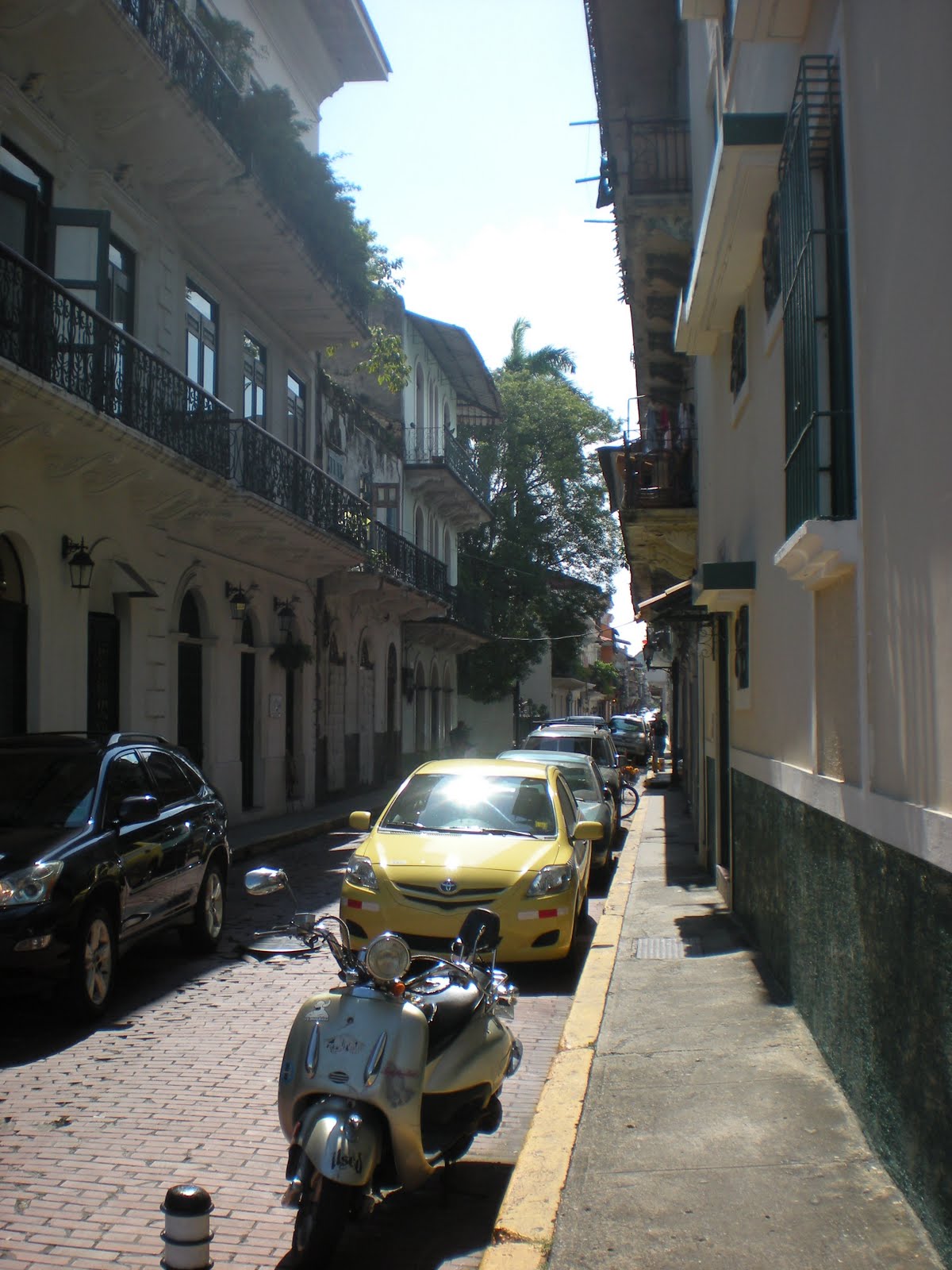
We began the Panama portion of our trip with 2 full days in Panama City, based in the neighborhood of Casco Viejo. Casco Viejo is the old city -- but not the very old city, which was sacked and burned by pirates in 1671. Afterwards the city leaders decided to rebuild in a more easily defendable spot, so they picked this peninsula which juts into Panama Bay.

When Panama became independent, Panama City was still limited to the Casco Viejo area. As the city grew, Casco Viejo went into decline, becoming a neglected slum. Recently the government began a concerted effort to improve the neighborhood.

Now, as you walk around the neighborhood, there are decaying buildings everywhere, and streets and sidewalks that are full of holes. But there is reconstruction work going on too. Several old buildings were in the process of being repaired when we were there, and much of Casco Viejo is beautiful now.


Plaza de la Independencia in Casco Viejo. Top picture is of the National Cathedral. The third picture is looking towards the glitzy new section of Panama, one of whose towers is visible.


That´s the President´s house in Casco Viejo on the left. This is as close as we could get.


Looking towards glitzy modern Panama City.

Our second day we went to the Canal. The Panama Canal´s visior´s center at Miraflores is very touristy, so of course we went there. What other obvious place is there to pick up a Panama Canal shot glass? We then checked out the museum on the history, ecology and workings of the Canal. It´s a very well-done, modern exhibit, with everything bilingual in English and Spanish.

Then we went up to the observation deck where, with the hot sun beating down on us, we watched as a huge container ship passed through the locks on its way to the Pacific.


The ship enters the locks.


The water level has been made equal.


And the ship goes on through.

Saturday, July 17, 2010

Kaohsiung and Kenting

This past weekend was my latest jaunt around southern Taiwan, including days spent in Kaohsiung (where I'd been before) and Kenting (where I'd never been).

On Friday afternoon Emily and I took the HSR down to Kaohsiung and quickly located Kaohsiung 202, a neat little backpackery hostel near the Love River. Kaohsiung 202 was great, the first backpacker's hostel I've stayed at in Taiwan. Our room, although extremely basic, was also clean and extremely cheap. The shared bathrooms were sufficiently clean. And there was free Internet. The hostel is marketed entirely to foreigners, and the women who run it didn't seem Taiwanese (we think they were Filipina).

Although it's a bit of a walk from the MRT, the hostel is centrally located. We headed to the Kaohsiung municipal film archive, just a short walk away, which has excellent exhibits on the history of Taiwanese moviemaking with an emphasis on southern Taiwan. We got dinner at Liuhe Night Market - often reviled as excessively touristy, but you can count on it for a fine meal - and returned to the Love River for drinking Taiwan Beer at a riverside cafe.

There's the view from the roof of the hotel. The Love River is visible beyond the parking lot.

The Love River used to be known as a dirty polluted mess. Now that it's cleaned up and the riverside area is developed, it's a center of Kaohsiung civic pride.

There's an election coming up in November, and like Taipei, Kaohsiung is covered with political posters. Beyond the obvious political differences with northern Taiwan, the other thing I noticed was that almost all the politicians running for office here have little South Park-esque cartoon avatars of themselves in their ads. Chen Chu, the mayor of Kaohsiung and easily the most visible political figure in all of southern Taiwan, is the most obvious example, but even the old male KMT candidates for office have their cartoon avatars.

Chen Chu's cartoon self spreading the word about a municipal hotline. Chen's adorable avatar is seen on all manner of information billboards and signage that have nothing to do with politics or the upcoming election.

On Saturday we met up with Emily's former housemate Robin, a Kaohsiung native, and went off exploring the British Consulate and Cijin areas. The old British Consulate is now a museum and a cafe (Jenna and I visited the cafe when we were there in 2008); at the moment the consulate's home to an exhibit on the Beatles and the city of Liverpool, and how Liverpool compares to Kaohsiung. I assumed they were sister cities, but Wikipedia says I was mistaken. So why Liverpool then? I don't know.

Flags and visitors at the very touristy British Consulate.

Cijin is an island in the harbor best approached by ferry. We'd had substantial Japanese noodles for lunch so we were not yet in a mood to appreciate Cijin's seafood offerings. Instead, we took a look at the historic lighthouse (closed) and the ruined fort.


The fort, and Kaohsiung beyond it. The fire in that last picture looked pretty serious, but I never found out what it was from.

That evening Jenna arrived via HSR after working all day, and we rented a car and headed south. (We headed south eventually. Thank to our unfamiliarity with the city's road network, it took us longer than it should have for us to be definitely going in the right direction.)

We stopped for dinner at Donggang, a coastal city south of Kaohsiung that's become quite wealthy as a center of bluefin tuna fishing. Jenna and I visited Donggang on two consecutive weekends last year to see the King Boat festival, which climaxed with the burning of a huge boat on the beach in the early hours of the morning. Central Donggang has several well-known seafood restaurants, but if you want the best food in town you do what we did: go to the harbor and eat at one of the outdoor restaurants there. We got there after ten in the evening, and there were still several places open and doing good business. We didn't have tuna, but we had oysters and crab legs and clams and non-tuna varieties of fish and it was all quite excellent.

We reached Kenting, a town of bars and restaurants designed to separate tourists from their money, after one in the morning. Driving right through it, we located a campground off the road south of Kenting. We paid, set up our tents, and realized our rented car had suffered a flat tire for some reason.

We fixed it in the morning, after a very hot and muggy night (the guy who'd set up a large fan to blow through his tent had the right idea). The car came with a spare tire, tools to change it, but no jack. The guy who ran the campground had a jack. Emily, being the most mechanically competent among us, was able to change the tire. Problem solved. We washed up (the shower facilities were extremely basic, but I was amazed they had hot water) and went off to explore the southernmost parts of the island of Taiwan.

The big stone marker at Taiwan's southernmost point.


The seaside at Kenting.

It was enough to make me regret not bringing snorkeling gear. I'd assumed there wouldn't be enough time.

Emily with coconut. They're available everywhere in Kenting.

Later on we turned inland, driving through Kenting National Park.


To tell the truth I think Jenna took these pictures; her camera was unavailable so she used mine.

Hengchun is one of the largest, if not the largest, town in the Kenting area. The oldest part was lies within the well-preserved old city walls.


That's the old North Gate, as the barely-visible Chinese characters say. Jenna's pictures.

Emily atop an old tank by the North Gate. There's nothing to say you can't climb up on it, and after Emily got off some kids got on. Again, Jenna's picture.

On the way back we stopped in Donggang again, this time at a decent restaurant near Donglong temple. Then we hustled back to Kaohsiung before the deadline passed before returning the car -- it was a relief when we saw giant billboards with photos (not cartoons) of Chen Chu, meaning that we were getting close to our goal. We got back to the HSR station with some time to spare, and they didn't charge us for the flat tire (good thing, too; we would have protested if they had). Hooray!

Monday, April 12, 2010

Capital flows

From the Taipei Times a while back: Gifts for ghosts changing from cash to flash goods.
It seems that fake paper money is no longer good enough for the dead of Taiwan, where relatives traditionally burn make-believe cash to help ease the passage of their deceased loved ones through the byways of the netherworld.

Instead, many people now opt to provide ancestral ghosts with more elaborate paper gifts — models of everything from Ferraris to iPhones and even villas.

This article is a wonderful source of food for thought. I like the straightforward statement that the afterlife is a place where "buying opportunities have never been convincingly documented".

There's also the bit about burning paper replicas of guns for dead gangster relatives, so that they may continue their lifestyles as ghosts.

I must admit I'm very curious: if a gangster ghost uses lethal force against a rival gangster ghost... what happens, exactly?

I'd like to read more socioeconomic studies of what goes on in the afterlife. A while back, PodCastle ran Maureen McHugh's story "Ancestor Money", which was a good start.

Sunday, April 11, 2010

Down the East Coast

Monday, April 5 was a holiday - Tomb Sweeping Day, the day that the Taiwanese traditionally travel to their ancestors' graves to honor them. What it meant for us was a 3-day weekend. Jenna and Emily and I rented a Toyota Camry and drove down and up the East Coast.

I'm not a confident driver in big cities and I've never driven so much as a motorbike in Taiwan. Also, neither I nor Jenna have an international driving license. So it was Emily who took on all of the driving duties, for which I am thankful.


We set off for Hualien on Saturday, driving along the narrow North Cross-Island Highway, through Fusing and Baling, eating a delicious lunch at a very modest restaurant in a very modest town. We stopped frequently to take pictures, hitting Suao as dusk was approaching and Hualien as night was falling.

Sunday morning, we drove down the coast on Highway 11. We stopped at Cow Mountain Beach, a lovely little beach (where swimming is not permitted) with very, very hot sand that made us regret our decision to leave our shoes and walk down barefoot.


We stopped at Shihtiping, a section of rocky coast popular with tourists (a Chinese tour group was leaving as we were arriving). I was most interested in checking out the many tide pools, particularly the contrast between the ones that were green and disgusting, and the ones with clear water, brimming with fish and crabs and other life.


We stopped at a seafood restaurant in one of the small coastal towns, where we had a good meal, watched over by the restaurant's very fat dog, Mimi.


At Highway 64, just north of the Tropic of Cancer, we turned inland towards the East Rift Valley. Highway 11 continues past interesting and beautiful areas south of the Tropic of Cancer, but Jenna and I had already visited Basiandong and Sansiantai on a previous trip.

We turned south on Highway 9, stopping at the Tropic of Cancer Monument and twin ancient Saoba Megaliths. Rough Guide claims that local legend says the megaliths are the remains of incestuous twins who were turned to stone. None of the ample bilingual signage around the megaliths actually makes reference to this story, though.

I liked the East Rift Valley quite a bit. It is very different from urban Taiwan. Its humid, tropical ruralness reminded me of the Philippines or Sumatra. We stopped to eat at Cifadahan Cafe, an Ami restaurant in Mataian that Lonely Planet recommended. Many of the cafe's specialties were out of season, but the salad made from local raw vegetables was excellent.

And that was it for Sunday, as we returned to Hualien that night. The following morning we packed up and left Hualien, heading to Taroko National Park. We'd all been there before, but not with our own transportation.


The weather did not really cooperate; rain came and went, and we took pictures of beautiful scenery partially obscured by fog. That said, we had a good time, and to make it a proper road trip we bought some unhealthy snack food (Pringles!) in a cafe at Taroko.


We made it back to Taipei that evening, after dealing with traffic both in Luodong (where traffic was allowed on the highway very slowly) and at the toll booths for the Xueshan Tunnel, but once we were in the tunnel traffic moved smoothly.

Jenna documented the trip here and here.

Tuesday, February 23, 2010

Our Chinese New Year's Trip


Our plan for Lunar New Year had been to go hiking and camping in the mountains of central Taiwan. We would enjoy some spectacular views and get some much-needed exercise in. And most importantly, we would get ourselves out of Taipei City during the week-long break when Taipei empties out and the city becomes a dull, boring place.

The plan once we realized the weather would be rotten was to spend the night in Taichung, then head up through Puli into the Cingjing Farm area. Cingjing's got some beautiful scenery, and we found a campground where we could pitch our tents. Then it would be a bus ride to Lishan, a little town near the Central Cross-Island Highway with beautiful views across the valleys of Taiwan's central mountain range.

As it happened, the weather turned really sour. Cingjing Farm's views were obscured by fog, and the rain was near-incessant. Good news #1: our tent was waterproof. (Joseph and Emily's tent was somewhat less than waterproof, we heard.) Good news #2: Cingjing Farm contains not only a Starbucks (good for passing a couple of hours when the rain is nonstop outside), but also several decent places for food, particularly a non-pretentious place where we got excellent mutton hotpot.


This is more or less what I picture the English countryside as looking like in parts, but it's a sheep-filled meadow near Cingjing, draped in fog.

So we spent much of the time in the campsite lodge playing cards. On the bright side, my first real sleeping-in-a-tent experience was one with nonstop rain, so my next one will almost certainly be pleasant by comparison.

We nixed the idea of traveling on to Lishan when we called ahead and confirmed that the weather wasn't terribly different from the weather in Cingjing. In addition, the bus wasn't running because of snow on the route; we had the option of getting a ride from someone who drove to Lishan every day anyway, but in the end we decided to go back to Puli, where at least the fog wouldn't be as bad. In a way it's too bad; I've never seen snow in Taiwan, and this would have been my chance.

Puli is a small city down in the Taiwanese lowlands, with a couple of interesting sights. The four of us got rooms at a hostel and explored the town. Puli's sights include the Shaohsing wine brewery, which includes a museum and a sizable market where one can browse several wine-based products, including candies and soap. The signature alcohol itself is a bit strange-tasting if you're not used to savory beverages, but several varieties of wine and liquor are available.

The next morning we started out at the Kuanhsing paper factory, where we took a guided tour showing us the art of making paper by hand. Of course, there is a sizable gift shop; there's also an area (popular with schoolkids) where visitors can put designs onto handmade paper.


It's kind of fun for people who haven't tried arts and crafts since elementary school.


Near the paper museum/shop we found some vendors selling fresh honey, with their bees right on the premises.


I'd never been so close to such swarms of bees, but I felt remarkably safe. The bees didn't care about human interlopers at all.


For whatever reason, they also had some cute little bunny rabbits on the premises, one month old, which we were assured were being raised as pets, not meat.

Puli also has a lacquerware museum and shop, where you can buy high-quality lacquer cups, bowls, and chopsticks.

When we were finished with Puli, we hired a taxi (rather than a bus, because of our heavy packs) to take us to the town of Caotun, an otherwise unremarkable town, not even mentioned in Rough Guide, that we visited for its Tzude Temple, as described here and here.


Apparently the temple is based on a dream that the builder had. As the result shows, it's incredibly ostentatious and looks nothing like any other temple in Taiwan.


There's a garden of little religious statuettes behind the temple.


Overall, our last day of travel and the decent weather we had on that day improved our spirits considerably. Read Jenna's account of the trip and the excellent pictures she took here.