Monday, April 12, 2010

Capital flows

From the Taipei Times a while back: Gifts for ghosts changing from cash to flash goods.
It seems that fake paper money is no longer good enough for the dead of Taiwan, where relatives traditionally burn make-believe cash to help ease the passage of their deceased loved ones through the byways of the netherworld.

Instead, many people now opt to provide ancestral ghosts with more elaborate paper gifts — models of everything from Ferraris to iPhones and even villas.

This article is a wonderful source of food for thought. I like the straightforward statement that the afterlife is a place where "buying opportunities have never been convincingly documented".

There's also the bit about burning paper replicas of guns for dead gangster relatives, so that they may continue their lifestyles as ghosts.

I must admit I'm very curious: if a gangster ghost uses lethal force against a rival gangster ghost... what happens, exactly?

I'd like to read more socioeconomic studies of what goes on in the afterlife. A while back, PodCastle ran Maureen McHugh's story "Ancestor Money", which was a good start.

Sunday, April 11, 2010

Down the East Coast

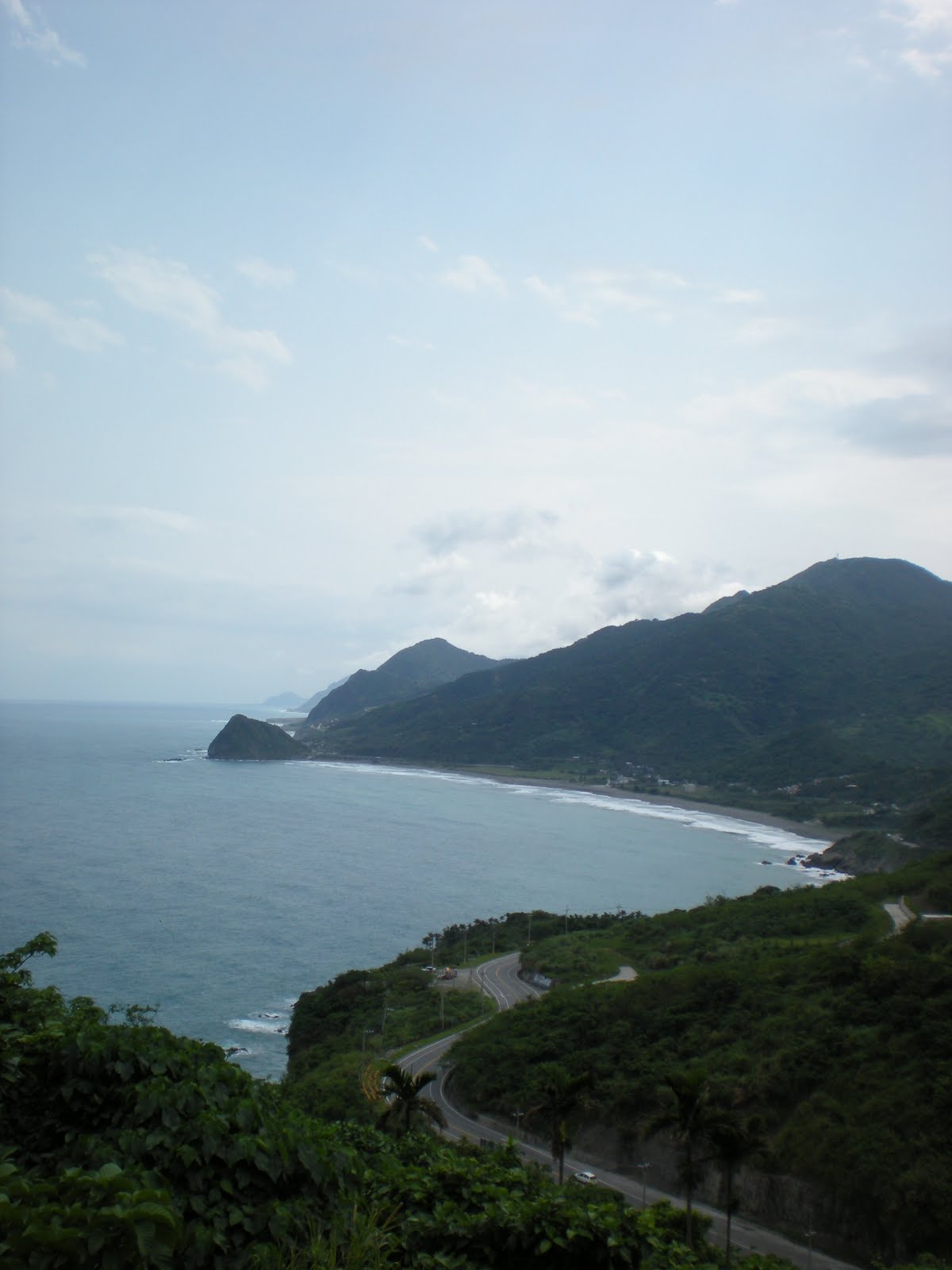
Monday, April 5 was a holiday - Tomb Sweeping Day, the day that the Taiwanese traditionally travel to their ancestors' graves to honor them. What it meant for us was a 3-day weekend. Jenna and Emily and I rented a Toyota Camry and drove down and up the East Coast.

I'm not a confident driver in big cities and I've never driven so much as a motorbike in Taiwan. Also, neither I nor Jenna have an international driving license. So it was Emily who took on all of the driving duties, for which I am thankful.


We set off for Hualien on Saturday, driving along the narrow North Cross-Island Highway, through Fusing and Baling, eating a delicious lunch at a very modest restaurant in a very modest town. We stopped frequently to take pictures, hitting Suao as dusk was approaching and Hualien as night was falling.

Sunday morning, we drove down the coast on Highway 11. We stopped at Cow Mountain Beach, a lovely little beach (where swimming is not permitted) with very, very hot sand that made us regret our decision to leave our shoes and walk down barefoot.


We stopped at Shihtiping, a section of rocky coast popular with tourists (a Chinese tour group was leaving as we were arriving). I was most interested in checking out the many tide pools, particularly the contrast between the ones that were green and disgusting, and the ones with clear water, brimming with fish and crabs and other life.


We stopped at a seafood restaurant in one of the small coastal towns, where we had a good meal, watched over by the restaurant's very fat dog, Mimi.


At Highway 64, just north of the Tropic of Cancer, we turned inland towards the East Rift Valley. Highway 11 continues past interesting and beautiful areas south of the Tropic of Cancer, but Jenna and I had already visited Basiandong and Sansiantai on a previous trip.

We turned south on Highway 9, stopping at the Tropic of Cancer Monument and twin ancient Saoba Megaliths. Rough Guide claims that local legend says the megaliths are the remains of incestuous twins who were turned to stone. None of the ample bilingual signage around the megaliths actually makes reference to this story, though.

I liked the East Rift Valley quite a bit. It is very different from urban Taiwan. Its humid, tropical ruralness reminded me of the Philippines or Sumatra. We stopped to eat at Cifadahan Cafe, an Ami restaurant in Mataian that Lonely Planet recommended. Many of the cafe's specialties were out of season, but the salad made from local raw vegetables was excellent.

And that was it for Sunday, as we returned to Hualien that night. The following morning we packed up and left Hualien, heading to Taroko National Park. We'd all been there before, but not with our own transportation.


The weather did not really cooperate; rain came and went, and we took pictures of beautiful scenery partially obscured by fog. That said, we had a good time, and to make it a proper road trip we bought some unhealthy snack food (Pringles!) in a cafe at Taroko.


We made it back to Taipei that evening, after dealing with traffic both in Luodong (where traffic was allowed on the highway very slowly) and at the toll booths for the Xueshan Tunnel, but once we were in the tunnel traffic moved smoothly.

Jenna documented the trip here and here.

Tuesday, February 23, 2010

Our Chinese New Year's Trip


Our plan for Lunar New Year had been to go hiking and camping in the mountains of central Taiwan. We would enjoy some spectacular views and get some much-needed exercise in. And most importantly, we would get ourselves out of Taipei City during the week-long break when Taipei empties out and the city becomes a dull, boring place.

The plan once we realized the weather would be rotten was to spend the night in Taichung, then head up through Puli into the Cingjing Farm area. Cingjing's got some beautiful scenery, and we found a campground where we could pitch our tents. Then it would be a bus ride to Lishan, a little town near the Central Cross-Island Highway with beautiful views across the valleys of Taiwan's central mountain range.

As it happened, the weather turned really sour. Cingjing Farm's views were obscured by fog, and the rain was near-incessant. Good news #1: our tent was waterproof. (Joseph and Emily's tent was somewhat less than waterproof, we heard.) Good news #2: Cingjing Farm contains not only a Starbucks (good for passing a couple of hours when the rain is nonstop outside), but also several decent places for food, particularly a non-pretentious place where we got excellent mutton hotpot.


This is more or less what I picture the English countryside as looking like in parts, but it's a sheep-filled meadow near Cingjing, draped in fog.

So we spent much of the time in the campsite lodge playing cards. On the bright side, my first real sleeping-in-a-tent experience was one with nonstop rain, so my next one will almost certainly be pleasant by comparison.

We nixed the idea of traveling on to Lishan when we called ahead and confirmed that the weather wasn't terribly different from the weather in Cingjing. In addition, the bus wasn't running because of snow on the route; we had the option of getting a ride from someone who drove to Lishan every day anyway, but in the end we decided to go back to Puli, where at least the fog wouldn't be as bad. In a way it's too bad; I've never seen snow in Taiwan, and this would have been my chance.

Puli is a small city down in the Taiwanese lowlands, with a couple of interesting sights. The four of us got rooms at a hostel and explored the town. Puli's sights include the Shaohsing wine brewery, which includes a museum and a sizable market where one can browse several wine-based products, including candies and soap. The signature alcohol itself is a bit strange-tasting if you're not used to savory beverages, but several varieties of wine and liquor are available.

The next morning we started out at the Kuanhsing paper factory, where we took a guided tour showing us the art of making paper by hand. Of course, there is a sizable gift shop; there's also an area (popular with schoolkids) where visitors can put designs onto handmade paper.


It's kind of fun for people who haven't tried arts and crafts since elementary school.


Near the paper museum/shop we found some vendors selling fresh honey, with their bees right on the premises.


I'd never been so close to such swarms of bees, but I felt remarkably safe. The bees didn't care about human interlopers at all.


For whatever reason, they also had some cute little bunny rabbits on the premises, one month old, which we were assured were being raised as pets, not meat.

Puli also has a lacquerware museum and shop, where you can buy high-quality lacquer cups, bowls, and chopsticks.

When we were finished with Puli, we hired a taxi (rather than a bus, because of our heavy packs) to take us to the town of Caotun, an otherwise unremarkable town, not even mentioned in Rough Guide, that we visited for its Tzude Temple, as described here and here.


Apparently the temple is based on a dream that the builder had. As the result shows, it's incredibly ostentatious and looks nothing like any other temple in Taiwan.


There's a garden of little religious statuettes behind the temple.


Overall, our last day of travel and the decent weather we had on that day improved our spirits considerably. Read Jenna's account of the trip and the excellent pictures she took here.

Saturday, December 26, 2009

Nikko 1

As a stopover on the way back to the States for Christmas, we stopped in Japan for the weekend. It was my second substantial visit to Japan and the Tokyo area, so we took the train up to Nikko for an overnight stay.


You can't tell in that picture but there was snow on the ground. There was snow on the ground! Today I'm in Maine, there's snow everywhere and it's nothing special, but I was very happy to get to Nikko last weekend and have snow on the ground there after a Taiwanese December. We stowed our luggage at the train station and got day bus passes to head to the temple and shrine area.


That last picture shows the bus (foreground) that rolled backwards while the driver was attempting to put chains on its tires, causing it to smash into our bus (background, just barely visible) thus forcing all us passengers to get off and mill about outside. No one was hurt, and we just walked the rest of our way to the temple complex.

Our first day was at the Tosho-gu shrine, where one half of Tokugawa Ieyasu is enshrined.


Toshu-gu in the snow.


The snow made the ground slippery, Jenna had to be careful because of her busted ankle (she'd torn a ligament a few days earlier), and I enjoyed the feeling of moisture soaking through my not-entirely-waterproof shoes. But the snow was beautiful.

Dinner that night was excellent yakitori - my first real Japanese-style yakitori - and then a train ride to the rural bit of Nikko where our hotel was located. Our train let us off in a middle-of-nowhere station with no employees, as rural an area as I've ever seen in Japan. You could see stars. I spotted Orion for the first time in weeks, perhaps months. Fortunately the hotel was across the street from the train station. We were shown to our cabin, a tasteful Japanese house with paper screens and fancy electronics, including a small TV built into the wall, an iPod, and fast wireless Internet.

The following morning, we set out to explore this semi-rural area of Nikko.


Looks oddly like parts of the eastern United States, in terms of population density and the mountains in the background.

We visited a well-known pickle store where we all stocked up on high-quality Japanese pickles, and we went to a tempura&noodle restaurant for some good tempura and noodles.


This friendly cat lives at the hotel and decided Jenna's backpack would be a comfortable place to sit for a couple of minutes.

After that, it was back to the temples for another day of sightseeing - to be continued!

Tuesday, September 22, 2009

Xiao Wulai

This Sunday six of us went out to Xiao Wulai. Xiao Wulai is another well-known bit of Taiwan's natural beauty; in the vicinity of Daxi and Fuxing, it's a waterfall and forest park that gets a fair number of day-tripping hikers.


Rural Taiwan, near the falls.


The valleys near Fuxing village.


And this is the waterfall proper. You can't get to that pavilion on the right; the way's been blocked by park authorities. Same for a multi-story pavilion out of the camera frame that's presumably been deemed unsafe. But it's quite a nice view, don't you think?

My pictures are few in number and unprocessed. Jenna took many more pictures and did some processing to make them look nice, her pics and commentary can be found here.

Tainan Day

Two Sundays ago we went down to Tainan for the day. Jenna got had a seminar scheduled for Monday in Tainan, so work paid for her to go down. I had the day free, so we went down together and spent the day wandering around central Tainan before I took the high-speed train back in the evening.

I like Tainan. It's quite a sizable city and so it would probably be an interesting place to live long-term. (Pity the public transport isn't better.) And yet there's a huge amount of historic Tainan that's been preserved, although much of it can be hidden behind new development. This was my fourth trip to Tainan and there's always something new to discover.


The Confucius Temple. You don't have to pay unless you want to visit the inner part of the temple; roaming the grounds is free and makes for a fine public park for Tainan.


Phoenix and dragon, outside the Confucius Temple.


Nanmen, the old South Gate and one of the few remaining bits of the old city wall.


The city view from atop Nanmen.


The Wufei Temple, in commemoration of the five concubines of King Ning Jin, who killed themselves when their king was defeated and overthrown in 1683.

After a day of wandering around in the hot, humid September air and snacking when we felt like it, we ended up in the Chikan Towers neighborhood, where they were giving a benefit concert to help Typhoon Morakot victims. From there, we took a taxi to the high-speed rail station, located inconveniently far from the city center (we couldn't be bothered with the bus) and I headed back to Taipei. Jenna stayed in Tainan for another day, working for decent money.

Friday, June 05, 2009

Hong Kong and Macau

We just had the Dragon Boat holiday here in Taiwan. To take advantage, we spent four nights in Hong Kong, just to explore the city in more depth than we'd ever been able to before. It was Jenna's fourth trip to HK, my second, and for the first time we had good weather and plenty of time.

On Thursday, we disembarked at the airport having already filled out our health questionnaires to make sure we did not have H1N1 and hadn't come into contact with it. These questionnaires were collected by personnel at the airport who gave them more scrutiny than our arrival cards got.

We stayed at the Wesley Hotel in Wan Chai. The staff at the hotel reception desk measured our temperatures with little electronic devices. We passed.

Central and inexpensive but with very few facilities, virtually nonexistent service and bare, stuffy rooms.

-- Lonely Planet

Now, I suppose that's true, but what we cared about mostly was the "central and inexpensive" part. Granted, our hotel room was tiny, but that's what you get when you stay in the densest part of Hong Kong Island and you don't want to pay extravagantly for your room. What amused me most was, while practically every other cable TV-equipped hotel room I've stayed at in Asia has provided either CNN International or BBC News (or both), our choices for English-language TV news were CCTV (the Chinese government mouthpiece) or FOX News. The same FOX News that you get in the States.

Once settled in at the hotel, our first priority was to get the heck off Hong Kong Island and over onto the Kowloon side. We took the MTR to Central, where we spent a decent amount of time wandering around like clueless tourists looking for the Star Ferry terminal. (This was particularly pathetic considering that we'd both been to the terminal on previous Hong Kong visits.)

At ground level, Central resembles a hideously overgrown Rosslyn, Virginia, and has about as much charm. It's got some of the best-known skyscrapers in East Asia, but these are best appreciated at a distance.

We finally found the Star Ferry terminal and traveled across the harbor to Kowloon. We wandered along the promenade for a while, and took in the views of the Hong Kong Island skyline.


(My camera is not all that great at nighttime pictures, as you can see.)

Then we headed to the Temple St. market for food. We filled up on some excellent seafood and looked through the oddities of the night market before taking the MTR back to Wan Chai.

On Day 2, we'd originally planned to go hiking on either Lantau or Lamma Island. Cool, drizzly weather scuttled that idea, so instead we explored some of the neighborhoods on the north side of HK Island. We ate dim sum for lunch in a shopping center in Causeway Bay - I'd never eaten dim sum in HK before, and since it's the style of food most associated with the city I figured I'd better try eating it in its hometown.

Once we had our fill of Causeway Bay, we took the MTR all the way to the northwest part of the island and Sheung Wan.


I'm not sure exactly what it means, but: many streets in Sheung Wan made me feel like I was in Chinatown in a Western city. I think it was all the Chinese medicinal goods out and on sale, like giant mushrooms and dried lizards.


A lovely little park off of Hollywood Rd. in Sheung Wan. Note the apartment blocks rising in the background.

Stone statues outside the Man Mo temple in Sheung Wan.

Eventually we met up with some friends who live in HK for dinner in Central, followed by relaxation at a bar where THE MUSIC IS SO LOUD YOU CAN'T HEAR THE PERSON NEXT TO YOU. I'm sure that appeals to some people, but I'm not one of them. Fortunately we were able to leave for a more relatively quiet alternative soon after.

On Saturday, we went to Lantau Island. We'd planned to take the ferry to Tung Chung to maximize our sightseeing enjoyment, but when we determined that would require a horribly circuitous route, we took the MTR there instead.

From the ultramodern densely populated new town of Tung Chung, you can catch a cable car up the mountain to Ngong Ping.


The cable car was lots of fun. Every bit the equal of the currently-nonfunctioning Maokong Gondola in Taipei, the views from the cable car are quite impressive (except when it's the smog-shrouded airport you're looking at).


At the top, you can walk through a touristy strip of stops and then you reach the stairs to the Tian Tan Buddha.


The Tian Tan Buddha is relatively new as Buddhas go - completed in 1993 - but it's quite well-known and a major tourist attraction.


We descended by cable car and took a bus to Mui Wo, a port town on Lantau, and boarded a ferry for Cheung Chau, a small island off of Lantau's coast.


The town on Cheung Chau, more than any other place in Hong Kong, reminded me of Taiwan. I can be more specific. It reminded me of the back streets of cities in southern Taiwan. I felt like I was wandering through an old section of Tainan or Kaohsiung. Except the language was different. And there were more Westeners about than I would expect. And there were people in little village greens playing croquet.


A sign in a little store in the Cheung Chau back alleys.

We ate dinner - seafood, of course - at a harborfront restuarant (despite an intriguing name and a mention in Lonely Planet, we gave Morocco Indian Food a pass) and took the ferry directly back to Central, giving us some stunning glimpses of the nighttime skyline along the way.

On Sunday: Macau.

Neither of us had been there, and a ferry from HK is relatively cheap and gets you there in under 90 minutes. For the purpose of traveling it's like crossing a national border, so we each collected a total of 4 new passport stamps in one day (and had to fill out 2 H1N1 flu questionnaires each).

Macau is best known for gambling, which neither of us is particularly interested in. I probably don't have enough self-control for gambling, and wouldn't know when to stop. With disastrous results. So we steered clear of the casinos and headed for historical touristy Macau.


You can still see some Portuguese, although I think maybe I heard people speaking it only once.


The most important old tourist sight is, of course, the ruins of St. Paul's. There is a nonstop crowd of tourists with cameras in the plaza in front.

The old town is beautiful. It feels like how I imagine an old city in southern Europe probably feels to wander through (not that I'd know). Of course, there's plenty of new development along roads that get a lot of tourists, and depending on where you point your camera, you might get this gigantic monstrosity towering above the old-timey cityscape.

But the food is wonderful, including the ubiquitous little almond cookies sold in a thousand little shops. Also, the egg tarts are the best in the world. And I'm comparing them to the ones in Hong Kong.

Macau may be small (however big you think Macau is, it's smaller) but I think I could probably enjoy another visit there. We never left the old city to explore the regions further south. Lonely Planet implies the best food in all of Macau is to be found there.