I went snorkeling for the first (and second) time this past weekend with Jenna, in Penghu. There was a bit of a learning curve to overcome (as it turns out, seawater doesn't taste all that good, but that didn't stop me from accidentally swallowing/inhaling bits of it) but if you're swimming in the right place, you can see some truly awesome things.
Monday afternoon we went snorkeling off the island of Chipei. At first I enjoyed exploring, via snorkel, the areas of the beach where boring sandy stretches alternated with rocky bits. I soon figured out that I was much more likely to see some cool animal life in the rocky parts, and I saw huge swarms of little fish, and a few slightly larger fish (which were about as big as the biggest aquarium fish). I saw one truly large fish the size of my torso swimming a bit further out - he wasn't menacing at all, but looked like a giant version of a silver and yellow tropical fish with a somewhat comical-looking face. Swimming further out, I also saw dark shapes on the seafloor which I initially thought were resting fish, but when one of them opened up its head, I realized they were giant sea cucumbers.
The following day we went snorkeling in a beach on the main island of Penghu. We did not have high expectations because the beach is not well known for snorkeling, but once we began swimming around a rocky section, we saw some impressive stuff. Huge schools of glittering silver fish which moved in precise formation. Black sea urchins lodged into crevices in the rocks. Pufferfish swimming around nonchalantly - they didn't puff up, but I recognized them as pufferfish because I'd seen them on so many restaurant signs in Korea and Taiwan. A group of about seven or eight ominous-looking black squid, each about a foot long, just hanging there suspended - maybe they were waiting for food to swim by. If I'd disturbed them perhaps I would have been squirted with ink - I didn't test out this theory though. We found two cuttlefish, looking like chubby, globular squid, wandering slowly through the rocky underwater terrain. This was all close to shore - we didn't go wandering dangerously far out. And we never would have seen any of it if we had stayed on dry land.
Friday, June 22, 2007

Saturday, June 02, 2007
Come to Taiwan: We're Not China (fortunately)
This is actual language from a Taiwan tourist brochure I found at the tourist kiosk at Taipei Station. I guess I don't disagree with any of it, but Jenna and I were both amazed it would be so blunt:
Interested in Chinese culture? Come to Taiwan. That's because
Taiwan is more "Chinese" than the mainland. No 50 years of communism, "Red
Guards," or "Cultural Revolution" here set on tearing down the old; just a
long-standing tradition of cherishing and preserving its rich cultural
heritage.
A bit later, the same brochure introduces the National Palace Museum by saying "China may be a dragon, but the dragon's treasures are in Taiwan."
Monday, May 28, 2007
漢字
Before I came to Taiwan, I studied Korean-style Chinese characters for a couple of months. It helped me with my grasp of more advanced Korean vocabulary, and was a good way fo rme to get acclimated to Chinese characters before coming here.
Chinese and Korean aren't related the way English and German are, and the basic grammar and vocabulary are quite dissimilar. But thousands of Chinese words have entered the Korean language in much the same way that English has adopted thousands of Latin words over the centuries.
I'm intrigued by the fact that you can usually see the phonetic similary, but not always. 生 is sheng in Mandarin and seng in Korean; 好 is hao in Mandarin and ho in Korean; 人 is ren in Mandarin and in in Korean; 光 is gwang in both Mandarin and Korean; 漢 is han in both Mandarin and Korean. But 學 is xue in Mandarin and hak in Korean, for some reason. Interesting.
Chinese and Korean aren't related the way English and German are, and the basic grammar and vocabulary are quite dissimilar. But thousands of Chinese words have entered the Korean language in much the same way that English has adopted thousands of Latin words over the centuries.
I'm intrigued by the fact that you can usually see the phonetic similary, but not always. 生 is sheng in Mandarin and seng in Korean; 好 is hao in Mandarin and ho in Korean; 人 is ren in Mandarin and in in Korean; 光 is gwang in both Mandarin and Korean; 漢 is han in both Mandarin and Korean. But 學 is xue in Mandarin and hak in Korean, for some reason. Interesting.
Elementary Mandarin
So I've been in Taipei for 3 months, and although I'm not learning Chinese as quickly as I'd like (I still lack the confidence to verbally tell a taxi driver my destination or order in a restaurant by myself, 2 things I did all the time in Korea) I feel like I've passed the first steep part of the learning curve and I'm learning more quickly now. Owning an mp3 player is a big help.
One slightly annoying thing is that practically all of the Mandarin-for-foreigners learning material out there teaches us to speak Mandarin with a strong Beijing accent. Which would be fine if I were in Beijing, but I'm several thousand miles to the south and I've been assured by both Jenna and the locals that people don't talk like Beijingers here in Taipei. There are no huge linguistic differences, but a lot of words that end with arr when pronounced by Beijingers don't sound the same down here. That includes one of the few bits of Mandarin I knew three months ago: ...zai nar? ("Where is...?") Instead of nar I should say nali, and instead of war (to play) I should say wan, and instead of idyar (a little) I should say idien. For some reason my main textbook, Practical Audio-Visual Chinese I (which seems to be the most popular Mandarin for Foreigners book around, judging by the fact that I've seen several people carrying it around the city in the past few months), teaches me to talk like a Beijinger but write like a Taiwanese (or a Hong Konger; they use the same traditional writing system).
Another little criticism of Audio-Visual Chinese I is that it teaches grammar a bit oddly. I still hadn't learned to say "If ______, then ________" or "I have to ________" when the book went into these subtle variations on expressing past time in Chinese that even Jenna was totally unfamilliar with. Jenna may not talk like a native but she speaks perfectly decent conversational Mandarin; if she doesn't know a particular grammatical construction then presumably I don't need to worry about it yet. So I've decided I'm going to plow ahead through A/V Chinese, only glancing at the grammatical explanations but using it to practice listening (I bought the 5 CDs sold as accessories, and I'm glad I did) and to learn vocabulary and characters.
One slightly annoying thing is that practically all of the Mandarin-for-foreigners learning material out there teaches us to speak Mandarin with a strong Beijing accent. Which would be fine if I were in Beijing, but I'm several thousand miles to the south and I've been assured by both Jenna and the locals that people don't talk like Beijingers here in Taipei. There are no huge linguistic differences, but a lot of words that end with arr when pronounced by Beijingers don't sound the same down here. That includes one of the few bits of Mandarin I knew three months ago: ...zai nar? ("Where is...?") Instead of nar I should say nali, and instead of war (to play) I should say wan, and instead of idyar (a little) I should say idien. For some reason my main textbook, Practical Audio-Visual Chinese I (which seems to be the most popular Mandarin for Foreigners book around, judging by the fact that I've seen several people carrying it around the city in the past few months), teaches me to talk like a Beijinger but write like a Taiwanese (or a Hong Konger; they use the same traditional writing system).
Another little criticism of Audio-Visual Chinese I is that it teaches grammar a bit oddly. I still hadn't learned to say "If ______, then ________" or "I have to ________" when the book went into these subtle variations on expressing past time in Chinese that even Jenna was totally unfamilliar with. Jenna may not talk like a native but she speaks perfectly decent conversational Mandarin; if she doesn't know a particular grammatical construction then presumably I don't need to worry about it yet. So I've decided I'm going to plow ahead through A/V Chinese, only glancing at the grammatical explanations but using it to practice listening (I bought the 5 CDs sold as accessories, and I'm glad I did) and to learn vocabulary and characters.
Thursday, May 24, 2007
Zhonghe
I wandered around my neighborhood of Zhonghe today. A couple of pictures that will show what a busy and crowded suburb of Taipei this is:


 Motorcycles parked outside Nanshijiao subway station.
 A Korean restaurant.
 Nanshijiao Station.
 Some interesting graffiti.


 This is in the local night market - I took this picture in the late afternoon, but they do most of their business between sundown and early morning.


 Motorcycles parked outside Nanshijiao subway station.
 A Korean restaurant.
 Nanshijiao Station.
 Some interesting graffiti.

 This is in the local night market - I took this picture in the late afternoon, but they do most of their business between sundown and early morning.


The entrance to my apartment building - I live on the 6th floor.
Tuesday, May 15, 2007
Hiking near Hualien
On Monday we went hiking near a lakeside town.


 It was humid and there was a cool breeze once we climbed to a high altitude.
 The view from the top.
The lakeside was full of the sound of frogs. You could also rent paddle boats and motorboats.
It was humid and there was a cool breeze once we climbed to a high altitude.Taroko Gorge
Jenna had no early Monday class, and I had nothing scheduled on Monday, so we went down to Hualien for the weekend. We decided to stay all day Monday too when Jenna found out she had no class that evening.
 Hualien itself is not a very exciting city, but there is great natural beauty nearby. Taroko Gorge represents Taiwan's single biggest natural tourist attraction.
 The gorge was carved out of marble cliffs.


 Exposed marble.


Hualien itself is not a very exciting city, but there is great natural beauty nearby. Taroko Gorge represents Taiwan's single biggest natural tourist attraction. The gorge was carved out of marble cliffs. Exposed marble. 


Thursday, May 03, 2007
Mr. Brown
I first encountered Mr. Brown on a poster on the GWU campus advertising "hometown snack foods" to homesick Asian students. It was an early lesson that more brand names exist beyond what's known to typical American suburbia.
I found Mr. Brown's coffee again when exploring the Asian grocery stores of northern Virginia. Each can of Mr. Brown contained the following helpful information: "EXPIRY DATE: TWO YEARS." There was no other date or year information on the can. I found this quite droll.
Now I'm in Mr. Brown's homeland. Not only is his coffee available in every convenience store, but he has a chain of coffee shops. Starbucks is extremely common in Taipei (and considerably cheaper than in Korea) but local coffee shop brands like Mr. Brown, Dante Coffee and Ikari Coffee are all more than just Starbucks clones. They all offer a selection of hot Western or fusion-style meals, which sometimes seem to have just been warmed in a microwave oven but are still surprisingly good. There's a Mr. Brown coffee shop directly across the street from the office where I teach twice a week, which is nice and convenient.
No, the coffee there doesn't taste like it came out of a can.

I found Mr. Brown's coffee again when exploring the Asian grocery stores of northern Virginia. Each can of Mr. Brown contained the following helpful information: "EXPIRY DATE: TWO YEARS." There was no other date or year information on the can. I found this quite droll.
Now I'm in Mr. Brown's homeland. Not only is his coffee available in every convenience store, but he has a chain of coffee shops. Starbucks is extremely common in Taipei (and considerably cheaper than in Korea) but local coffee shop brands like Mr. Brown, Dante Coffee and Ikari Coffee are all more than just Starbucks clones. They all offer a selection of hot Western or fusion-style meals, which sometimes seem to have just been warmed in a microwave oven but are still surprisingly good. There's a Mr. Brown coffee shop directly across the street from the office where I teach twice a week, which is nice and convenient.
No, the coffee there doesn't taste like it came out of a can.
Back to Korea?
Even though I generally like Korea, like Korean food and want to return there to get my knowledge of the Korean language to something approaching acceptable, I am quite certain I am not working for a language school there again.
The recent troubles of the guy behind the Zenkimchi blog make me think that working for a typical language school in Korea at this point is a big gamble. (ZenKimchi's site doesn't seem to have much on the specifics now, but read Metropolitician's take on it.) I never had any problems working in Korea, and all the horror stories I heard involved people I didn't know, but I think it was a matter of luck that I ended up working for a decent place. Twice.
So I'm thinking that if/when I return to Korea it will be as a student.
The recent troubles of the guy behind the Zenkimchi blog make me think that working for a typical language school in Korea at this point is a big gamble. (ZenKimchi's site doesn't seem to have much on the specifics now, but read Metropolitician's take on it.) I never had any problems working in Korea, and all the horror stories I heard involved people I didn't know, but I think it was a matter of luck that I ended up working for a decent place. Twice.
So I'm thinking that if/when I return to Korea it will be as a student.
Monday, April 30, 2007
Chinese Progress - Beginner Level
One of my top priorities ought to be to get a regular Mandarin tutor, or at least a language exchange partner. I'm up to Lesson 9 in my textbook (the most popular beginner's Mandarin textbook here in Taiwan, judging from the number of other people I've seen carrying it) and I am seriously considering paying for a Chinesepod membership, but I really need a native speaker to listen to my speech and correct it. These days I don't feel enough self-confidence to say much of anything to a local in Chinese, and that needs to change.
Here is one observation - I overhear a lot of obviously non-Asian people here speaking pretty good Chinese (especially in the part of Taipei around Gonguan and Taipower Building MRT stations - that seems to be a local hub of foreigner activity). It happens much more than I ever heard foreigners speaking good Korean in Korea. It's encouraging.
Here is one observation - I overhear a lot of obviously non-Asian people here speaking pretty good Chinese (especially in the part of Taipei around Gonguan and Taipower Building MRT stations - that seems to be a local hub of foreigner activity). It happens much more than I ever heard foreigners speaking good Korean in Korea. It's encouraging.
More Downtown Taipei Pictures
Here are some more pictures I took around downtown Taipei. I have finally learned to decrease my pictures' file size before uploading them, which means you can't enlarge them hugely any more, but also means I don't have to spend ten minutes waiting for the pictures to load.

 The old North Gate. There are 3 old gates around the city that I know about; as in Seoul, you can see how much ground the old walled city covered and how much the city has grown since hen.
 Zhongshan North Road.
 Local traffic. Actually, this picture makes the traffic look far more orderly than it generally is. Also, you can't tell that fully half of the traffic is motorbikes.
Taken from a pedestrian overpass, this is looking south towards Taipei Main Station.
The old North Gate. There are 3 old gates around the city that I know about; as in Seoul, you can see how much ground the old walled city covered and how much the city has grown since hen. Zhongshan North Road.Local traffic. Actually, this picture makes the traffic look far more orderly than it generally is. Also, you can't tell that fully half of the traffic is motorbikes.Sunday, April 29, 2007
Downtown Taipei
I wandered around downtown Taipei yesterday. Some pictures of Taipei urban architecture follow:  This is near the MRT station in Zhonghe where I live. Living outside of Taipei city limits means I am under no legal obligation to sort my garbage into recyclable and non-recyclable; it also means for certain services (like getting my Alien Registration Certificate) I need to go to a suburban office instead of the convenient place in downtown Taipei.
 These signs are pretty common at MRT station entrances. That says, "To prevent bird flu virus from spreading, do not carry poultry and birds into the station." Taipei is as modern a city as I have ever lived in; somehow I can't imagine that the subways would be full of squawking chickens if there weren't a ban.


This is near the MRT station in Zhonghe where I live. Living outside of Taipei city limits means I am under no legal obligation to sort my garbage into recyclable and non-recyclable; it also means for certain services (like getting my Alien Registration Certificate) I need to go to a suburban office instead of the convenient place in downtown Taipei. These signs are pretty common at MRT station entrances. That says, "To prevent bird flu virus from spreading, do not carry poultry and birds into the station." Taipei is as modern a city as I have ever lived in; somehow I can't imagine that the subways would be full of squawking chickens if there weren't a ban. That's a sign for a Garfield Restaurant. As big as Garfield stuff is in the States, I don't think that particular bit of merchandising ever caught on.
Preparation for an outdoor concert in Ximending.
Taipei has a lot of motorbikes. A lot of motorbikes.
Saturday, April 21, 2007
The Future of the MRT
I found an English-language map of what the Taipei MRT (mass rail transit system) is going to look like in a few years.
Since the current MRT is clearly a work in progress (the work being done on the new XinYi subway line is obvious to everyone who visits that part of Taipei), I'm not surprised to see all of the new lines and stations. That said, they seem to be getting ready for a major re-alignment of the downtown lines.
In the current configuration, I can get on the subway in Nanshijiao and take it directly to Taipei Main Station, or go on to Shilin (Jenna works in Shilin and besides it's a neat neighborhood, so that's convenient for me). In the future, judging by that map, it looks like trains from Nanshijiao are going to end up on a new Orange Line, which will go under downtown Taipei and then turn west, and if I want to go to Shilin I'll have to transfer trains. Of course, I'm not going to live near Nanshijiao long-term. Nothing's going to happen before 2008, and the major new lines won't begin opening until 2009-2011.
I shouldn't complain, as the MRT expansion is providing service to places where rail service was conspicuously absent before (Tianmu, Neihu, and most of suburban Taipei, for starters).

Since the current MRT is clearly a work in progress (the work being done on the new XinYi subway line is obvious to everyone who visits that part of Taipei), I'm not surprised to see all of the new lines and stations. That said, they seem to be getting ready for a major re-alignment of the downtown lines.
In the current configuration, I can get on the subway in Nanshijiao and take it directly to Taipei Main Station, or go on to Shilin (Jenna works in Shilin and besides it's a neat neighborhood, so that's convenient for me). In the future, judging by that map, it looks like trains from Nanshijiao are going to end up on a new Orange Line, which will go under downtown Taipei and then turn west, and if I want to go to Shilin I'll have to transfer trains. Of course, I'm not going to live near Nanshijiao long-term. Nothing's going to happen before 2008, and the major new lines won't begin opening until 2009-2011.

I shouldn't complain, as the MRT expansion is providing service to places where rail service was conspicuously absent before (Tianmu, Neihu, and most of suburban Taipei, for starters).
Sunday, April 15, 2007
Museum of Contemporary Art
Went to the Museum of Contemporary Art today. The museum is housed in a building downtown that used to be Taipei City Hall, before City Hall moved to the newish district in the eastern part of the city that's home to Taipei 101 and all sorts of modern civic buildings. The museum building has obviously undergone considerable renovation and remodeling, but it's an interesting mix.
The exhibit itself - the museum doesn't seem to have any permanent exhibits - is called 'Second Skin' (or 2ECOND SKIN as the museum spells it) and is dedicated to all sorts of variations on the theme of skin, clothing, and coverings for humans and furniture. Large swathes of the exhibit made me feel I was walking through a home furnishings catalog, as I saw various artists' take on, say, light bulbs or chairs.
Still, it was worth the $50NT each. And all of the signage and explanations were in perfect English that was just as comprehensive as the Chinese, something of a rarity in museums in this part of the world.
The exhibit itself - the museum doesn't seem to have any permanent exhibits - is called 'Second Skin' (or 2ECOND SKIN as the museum spells it) and is dedicated to all sorts of variations on the theme of skin, clothing, and coverings for humans and furniture. Large swathes of the exhibit made me feel I was walking through a home furnishings catalog, as I saw various artists' take on, say, light bulbs or chairs.
Still, it was worth the $50NT each. And all of the signage and explanations were in perfect English that was just as comprehensive as the Chinese, something of a rarity in museums in this part of the world.
Jiufen
I went to Jiufen yesterday with Jenna.
 Jiufen is a very touristy place - it's an old town that was apparently "rediscovered" by the Taiwanese public after a hit movie was set here recently, and now it draws large crowds from Taipei every weekend.
 There's no direct train service - you have to take a train to Rueifang and then catch a bus or taxi to Jiufen. As soon as we hailed a cab outside Rueifang train station, the driver asked us, "Jiufen?"
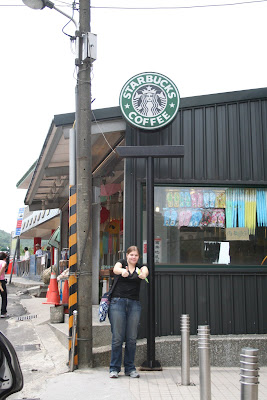 Jiufen is full of old teahouses. What was the first place we saw when the taxi let us off? A Starbucks. (A Starbucks that apparently gets lots of foreign tourists - it's the first Starbucks I ever went to with Jenna where the staff seemed actually impressed with her spoken Chinese - which is pretty good, I'll admit.)
 This is a long covered road full of snack stalls and shops selling little touristy trinkets. Lots of bracelets and statuettes for sale - there was one store devoted to ocarinas too.

 Jiufen snack food.
 That same covered street has calligraphers and painters as well.
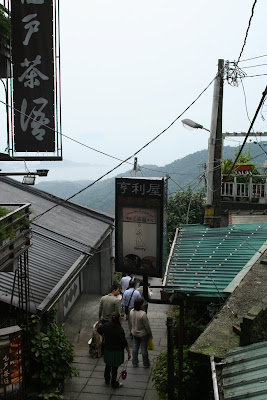 This is a street where most of the teahouses are located - it's built into a hill so it's almost one long staircase.
 The Pacific Ocean, as seen from the teahouse where we settled down in late afternoon.
 Jiufen is a very touristy place - it's an old town that was apparently "rediscovered" by the Taiwanese public after a hit movie was set here recently, and now it draws large crowds from Taipei every weekend.
 There's no direct train service - you have to take a train to Rueifang and then catch a bus or taxi to Jiufen. As soon as we hailed a cab outside Rueifang train station, the driver asked us, "Jiufen?"
 Jiufen is full of old teahouses. What was the first place we saw when the taxi let us off? A Starbucks. (A Starbucks that apparently gets lots of foreign tourists - it's the first Starbucks I ever went to with Jenna where the staff seemed actually impressed with her spoken Chinese - which is pretty good, I'll admit.)
 This is a long covered road full of snack stalls and shops selling little touristy trinkets. Lots of bracelets and statuettes for sale - there was one store devoted to ocarinas too.
 Jiufen snack food.
 That same covered street has calligraphers and painters as well.
 This is a street where most of the teahouses are located - it's built into a hill so it's almost one long staircase.
 The Pacific Ocean, as seen from the teahouse where we settled down in late afternoon.
Subscribe to:
Posts (Atom)