Monday, August 28, 2006

International Love and Understanding.

This poster is for a movie called (something like) "The Sinking of Japan". It's a Japanese disaster movie that's been described as kind of a "Japanese The Day After Tomorrow." Basically Japan sinks into the ocean due to some natural disaster.

The line above the title says "The day has finally come." People I know expect Korean audiences to be cheering.

Saturday, August 26, 2006

Myeongdong II

More pictures:
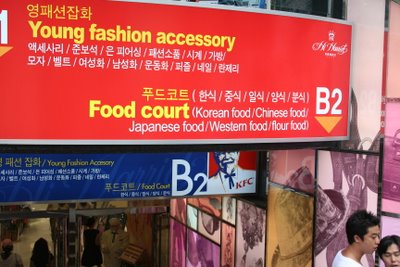
Not only do I not have the faintest idea what "flour food" is, but being able to read the Korean doesn't help me at all.


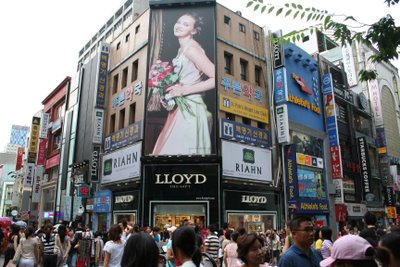
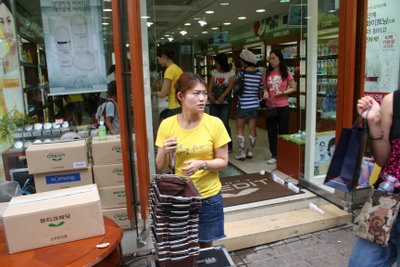
Most buildings in Myeongdong look something like this. I can't post a pic with high enough definition for you to see, but this building has fashion stores, restaurants, hair stylists, sneaker stores, a pharmacy, a real estate office, and "Dr. Paik's Weight Loss Clinic."


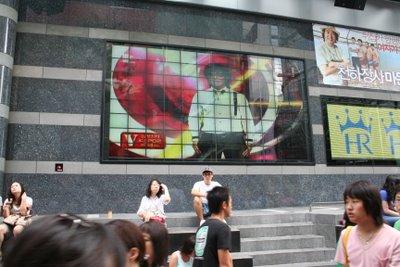
That big screen shows movie promos and music videos.


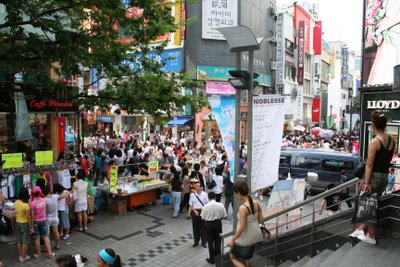
Now I am standing in front of the screen. Most of the pictures I took are within about 100 meters of this intersection.

Myeongdong I

Today the informal photo class I'm in roamed the streets of Myeongdong to take pictures. Our leader Michael practices street photography - particularly candid shots.

For me, today was all about overcoming my shyness taking candid photos of strangers in public. I don't know how many of my shots have artistic merit, but then I'm new at this game.


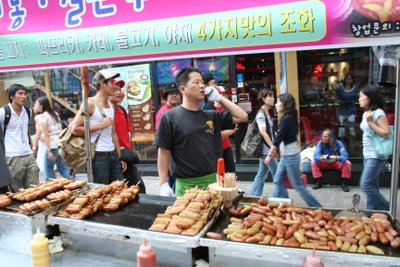
Sausages-on-skewer vendor. Of the five little sausages on each skewer, two are actually some sort of fishy substance.


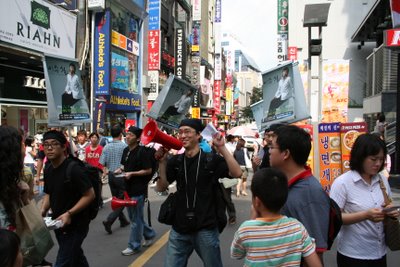
At first it looks like a protest, but then you see it's an organized ad activity making its way through the streets.


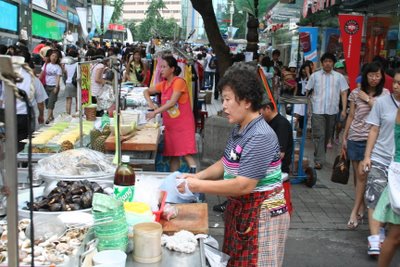
Woman selling all sorts of street stall food.


This employee looks either angry or cautiously watching something.


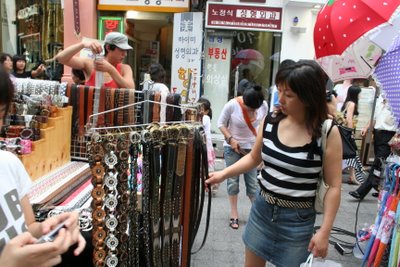
Stylish belts for sale.


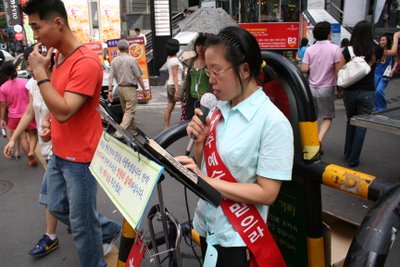
Reading a sermon. It's not unusual to see people standing at intersections handing out Christian pamphlets, or ever marching through crowded streets carrying a big cross-shaped sign with Christian music playing.

Photos, at last


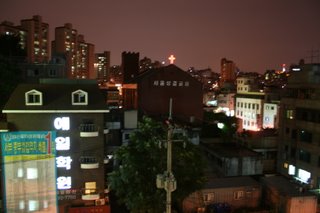
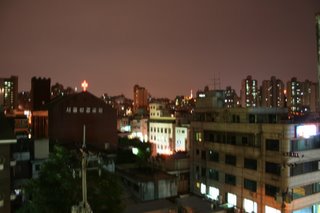
Nighttime views from my window, taken with my new camera. Once I get the software figured out I may be able to combine those two photos into one picture.

The building on the far left is a hagwon, or an academy for students to take extra classes after school to meet the demands of the educational system over here. Notice the church in the middle of the scene, with the neon cross.

There's only a small section of the window I can actually open to let in fresh air. I had to poke my camera through it and point it in different directions. The exposure time was quite long (this was night, remember); I think I did a good job minimizing blurring considering the weird angle I had to hold the camera at.

Thursday, August 24, 2006

Hanja

I've decided to start making an effort to learn hanja, or Chinese characters as they're used in Korean.

For a long time I stubbornly refused to study them. After all, my greatest weaknesses in Korean are speaking and understanding what people say to me, and it's not obvious how studying Chinese characters will help me with that. Also - quite unlike Japan - in Korea there's not really a need to learn Chinese characters to be able to function well in the language. Most books and magazines omit them completely. Sometimes it seems they're reserved for special occasions. For example, the name of the author on a book cover might be written in hanja, or a business card might be all hanja.

But recently I discovered Lee Young-hee's Learn Hanja the Fun Way in a bookstore, and I decided to go for it. First of all, learning to write the characters will give me a head start when I learn Japanese and Chinese, though I know that the Japanese and Chinese use and pronounce characters differently (not to mention the several hundred characters that the PRC decided to alter a few decades ago). Also, as I learn the characters I'll review and learn high-level Korean vocabulary. Finally, I genuinely feel like I'm learning a new skill - but I need to find someone who will check and correct me on my handwriting. (I'm assuming that if I learn to write Korean hanja well, that at least will carry over to Chinese and Japanese.)

Classical Chinese has about the same relationship to Korean that Latin and Greek do to English. Take the syllable dent. Through words like dentist, dental, dental floss, dentures, and dentistry, we can see that dent means "tooth". But we wouldn't use it alone to mean "tooth"; for that we'd use the native English word. (The Korean word for "tooth" is 이 or ee; the Chinese-derived equivalent of dent is 치 or chee.)

Now imagine that, although we usually wrote Latin and Greek-derived words in our own alphabet, it was also possible to write them in a special writing system quite distinct from our alphabet. And most educated people knew the symbol for dent, even though they usually just spelled it out in English letters.

To write dentist, you would usually just use English letters, but another option would be to pair the dent symbol with the ist symbol, also used in words like pianist, taxidermist, scientist, and so on. So you would have 2 options to write dentist: you could spell it out d-e-n-t-i-s-t, or you could write it in 2 characters: the dent character and the ist character. But for a word like tooth, you would have no choice but to spell it t-o-o-t-h.

That is how Chinese characters work in Korean.

I've noticed a few hanja-based cross-linguistic puns. These days lots of Korean companies advertise "well-being," or healthy, foods. No effort is made to translate "well-being" into Korean; instead they've just adapted the English words and write it 웰빙 ("wel-beeng"). The other day I saw a street stall where they were selling healthy iced snack foods. The slogan "well-being" was prominent, but the "being" part of it was replaced by the Chinese character for ice. The Korean pronounciation for this character is "beeng".

Public Service Annoucement

You should now be able to post comments, even if you're not a Blogger user.

Monday, August 21, 2006

Korean class!

I've done it - I've registered for a month of Korean classes at YBM-Sisa. It's not my first choice, but it's apparently popular, and cheaper than a university (but still a significant investment), and a 5 minute walk from my workplace. 2 hours a day, 5 days a week, starting September 4.

The guy who briefly interviewed me put me into Level 4. The web site says of level 4, "Students learn not only the language but also things to help students better understand Korean culture. Students will learn to speak in longer and more complex forms accurately." I'm somewhat worried that I've been put into too difficult a class - I don't understand spoken Korean well at all, but I can speak reasonably well enough to make people assume that I do - but I'll only know for sure in 2 weeks. I bought the textbook, which looks quite boring, but I teach English with equally boring books so I guess this is cosmic justice.

Between this class and other looming purchases (plane tickets to Taiwan, digital camera), I'm going to spend quite a bit of money this week. At least it will be mostly one-time expenses.

Saturday, August 19, 2006

Yonsei's Korean reader

I've been studying Yonsei University 5-6급 한국어 독본 (Korean Reader). Each reading (they vary from 2-3 pages long to several pages long) is followed by a whole bunch of vocabulary words with English translations.

I wonder how the editors decided which words to give English translations for. In Chapter 6: 까치 ("Magpies") most of the translated words are on the advanced side, but there are some relatively basic words, like 호기심 ("curiosity"). But look at this sentence:

음력 칠월 칠석에 견우와 직녀가 은하수에 걸린 오작교를 건너 일 년에 딱 한 번 만난다는 이야기는 너무나 유명한 전살이다.

My translation, with the help of a dictionary:

There is a very well-known legend that on the seventh day of the seventh month of the lunar calendar, the crow and the magpie are in the Milky Way for Altair and Vega to meet annually.

(...And so on to other astrological matters. I have little confidence that I translated that accurately.)

Does the book offer the English speaker any help translating "Vega" or "Altair" or "Milky Way"? No. Of course, living near the center of a brightly lit city of 11 million people I rather have to take it on faith that Altair and Vega and the Milky Way even exist.

This is a very philosophical set of Korean readings. The first 6 chapters:

1. "Language and Living" by Shim Jae-gi. The author gripes that young Koreans can't speak their own language correctly, says that speaking well is a requisite for thinking well, and quotes Buddha to support his position.

2. "Life's Happiness" by Lee Chang-bae. How to be happy, in the author's opinion.

3. "Meetings"by An Byeong-wook. The author believes in reincarnation, and reflects that the stranger we sit next to on a train may well have repeatedly been our soulmate or good friend in dozens of past lives.

4. "Trees" by Lee Yang-ha. The author imagines trees are sentient and speculates on their personalities, and would like to come back as a tree in a future life.

5. "Life as a Person" by Lee Eo-ryeong. The author compares Korean and Western thought by examining how they cry for help (Koreans say "Save this person!" rather than the egocentric "Help me!").

6. "Magpies" by Oh Chang-yeong. All about magpies in Korean culture and legend.

That last one is the least philosophical one in the bunch (so far). We'll see if the theme continues.

Thursday, August 17, 2006

Transportation

South Korea is, for all practical purposes at the moment, an island. And not a terribly huge one at that. So it's amazing to compare the quality of the passenger railroad service here and in the United States.

First, there are the high-speed trains, that run several times an hour between Seoul and Busan. Another high-speed line runs from Seoul to Gwangju and Mokpo. The Seoul-Busan line is often packed.

One step below the high-speed trains are the Saemaul trains, which run only a few times a day but link up every city in South Korea of any size. I traveled by Saemaul between Seoul and Gwangju, economy class (first-class seats are also available), and other than the lack of a tray table the ride was considerably more comfortable than riding Amtrak's Northeast Corridor. Not only the seats - the ride itself seemed to be smoother.

Then there are the cheap trains, the Mugunghwa trains, which presumably stop at all the little towns that the Saemaul train I was on sped by. There is also an excellent intercity bus system.

Compare to the United States. Passenger trains don't even run any more to central-eastern Maine - I can take Amtrak from DC as far as Boston before I have to switch to a bus. Koreans value cars - as a status symbol especially - but they don't have the US's car-centric culture that relegates all other forms of transportation to secondary status. I've been spoiled living here.

Monday, August 14, 2006

Gyeongju

Gyeongju is hot. Very hot.

I came down here yesterday morning by Saemaul train. My economy-class seat on Korea's non-highspeed train was if anything more comfortable than my trip to Busan by highspeed train two months ago - there was no tray table, but plenty of legroom. I wonder what a first-class seat would have been like.

The Gyeongju train station - my first small-town Korean train station - lies on the east side of town, and I soon found cheap accomodations and some mandu for lunch. Gyeongju is compact enough that the central areas are all easily walkable from each other, and so I more or less immediately left the central area and walked south.

I skipped some of Gyeongju's more famous attractions, south of the city center - I was here a few years ago with a friend and took in most of the tombs and ruins of the south-central area - and instead hiked directly to the National Museum, which Lonely Planet rates as the best history museum in Korea, surpassing any in Seoul (though to be fair, the new National Museum in Yongsan is too new to qualify for inclusion.)

The museum turned out to consist of four seperate buildings, all of which had (this seemed like the most important thing at the time) air conditioning. The central building is devoted to archeological finds; not just pottery but also armor, crowns, spearpoints and little statuettes. The art gallery was generally ancient Buddhist sculpture. The remaining two buildings are more tangential.

At the museum I kept encountering the same group of French-speaking foreigners who I had noticed boarding the train back in Seoul and getting off in Gyeongju. I hope they didn't think I was stalking them.

Today, ever mindful of the heat and sunshine (I've been buying bottled water like I rarely have before), I took the bus to Bulguksa, and from there to Seokguram. At Seokguram, Buddha, carved in stone, has been looking out from his cliffside grotto across eastern Korea for over a thousand years. The grotto itself seemed almost an excuse to make the trek up a shaded mountain path from the parking area; even given that it wasn't a totally clear day, the views were gorgeous. (On a clear day apparently you can see the sea.)

I returned to the collection of tourist shops near Bulguksa, ate dotori muk for lunch (I've never eaten dotori muk in Seoul, for some reason, but often have it when outside of the city limits), and... decided against going to Bulguksa this time. Maybe it was the heat, maybe it was the fact that I'd been to Bulguksa last time I was in Gyeongju and it and similar places I've been to are all running together in my mind. Bulguksa's the most famous Buddhist temple in the country, but it will be there next time I am in Gyeongju.

Now to leave and face the heat once again...

Saturday, August 12, 2006

Gyeongju-bound?

I have this Monday and Tuesday (Aug. 14-15) off, as a direct result of Japan losing World War II. (Actually Japan losing World War II is probably responsible in one way or another for a lot of stuff that affects me, but this is the most immediate.) I've decided to go to Gyeongju tomorrow and stay for 2 nights.

I went to Gyeongju a while ago with a friend, but we only were able to stay for a night and I didn't get around to seeing the National Museum or the Seokguram grotto.

Right now my plan is to go to Gyeongju not by bus like last time, but by train. This makes it a more complicated excursion than my trip to Busan, because the high-speed train doesn't service Gyeongju. So I have to take an ordinary 새마을 - saemaul - train, which I haven't experienced before. Also, it appears the last morning train for Gyeongju leaves Seoul Station at 7:40AM, and if I miss it I either find other transportation (possibly a high-speed train to Daegu, and try my luck from there) or wait until evening

That's assuming Seoul Station is even where I want to be. Seoul's got 3 big passenger train terminals, and the official site of the national train service sure makes it look like Gyeongju-bound trains all depart from Cheongnyangni Station, which is where I went yesterday hoping to buy a ticket in advance. The girl at the ticket window was quite amused that I had come there and directed me to go to Seoul Station, which I did, only to find it so hopelessly crowded that I resolved to return only on Sunday morning. But I confirmed that the train numbers that the web site said were Gyeongju-bound were indeed on the big timetable, so I left feeling relieved and optimistic.

Sunday, August 06, 2006

Cicadas

Cicadas are loud little creatures. I'd assumed that the noise I heard walking under some trees was being caused by dozens - hundreds? - of the insects sitting up in the branches. But today I came across a single, solitary cicada sitting on the trunk of a tree. Chirping. More loudly than I would have thought possible from such a little animal. Impressive.

China and Korea

English tutors complain of Chinese abuse

Scary stuff. Every expat teaching English in Korea has heard horror stories about schools that mistreat their foreign teachers. But I haven't heard many stories that come close to the schools described in the article.

It's almost funny. It seems so many people in East Asian countries are sensitive about how their nation is seen by Westerners, and they really want foreign visitors to come away with a good impression. But some businessmen in China and Korea treat foreign teachers in a way that almost assures some of them will go home and complain about how greedy and uncaring the Chinese and Koreans are. Greed is stronger than national pride for many people - in any country.

Not to be overly negative, but in Korea - and in China too, I'd expect - there are a large number of migrant workers from South and Southeast Asia who make less than English teachers, work longer hours under substandard work conditions - and yet you don't hear much about them.

Sunday, July 30, 2006

한국어 어렵다

Foreigners who live in Korea like to talk about how difficult the Korean language supposedly is. They cite the completely unfamilliar vocabulary, the difficult sound system that foreigners have trouble getting their tongues around, and the complex grammar which is so very different from English.

I think they're barking up the wrong tree. The only languages I've seriously studied before have been Spanish and German, but still, from a purely linguistic standpoint, I don't see how Korean is the hardest thing ever. Sure, acquiring a good vocabulary in Korean is a lot tougher than doing the same in French or Italian, but that's because of the massive Latin influence on English that won't help you a bit when learning Korean. I think Korean vocabulary's not that much harder than most other non-European languages. I think Korean phonetics is harder for English speakers than, say, Spanish, but it's probably not much more difficult than French. (Although French people are probably more used to hearing foreigners butchering their language than Koreans, which means the learner of Korean has to put in more effort to be understood.) And grammar? It's certainly different from English, but I once heard a language buff say that if Korean grammar ever seems difficult, you should try learning about Navajo grammar. Then Korean will seem so easy you can learn it by smacking a grammar book against your forehead.

So is Korean easier than people say? Well, don't fool yourself by thinking in purely linguistic terms. I recently read Michael Agar's wonderful Language Shock: Understanding The Culture Of Conversation in which he argues that people tend to overvalue the importance of the nuts and bolts of learning a language - correct grammar, vocabulary, and the like. And people ignore cultural differences in conversation and thinking.

I certainly hope that I am learning about Korean interpersonal relationships. Take the idea of nunchi. Nunchi is, basically, the ability to sense another person's intents by way of facial expression, eyes - and shared cultural expectations. Every culture in the world probably has some version of nunchi - but Koreans have an explicit word for it and they highly value it. I plan to be as adept at it as a native Korean approximately... never. I probably will not live in this country long enough.

And yet people who say "Korean is hard" still get caught up on things like grammar and phonetics...

Friday, July 28, 2006

Classes

I want to take a serious Korean class. Right now I am leaning towards the big YBM academy in Jongno - possibly starting in September.

Sogang University's Korean program attracted me for a while. At 3 hours a day, 5 days a week, plus homework, it likely would have reduced my weekday existence to school and work - but is that such a bad thing? I think I have a general mental trend towards laziness and sometimes it feels like the less free time I have, the more I accomplish. And Sogang has a generally good reputation among foreigners here.

But I've been unable to get a guarantee from the head teacher that I'll continue to be free between 10am and 1pm in future months. So it looks like, if Sogang is in my future at all, it will have to wait. (Yonsei and Ewha universities have comparable programs for foreigners, but the timing of the class appear to be just as inconvenient for me.)

YBM offers a less intensive experience than Sogang - 2 hours a day, 5 days a week. And the 3pm-5pm timeslot is perfect - my head teacher confirms that I won't have a class scheduled then anytime soon. There's also the matter of cost - a 3 month course at Sogang would have cost nearly 3/4 of one month's salary, though it could be argued that that would give me an incentive to study hard and make the most of it. YBM is not particularly cheap, but it's less of a financial hit than Sogang. Also, YBM is about a 5 minute walk from where I work, while Sogang U. is a bus ride away.

But how would the classes compare? The impression I'm getting is that YBM classes are focused on learning grammar and vocab, at the expense of actually SPEAKING. I can study grammar and vocab all by myself sitting in Starbucks. But do I have the mental discipline to actually do it? I think paying the money and taking a class is probably the best idea for me.

Anyway, I'm going to look into taking a YBM class, to begin in September. I'm almost certainly going to have to get a student visa - the red tape involved in obtaining a visa when I already have an E-2 work visa is something I will have learn about.

Wednesday, July 26, 2006

스타벅스

They just opened up a new Starbucks near where I work. I was really taken aback to walk by it last night and see it nearly open for business (today's opening day), because I'd walked past that same spot a dozen times this past week and I hadn't noticed it. Maybe they put the big green logo up just yesterday, and until then the identity of the new store was A Big Secret.

Jongno 2-ga must be about the most Starbucks-dense places I have ever been. A few weeks ago I was astonished to see a Starbucks close up shop here. I'd never seen that happen before. Barely a week passed before a business moving in down the street put up the big green Starbucks logo.

An inventory of Jongno 2-ga Starbucks:

- The Starbucks that faces Cheonggyecheon

- The Starbucks that is on a side street between Jongno and Cheonggyecheon

- The newly opened Starbucks on Jongno

- The Starbucks across from Jongno Tower

- The Starbucks on the southern end of Insadong

- The Starbucks in Youngpoong Bookstore

That last Starbucks is not visible from the street, which raises the possibility that there might be other Starbucks I don't know about. All these Starbucks are within a very small geographical area, and I'm not counting the area south of Cheonggyecheon (which has several Starbucks) or north of Insadong (likewise).

Jongno has officially surpassed Dupont Circle in Washington, DC on my count of Starbucks density.

Monday, July 17, 2006

바람난 한국어

A week ago I picked up 바람난 한국어 by 곽상흔 (Gwak Sang-heun) at the "Korean language for foreigners" section at Kyobo bookstore. Ms. Gwak's apparently an experienced teacher of the Korean language to f0reigners, and in this book she's assembled her favorite tidbits from her classes, along with her commentary on Korean culture.

To be honest I'm not sure if this book was written more for foreigners or native Korean speakers. Still, right now it's my main object of study - it's written all in Korean, but not Korean that's so difficult I need to use a dictionary more than 3-4 times per page, on average. (It's way easier than Yonsei University's level 5 Korean reader.) So by rereading it a few times I feel I can retain vocabulary. And Gwak ties everything to her own observations of Korean culture.

In just the first half of the book, Gwak:

- properly explains 근사하다, an excellent example of a word that Koreans do not use the way dictionaries say they should.

- clarifies differences, like between 미련이 있다 (be emotionally attached to) and 미련하다 (be stupid), so that the reader remembers that they look/sound similar but mean different things.

- ties vocabulary to culture, like when she deals with 어리광 부리다, 애교 부리다 and 교태 부리다, all 3 of which have something to do with a woman acting cute or deliberately immature to appeal to men.

- talks about social problems, like when a student complains that a doctor was rude to her. Gwak admits that a lot of Korean doctors are lacking when it comes to relating to patients, and just to remind them of their duty she prints a Korean translation of the Hippocratic Oath (though I had to refer to my dictionary ten times to get through it!)

Saturday, July 15, 2006

Ginseng

A while ago I began drinking a little bottle of red ginseng extract every day, inspired in part by Simon Winchester's book on Korea where he claimed the stuff genuinely did good.

My report on the effects of Red Ginseng extract on me:

A bottle of Red Ginseng extract makes me feel as though I got a full night's sleep the previous night. It doesn't make me feel caffeinated, but I do feel less fatigued and sleepy-stupid.

For a while I felt that I feel most intelligent on Sunday, which is also the only day of the week I can sleep in to my heart's content. When I take ginseng, I feel like every day is Sunday.

Disclaimer: Yes, I know that "correlation does not equal causation", and there might be placebo effects at work. Who knows?

When Worlds Collide

Video: Shinhwa in North Korea

The South Korean group Shinhwa performs at some kind of benefit in Pyeongyang. What I find most fascinating about this video is the reactions on the faces of the North Koreans watching - something between polite plastered-on smiles, complete disdain, and the reaction of an anthropologist studying another culture's rituals.

Saturday, July 08, 2006

괭이부리말 아이들

I've finished the novel my Korean tutor gave me, 괭이부리말 아이들 (Gwaengiburimal Children). Gwaengiburimal - I'm not sure if it's fictional or not - is a poor, dirty, industrial neighborhood in or near Incheon. The book is about kids dealing with parental abandonment, drunkeness, and drug abuse, and some adults who try to help them.

I got the feeling it's not world-class fiction - one character's death was very obviously telegraphed to the point I was thinking, "well, I hope he at least dies quick" - but it was excellent reading experience for me, I thought.

Some thoughts about the Korean language that I had. In the book, Sook-ja and Sook-hee are twin girls. Sook-ja was born first. For this reason, the girls' parents are known as "Sook-ja's mother" and "Sook-ja's father". As far as I can figure, they have no other names in the book. This wasn't a new phenomenon to me - I used to know a Mr. Park, and his wife, who was always "Mr. Park's wife" and I never knew her family name. But it's interesting that Sook-ja won out over Sook-hee to be the person whose name her parents were known by, just because she was a few minutes older.

Another linguistic bit - Koreans sometimes use the word for "rice" to mean "food" in a generic way. Kind of like how "bread" is sometimes generic "food" in Western culture - think of "daily bread", "bread and circuses", and so on. So if a hungry kid is described as eating "two bowls of rice", is he really just downing two ordinary bowls of white rice and calling it a meal? Or is he eating something more interesting? Most of the characters in this book are pretty poor, so maybe he really is just eating two bowls of rice.