Saturday, December 09, 2006

Cheonggyecheon II

There are stepping stones.
That's a footbridge.
Stream-side architecture.
Cheonggyecheon residents.

More Cheonggyecheon scenes...
This is the official end of Cheonggyecheon. It merges with another stream, Jungnangcheon, and flows for another couple of kilometers until it reaches the Han River.
Around here the duck population skyrockets.
I finally ended up here (my feet didn't hurt, but it was getting colder). I admire how Ungbong Station is resisting the new official Romanization (in which it would be Eungbong), which is now about six years old. I suspect that's because it's on the Jungang Line, which always seems to be the victim of neglect compared with the numbered subway lines.

Cheonggyecheon I

Today I tried again to walk along Cheonggyecheon all the way to the Han River. I didn't get all the way to the river, but I did keep going past the point where it's technically no longer Cheonggyecheon. Does that count?Cheonggyecheon entrance, near Dongmyo. When I took this picture I had just consumed a too-large amount of spiced garlicky mutton at Himalaya nearby. I'm going to walk east, away from Seoul's downtown area (and the phantasmagorically colored snail shell sculpture where Cheonggyecheon begins that everybody seems to hate).
Quite a nice ultra-lanscaped place to walk.
Those statues guarding the bridge are usually associated with Jejudo, the island to mainland Korea's south. But Koreans from all over see them as a sort of cultural symbol.
There used to be an elevated roadway here, and some of the supports are still up.
It's like you're looking at ancient ruins.

Wednesday, December 06, 2006

Me and 漢字

I bought some new notebooks for studying Chinese characters. These are meant specifically for beginners' study of Chinese characters.That's right, it's some kind of teddy bear studying 漢字 on the cover. That shows you what kind of age group they expect to be learning Chinese characters for the first time. I have some catching up to do.

They're moving Gwanghwamun!

I took that photo about two weeks ago. Now they've totally encased Gwanghwamun - soon-to-be-demolished Gwanghwamun - behind obaque scaffolding, as you can see here.

I suppose it's not right to miss the old gate. It wasn't all that old, after all - unlike Namdaemun which dates from the 1400s, and Dongdaemun which was last rebuilt in the 1800s, Gwanghwamun in its present form is only a few decades old.

Now that they are tearing down and rebuilding the gate, they are taking this opportunity to remodel that whole area, which I welcome. The intersection at the northern end of Sejong-no can be a pain to cross on foot. Pedestrian access can only be improved, in my opinion. A few weeks ago someone from the city government came to my workplace and had me fill out a survey on what kind of improvements foreign residents wanted to see. I am under absolutely no delusion that my opinion will make a difference, but I picked my favorite plan for the remodeled street out of the four choices I was shown. Assuming it doesn't completely mess up traffic, I figure it will probably be an improvement.

Monday, December 04, 2006

Heungbu and Nolbu

In Korean class last week we discussed "Heungbu & Nolbu". It's probably the single most well-known Korean folk story - every Korean knows the story, and it's part of basic cultural literacy here.

Heungbu and Nolbu were brothers. Older brother Nolbu was greedy and cruel. Younger brother Heungbu was kind and good-hearted. They both found wives with personalities to match their own. They inherited a fortune from their father, but Nolbu had Heungbu and his family kicked off the family estate.

Heungbu, his wife, and their many children settled some distance away and began a marginal existence. Heungbu could not grow enough food for his family, and when he came to his brother's house to beg for food, Nolbu's wife chased him away. Even as his children neared starvation, Heungbu stayed peaceful and law-abiding.

One day a huge snake attacked a family of swallows that had made their nest in the eaves of Heungbu's house. Heungbu chased the snake away, but not before a baby swallow fell from the nest and broke its leg. Heungbu carefully set the bird's leg and bandaged it with cloth, and the bird rejoined its family.

The swallows flew south that fall. When they returned the following spring, a swallow approached Heungbu and gave him a seed. Heungbu planted the seed near his home, and throughout the summer he and his family watched as a tree grew and sprouted giant melons. When fall came and the melons were fully ripe, Heungbu and his wife cut one open, only to have precious jewels and gold coins spill out. Another melon yielded magical builders, who built Heungbu and his family a grand palace.

Word of Heungbu's wealth spread around, and eventually Nolbu heard of it. He summoned his brother and demanded to know how he had become rich. Heungbu - who apparently held no hard feelings for his older brother - told Nolbu the whole story. Nolbu listened, at first with disbelief, and then with growing excitement.

The next spring, the swallows returned, and one family made their nest in the eaves of Nolbu's house. Nolbu impatiently waited for a snake to come along and attack them; when no snake appeared, he deliberately broke a baby sparrow's leg, then mended it and let it rejoin its family. The swallows flew south that winter, and Nolbu confidently waited for them to return with his fortune.

The next spring the swallows returned, and one of them presented Nolbu with a seed. Nolbu planted the seed, and he and his wife impatiently waited for the magic melons to ripen. When they judged the melons to be ripe enough, Nolbu and his wife split one open with a saw. Immediately a gang of bandits emerged from the melon; they stole all of Nolbu's belongings and torched his house.

Suddenly broke, Nolbu and his wife came to Heungbu's house and begged for his forgiveness. Heungbu happily let them stay in his house, where they lived peacefully ever after.

--

Obviously, fairy-tale justice is meted out at the end of this story. Heungbu is rich and powerful, and Nolbu is at his mercy. As the Yonsei University Korean textbook points out though, Heungbu is basically passive. At no point does it even enter his mind to protest Nolbu's treatment, and he never takes any action against his older brother. He lives a completely subservient life, and is rewarded for it.

Of course, Heungbu is the hero and we are supposed to cheer for him. But there's a reason why there's a chain restaurant with locations across Korea called Nolbu's. Nobody would expect Heungbu's poverty-stricken household to give guests much to eat, but you can always count on Nolbu for a good meal.

Sunday, November 26, 2006

East of Gyeongbokgung

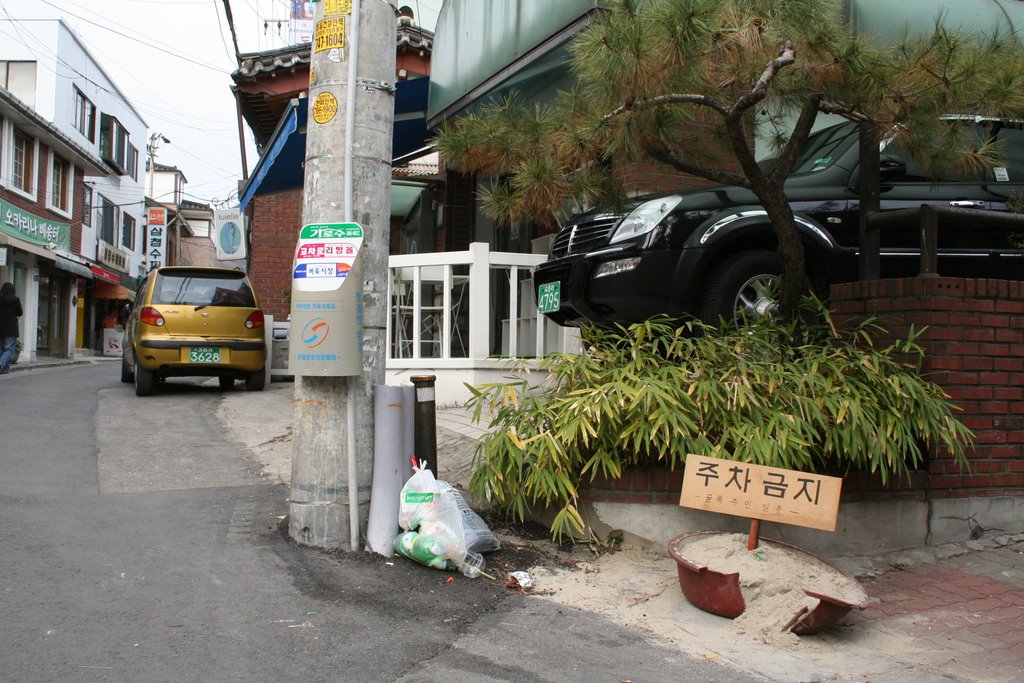
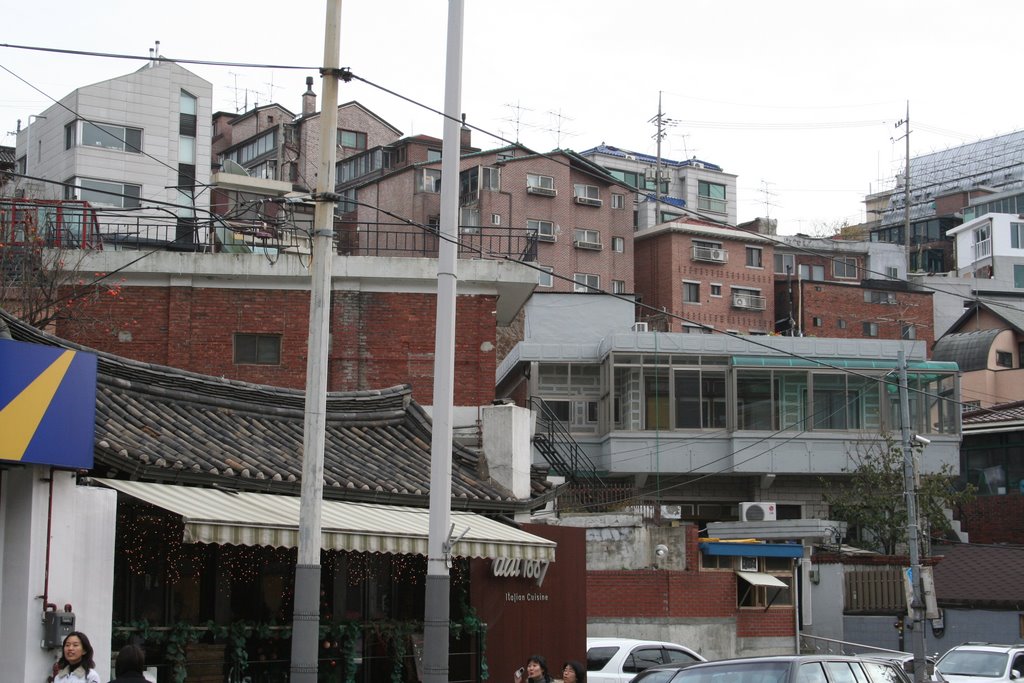
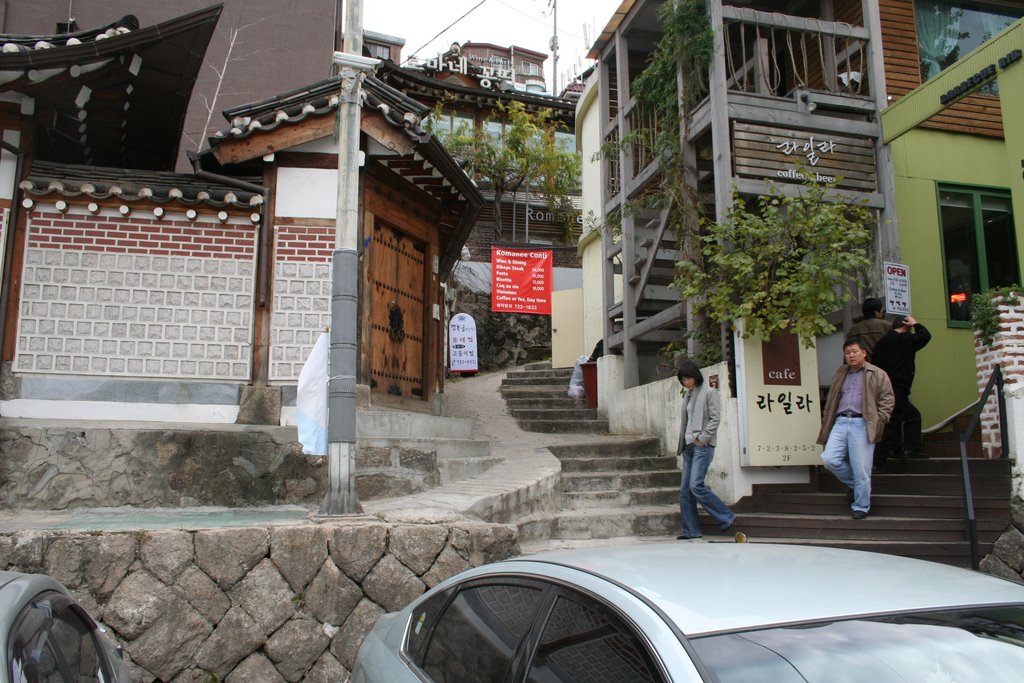
I really like the neighborhood east of Gyeongbok Palace and north of Insadong. I am not certain what it is officially called, but it's full of little shops, Italian restaurants, and art galleries. It draws a very artsy-type crowd on weekends. After wandering around for a while, I gradually realized that there are no chain stores. A Starbucks would not look out of place, but there isn't even a 7-11 or a Family Mart.Even the "No-Parking" sign in the lower right is oddly classy.
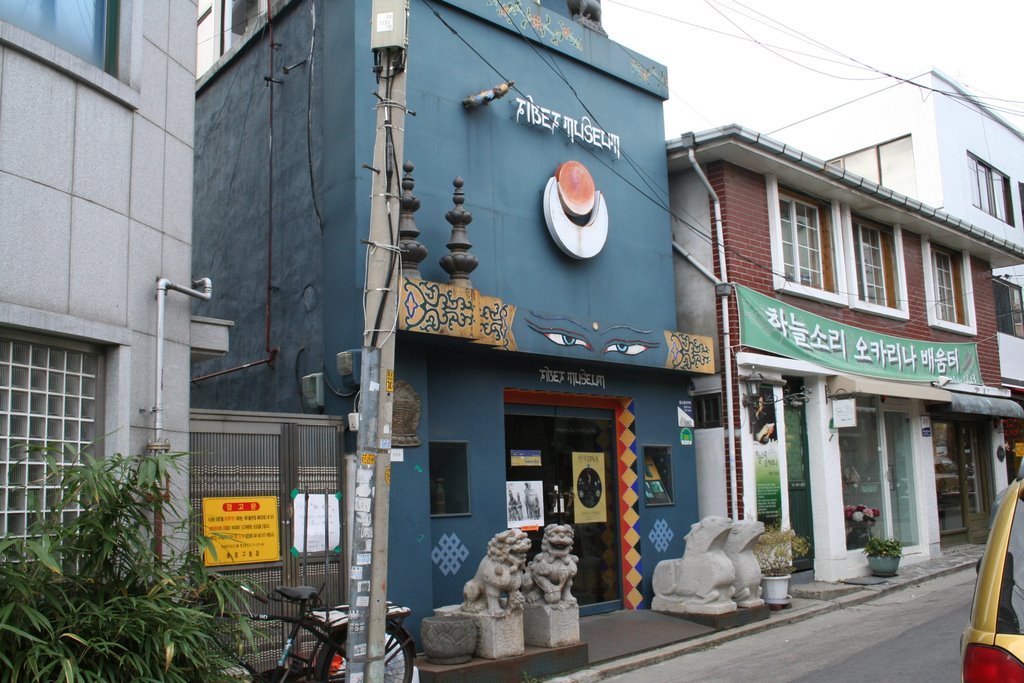
The Tibet Museum. I don't know what's inside.
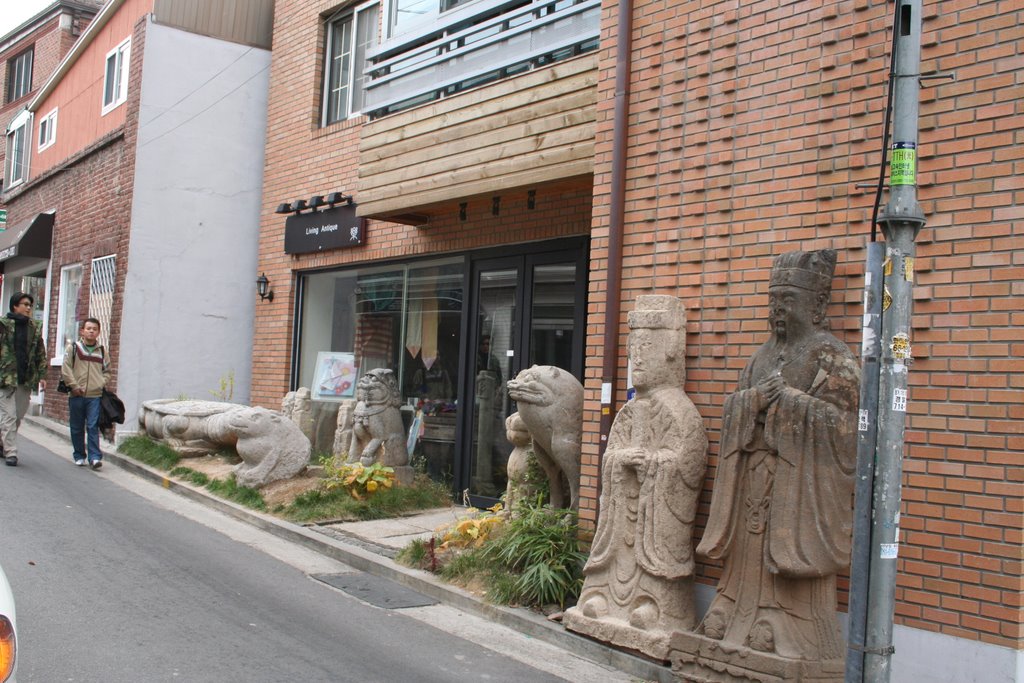
A sculpture store.
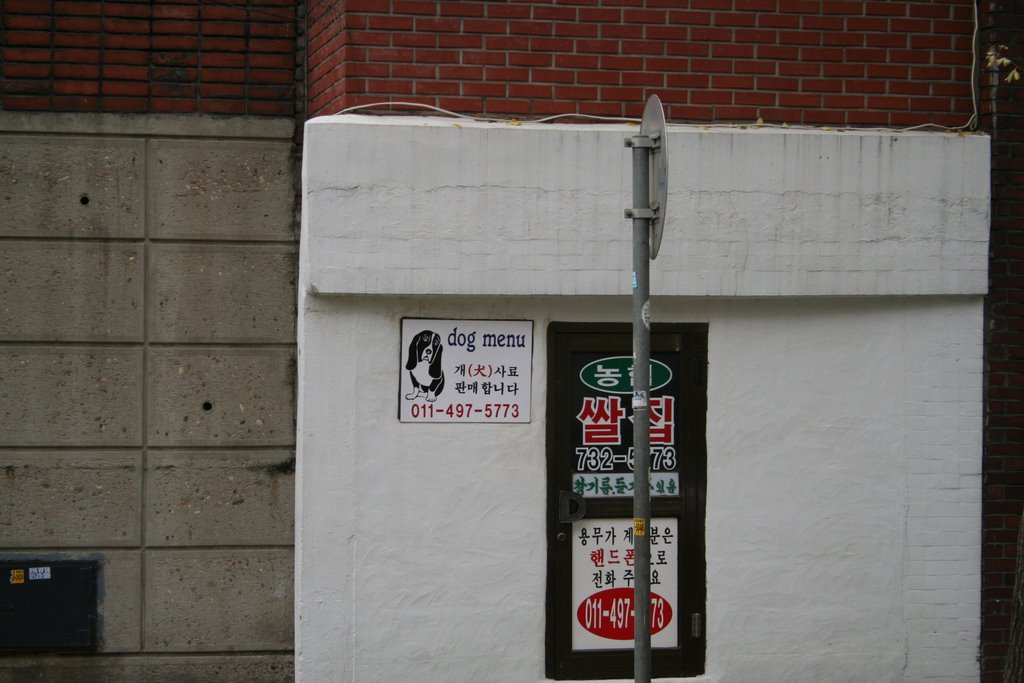
I'm pretty sure that means they have a menu for dogs. But you know Westerners who walk by are going to make fun of it, right?
This isn't quite traditional Korean architecture. But there are plenty of buildings like this coexisting with more traditional-looking buildings here.
Seoul is a hilly city, and you often see buildings only accessible by side roads that rise steeply up hills.
That said, it may be picturesque, but I'd hate to have to live in a wheelchair in this country.
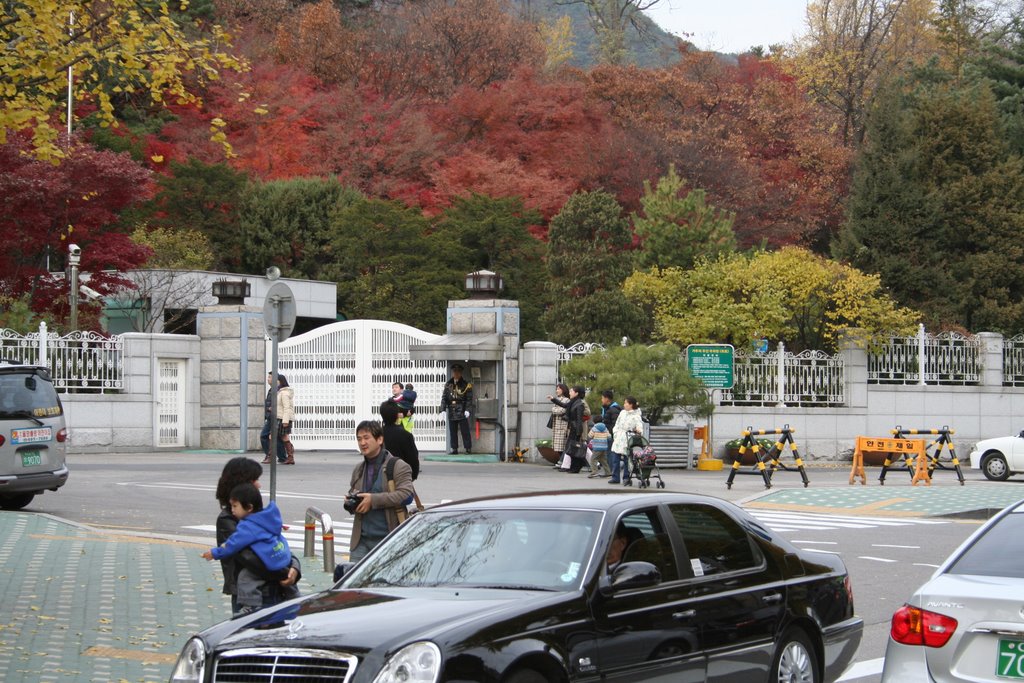
Take a look at that foliage. Something Highly Official is behind that gate (note the armed guard); I'm not sure what it is but the President's official residence is nearby.
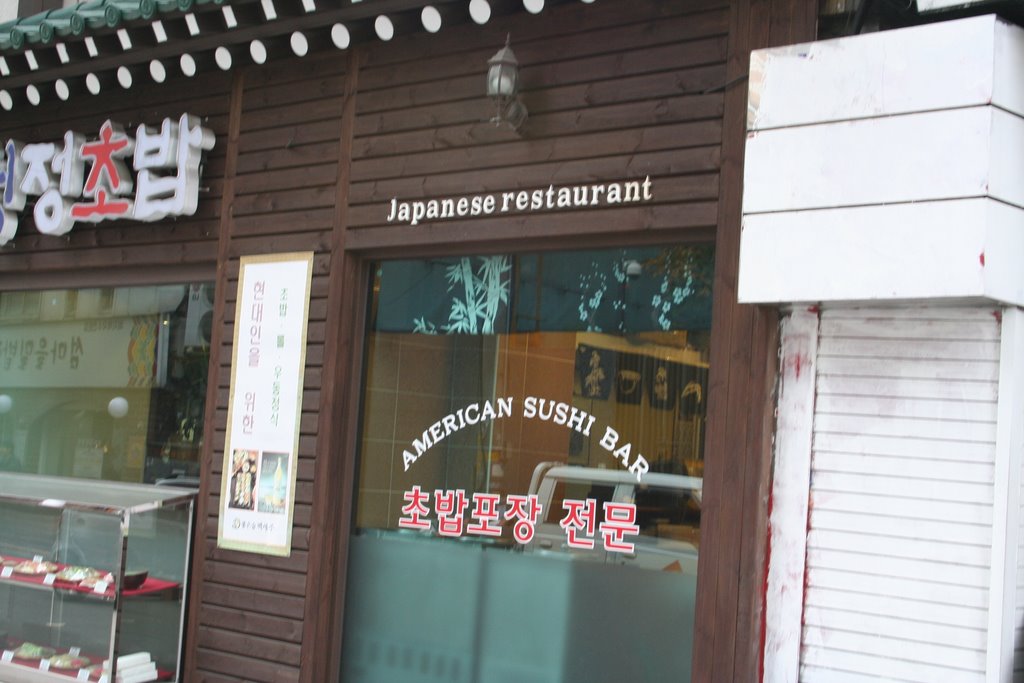
This is The Restaurant. If you're ever in Seoul and you're wondering where the restaurant is, well, here it is.
Next door to The Restaurant is this building with what looks like a statue of a woman bowling on the roof. She's either bowling or running - I can't tell. I figure it's a step up from the naked scowling pigman rooftop sculpture I saw in Suwon.

International Food in Seoul

Saturday, November 25, 2006

Korean Food

When I talk about the food I can get in little Korean diners, THIS is what I'm talking about.


This is ordinary Korean comfort food. Full English descriptions for the curious. Thanks to Mary Eats!

Google Maps

I live here.
Well, kind of. That apartment building dead center in the middle of that Google Maps page is indeed where I live - I'm there right now typing this. But in the time since they shot that satellite picture, they built 3-4 additional apartment buildings around my building - there ought to be 2 more on that road (Maporo) just north of where I live.


I work here.
But you see the highway in the lower part of that satellite shot? It no longer exists - in that form, at least. That's Cheonggyecheon. In 2005 the city government tore down the roadway, uncovered an old stream bed and turned the whole area into a landscaped park. It escaped Google Maps' attention, apparently.

UPDATE UPDATE UPDATE! It's December 6th as I write this. Google has updated part of their Seoul map. Now the area around my apartment building looks more accurate. Check out the workplace link, though, and you can see where the updated photo is joined to the old photo just to the west.

Saturday, November 11, 2006

YBM Level 5

I started my YBM Korean level 5 class on Friday. The class is largely made up of people from my Level 4 class - mostly Japanese.

We have a different teacher and she makes it a point to talk QUICKLY. Which isn't a bad thing. I'm being challenged. The book is Yonsei University's level 5 book. Each chapter starts out with short dialogues and readings, then explanations of vocabulary words, expressions and grammatical structures, then a bunch of example sentences showcasing various structures, then a final reading.

Only thing is, the first chapter is devoted to Korean special ceremonies and customs, and so much of the vocabulary is somewhat difficult and esoteric. There's a whole bunch of difficult words about Korean funeral customs, for instance. The good news is that the teacher assures us things will get slightly easier in chapters to come. And most of the difficult vocabulary comes from Chinese, so I can easily recognize the Chinese-derived entymological roots than I know based on other words I've learned that Korean got from Chinese, which is sort of fun.

Peppero Day

Today is November 11 - 11/11 - Peppero Day. Peppero is candy sold in long thin stick form, and if you write out 11 - 11 you get four sticks - November 11 - Peppero Day - get it? It's a pretty transparent marketing gimmick, but places that sell Peppero have really gone all-out promoting it, and most convenience stores have big displays set up where they have all kinds of specialty Peppero laid out for people to buy and give as gifts. The last Peppero Day I was in Korea I worked at a kids' English school, and I recieved a staggering amount of Peppero from the children. I'm not expecting to get much this year, but maybe I'm better off that way, health-wise. Whoever the marketing genius was who thought up Peppero Day, I hope he was handsomely rewarded.

Sunday, November 05, 2006

Near Dongmyo

Today I went to Himalaya, the Indian-Nepalese restaurant near Dongmyo Shrine, for a solo lunch. I also took my camera. Look at this wide-angle picture, and compare it to...
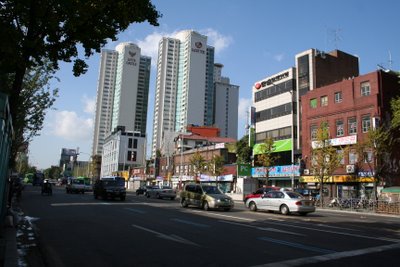
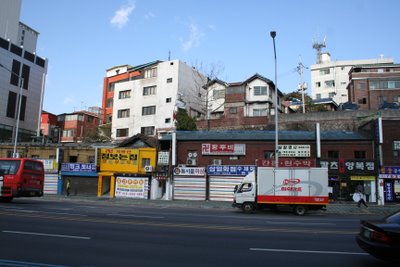
...this one, taken just down the road and looking back. Note the Lotte Castle high-rises. Those are clean, slick, ultra-modern buildings with shops on the lower floors and apartments above. Presumably several of those older buildings were bulldozed to make way for Lotte Castle.
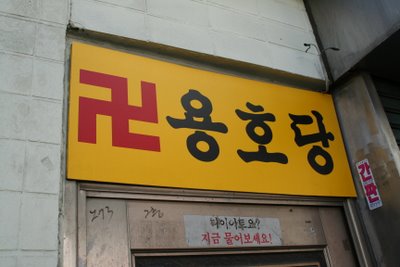
I wonder what a Westerner who didn't know the swastika meant Buddhism in Korean culture would think if he saw how ubiquitous the symbol was in some neighborhoods here.

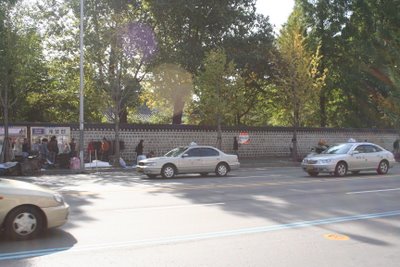
The wall around Dongmyo Shrine. All of these pictures were taken very close to one another.

The food at Himalaya is excellent, by the way.

Sunday, October 29, 2006

Public Art

I do kind of wish I'd taken my camera to Suwon though. I checked out the Kyonggi provincial capitol building (mostly because it was marked on my Lonely Planet map), which turned out to be done in modernist Korean public building style, which is one of the least interesting architectural styles ever devised.

The road to the provincial government building was mostly nondescript, but there was one rather ramshackle building with all sorts of secondhand stuff on the porch, presumably for sale. The one piece of secondhand stuff that I remember was a garish gilded statue of a nude woman.

But she wasn't the tackiest part of the house. Sitting on the roof of the house was a pink statue of a pig, sitting like a porcine "The Thinker" (his nude body was human from the neck down), with a scowl on his face as he looked down on the street. The fact that Suwon is known for its rib dishes is the only tenuous connection I can make to make the pig anything less than inexplicable.

Suwon

The weather was beautiful yesterday, so I went out to Suwon. Suwon's the capital and largest city of Kyonggi Province and is basically a very large suburb of Seoul; the main attraction is the Hwasung fortress wall, slightly over 2oo years old and located up on a hill that rises above the heart of the city. I did not make a full circuit of the wall as Lonely Planet recommends, but I did stay long enough to enjoy the view - Suwon is a much bigger city than you tend to think living in Seoul, and you can see for quite a long way from the top of the hill.

Also, there's a little park within the fortress walls with a March 1 1919 (analogous to July 4, 1776 in the USA) memorial and some benches. It's a very quiet place, considering it's surrounded by city on all sides. I didn't take my camera, but that means I could focus on the moment rather than take pictures for later.

Friday, October 27, 2006

Equal pay for equal work?

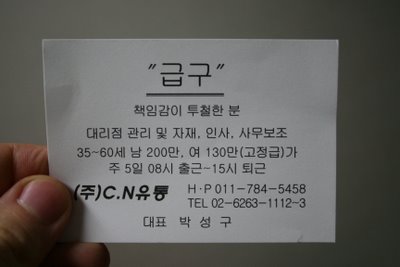
It's quite common on the Seoul subway to see little card-sized advertisements tucked into the frames the big ads go in.
This is a "Help Wanted" ad for what looks like a routine office admin job. I'm curious about the explicitly different salaries for men and women. This ad says they'll pay 2,000,000 won/month to men and 1,300,000 won/month to women. I know this country is widely considered to be far less committed to the ideals of sexual equality than most Western countries, but still I'm suprised at the sheer directness of this ad. They don't even try to claim they want men and women for different jobs. They want men or women for the same job, but they'll pay men a lot more. Am I misunderstanding something here? Or is there some cultural issue I don't know about?

Again, I'm cynical enough I'm not shocked that they'd pay men more - I'm just shocked that they'd be so upfront about it.

Wednesday, October 25, 2006

Change of seasons

Koreans like to mention that this country has 4 seasons. This tends to provoke a great deal of ridicule from expats who live here, who wonder if Koreans are aware that there are other countries with 4 seasons, too.

But I gained new appreciation for Korea's 4 seasons last weekend, when summer belatedly ended and fall began. I'm used to it being a gradual process. Not this time. The balmy unseasonable warmth we'd had ended when the sun went down on Saturday. Sunday was a misty rainy day, and Monday was a day of low temperatures and strong winds. Obligingly, the leaves began to fall from the trees. I've never seen such a well-defined break between seasons.

Sunday, October 22, 2006

Happy Chuseok!

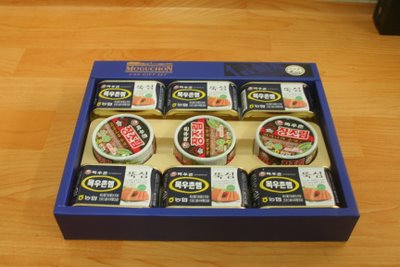
My Chuseok gift from my employer:

Canned ham!

This is not an unusual Chuseok gift here. On the previous Chuseok I spent in Korea, my boss gave me a big gift set of soap, shampoo, and body washes. This spam is probably going to find its way into my stir-fry. It's a lot of ham, but I'm not in any hurry to eat it. The expiration date is January 1, 2009.

Choe Gyuha

Choe Gyuha, the man who was President of Korea when I was born, died this morning. By the time I was born, there'd been a coup d'etat and the country was actually being run by a bunch of generals. But on my birthday Choe still held the office of President, so I figure there's some kind of cosmic connection there. Or something.

Taipei VI

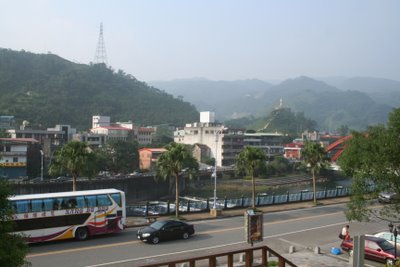
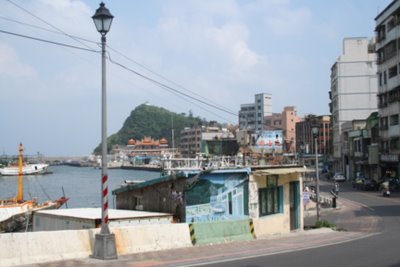
Jenna and I took a day to visit a village outside of Taipei that's famous for its local tea, and which even has a Tea Museum. And I've completely forgotten its name.
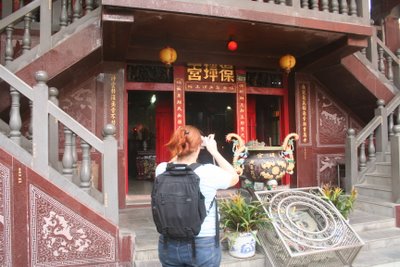
More in the series of Jenna taking pictures, this time of a temple in the aforementioned village.
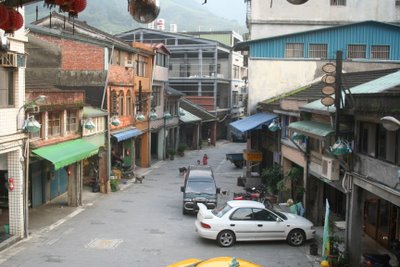
A view from the top of the stairs in the previous photo.

Back in Taipei, we had dim sum at a 24-hour Cantonese restaurant that even had a write-up in Lonely Planet. One oddity: it was a very Western-looking restaurant (kinda like a Chinese IHOP, I thought) and there were several non-Asians there besides us, but the menu was entirely in monolingual Chinese. I certainly don't believe that non-English-speaking countries should affix English labels to absolutely everything, but it seems like a bilingual menu would be what you would expect to find at that sort of place. Not a value judgement - just thinking out loud.

Taipei V - Food Court

I have more pictures from Taipei...
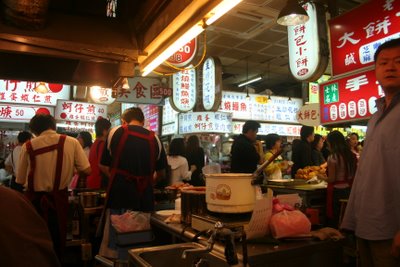
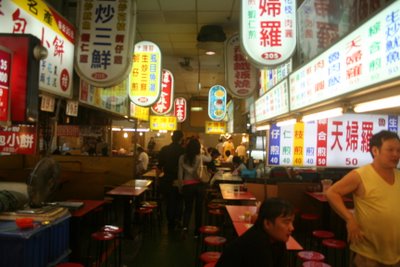
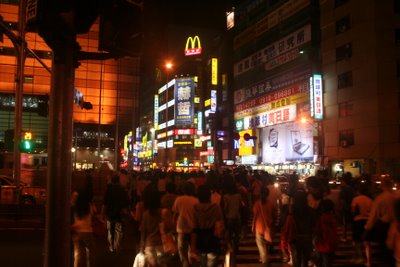
These are pictures of a food court at a night market (I forget the name) that Jenna and I visited. Jenna's recommendation was that I try an omelet dish with oysters. I did and it was excellent.
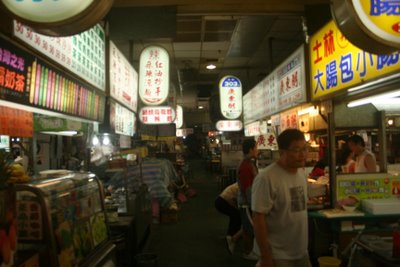
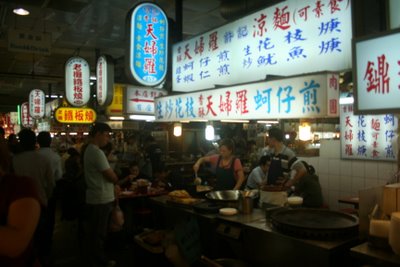
These are all food stalls. I also got a fruit smoothie made with some of the tap water that everybody tells visitors to Taipei not to drink. I felt fine afterward.
These pictures were taken in the late evening. I assume the food court stayed open for several hours afterwards... if it ever closes for the night.

Sunday, October 15, 2006

Cheonggyecheon - More of it

I'm still trying to fulfill my goal of walking Cheonggyecheon all the way to the Han River. I tried it yesterday, but my feet still have some residual blisters from walking all over Taipei. And these are not the most comfortable shoes for walking long distances.

That said, I walked all the way from Dongdaemun to the vicinity of Sindap Metro Station. Once you get out there, Cheonggyecheon is no longer a trench cut through downtown Seoul, but is running through a neighborhood with a much more suburban feel. It's much wider, and has the feel of a real stream. At one point another wide stream feeds into it, in an area with gorgeous landscape architechture that I really should take pictures of. Nearby sections of the old Cheonggyecheon elevated expressway are still standing. It looks like ancient ruins.

But eventually my feet were killing me, so I turned off Cheonggyecheon and took the Metro back from Sindap. With more comfortable shoes and feet that have healed, I still plan to walk to the Han River sometime before winter.

By the way, more Taipei pics are coming, when I have time to upload them!

Saturday, October 14, 2006

Taiwan IV

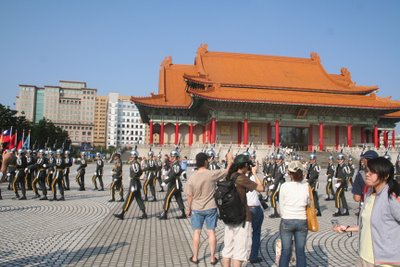
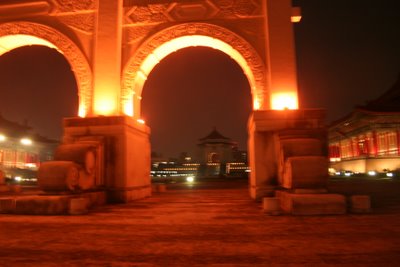
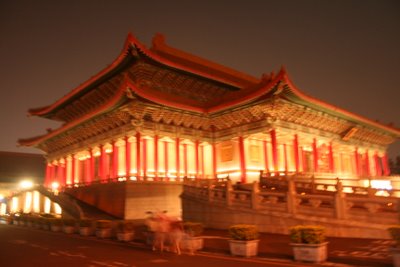
Military guard in front of Chiang Kai-shek Memorial Hall on Saturday.

They went through their steps and marched for the audience - largely tourists.


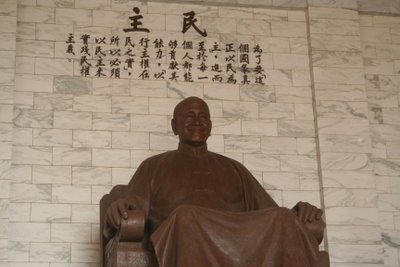
Inside the Memorial Hall is a Lincoln Memorial-sized seated statue of Chiang Kai-shek. Despite having taken a course in Chinese history in college, I don't have much of an opinion about Chiang. The Taiwanese seem to see him as a "father of our country" type figure, but his rule was dictatorial and often extremely cruel, especially in the early years after he lost mainland China.

Taipei III - More Yehliu

The little town of Yehliu, where Jenna and I had a very good seafood lunch.

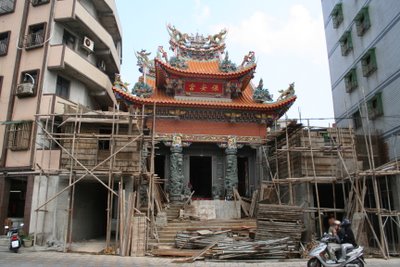
A temple in Yehliu, under construction.


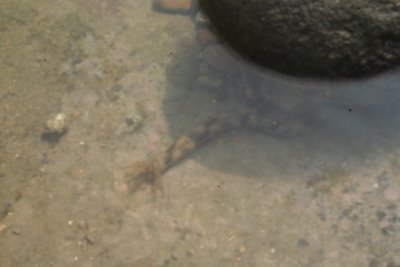
Any biologists out there? This little creature had us entranced for a good ten minutes, largely because we couldn't figure out what the heck it was. It was in a saltwater tide pool. It wasn't rooted to anything and could move (slowly), but didn't have much of a distinct head. It did have what seemed to be a mouth, surrounded by feather-like appendages that I suppose helped bring food in. My only guess is that it's some kind of sea cucumber; otherwise, it belongs to one of those myriad invertebrate phyla that few non-biologists have heard of. Any ideas?

Taipei II - Yehliu

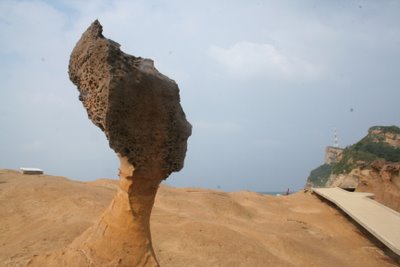
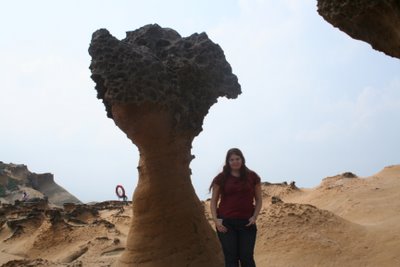
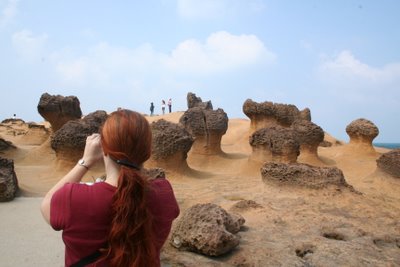
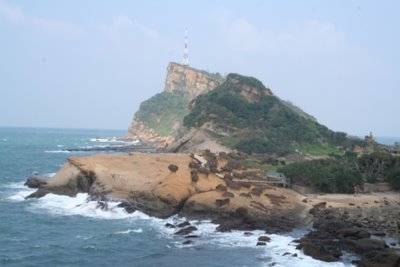
Yehliu is a seaside area where the forces of wind, rain, tides and volcanism have created some pretty bizarre-looking rock formations.
Widow's Head Rock. The local tourism authorities helpfully indicated the best spot on the ground to stand when taking a picture.

Jenna posing next to one bizarre looking rock - for size comparison.


Taking pictures of people taking pictures.


The Yehliu coastline.

Taipei I

I got back from Taipei on Sunday, but between teaching and writing TOEIC questions and Korean class I've been too busy this week to upload many pictures. Now it's Saturday afternoon and I'm free.


My initial impressions of Taipei - and these are mostly comparisons to Seoul:

- Taipei has a lot of motorbikes. Huge plagues of motorbikes. I used to think Seoul had plenty of motorbikes but... nope.

- Maybe it's just the week I went down, but Taipei's got some serious air pollution problems. Worse than Seoul, which is several times larger and which seldom wins accolades for the quality of its air. Maybe the motorbikes are the cause?

- The Taiwanese love dogs - of all shapes and sizes. As pets, not food. Living in Seoul, I'd gotten used to the fluffy little dogs that Koreans generally prefer as pets. But in Taiwan you regularly see all sizes of dogs out on walks (or walking around freely in small towns).


But I don't really have any impressions of the Taiwanese people. I talked to a very few of them, but I was only here from Wednesday to Sunday so I don't want to overgeneralize.

(By the way, in some of these pictures I accidentally had my camera on "manual focus" - if some of them look slightly blurry, that's why. Heck, maybe it improved them.)


I liked Taipei. I liked the food, I liked the crowds, and I liked the markets. I was able to overlook the air pollution. Of course, maybe this is partly due to the fact that I didn't have to work - and the weather was absolutely beautiful while I was there.

Tuesday, October 03, 2006

I'm off, almost

Tomorrow I fly to Taiwan to visit an English-teaching American friend. I'll try to take plenty of pictures and report on Taiwanese food.

Already I'm curious about what EVA Air will give us to eat on the flight. When I flew from Incheon to Osaka one morning I got a nice little Bento Box-like cold meal. Quite nice. But when I flew from Incheon to Beijing I got a boring plastic-wrapped sandwich and a cup of juice.

When I flew Dulles to Heathrow aboard British Air, I ate a fairly ordinary chicken meal, while being tormented by the wonderful smells of the Indian meals being enjoyed by those people who had specified beforehand that they wanted vegetarian. Drat.

We'll see what EVA Air gives me.

로만아이재션

Hangul Romanization Revision Proposed

Already? Even now this country is awash with two quite different Romanization schemes. I hate typing Korean words in English because, quite unlike Japanese or even Chinese, there is NO universally agreed on system of Romanizing Korean words. Without getting into actual names of different Romanization schemes, there is an old system (Pusan, Taegu, Chongno, Kyongju with a doohickey above the "o") and a new system (Busan, Daegu, Jongno, Gyeongju, with no special characters).

Even this blog is not internally consistent. I spell the neighborhood where I spent most of my waking hours J-O-N-G-N-O (new system) but just a few entries below this one I mention Kangnam (old system) not Gangnam (new system). Why? Because I felt like it.

I'll agree that the "new system", which most guidebooks follow, can be confusing to pronounce for people who don't know Korean phonetics. The big Buddhist temple in Busan is called Beomeosa. That's pronounced "buhm-uh-sa." Not exactly intuitive. But look at Chinese Pinyin, which is pretty universal as a way of writing Chinese words. What Westerner would instinctively know how to say "c" or "x" in Pinyin words? Pinyin works because the Chinese government has been promoting it for decades, even getting the whole world to write "Beijing" and "Mao Zedong" rather than "Peking" and "Mao Tse-tung".

My only piece of advice for Korea: Pick a Romanization scheme, and stick with it. Don't change it after five years. You don't want half the English signs saying "Kyongju" and the other half "Gyeongju".